
In the journey of the human spirit, the tension between religion and spirituality often surfaces when we confront issues of identity, community, and purpose. In particular, the phenomenon of religious division underscores the difference: when systems of belief become vehicles for separation rather than unity. The UEF Foundation article on sectarian splits titled “The Irony of Division in Religion” lays the foundation for a deeper look at how spirituality differs from religion, especially against the backdrop of fragmentation within faith traditions.
What is Religion, and Why It Can Lead to Division
Religion is often defined as an organised system of beliefs, rituals, communities, and institutions. It offers structure, identity, shared practices and meaning. However, the UEF article spotlighting sectarian splits shows how religion, despite its purpose of unity, often becomes the very source of division. For example:
- Within Christianity there are three broad traditions (Catholic, Protestant, Eastern Orthodox) and up to 40,000 denominations worldwide.
- In Islam the main divisions are Sunni, Shia and the Sufi mystic tradition — the initial split occurred over succession after the Prophet.
- Other faiths like Hinduism and Buddhism are also noted to have multiple sects even when their underlying teachings emphasise oneness.
These examples highlight religious division in action — the breaking of communities into sub‐sects due to doctrinal, ritualistic or authority‐based disagreements. The irony, as UEF points out, is that religions meant to promote unity often harbour fragmentation.
What is Spirituality — A Personal Inner Journey
In contrast, spirituality refers to an inward, personal pursuit of meaning, connection, and transcendence. It is less about institutional allegiance and more about inner awareness. While UEF’s article on sectarianism does not dwell exclusively on spirituality, the implication is clear: when religion fragments, spirituality is what can bring us back to underlying unity.
Spirituality invites going beyond the external forms of belief — ritual, dogma, institutional belonging — and focusing on the essential: the inner self, the connection with the divine or ultimate reality, and our shared human purpose. It asks: How do I live with awareness, compassion and wisdom?
The Difference Between Spirituality and Religion
Here’s a breakdown of how the two compare, helping us understand the fault‐lines where religious division tends to arise:
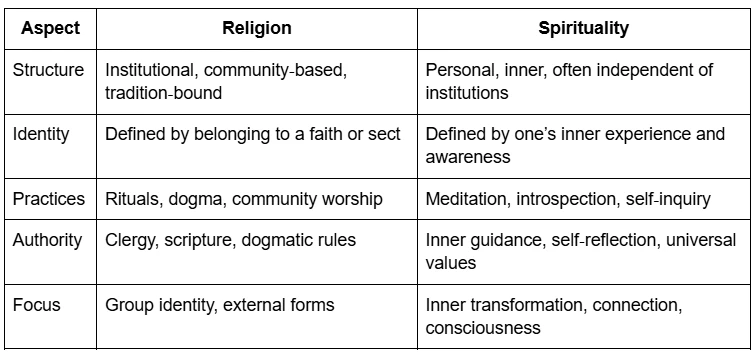
With religion, the risk arises when external forms take precedence over inner truth — and when identity becomes attached to a particular form. That is often where religious division creeps in. The UEF piece states: “It is one of the greatest ironies in human history that it is through the medium of religion that the biggest sectarian divisions occur…”
How Religious Division Occurs — And What It Teaches
The UEF article offers insight into how such splits emerge:
- Leaders or institutions may prioritise power, authority or institutional identity over the original prophetic teaching of unity.
- Differences in practice, interpretation or leadership succession can lead to schisms (e.g., in Islam, Christianity).
- Many of these splits are not primarily about belief in the divine, but about control, identity and community boundaries.
Clearly, when religion becomes about “us vs them”, the result is religious division. And yet, we see that scriptures themselves (in Christianity, Islam, Judaism) caution against such splits — emphasising unity and mutual respect.
Why Spirituality Can Bridge the Gap
Given that religion can lead to division when form outweighs essence, spirituality offers a way forward by focusing on the root rather than the branch. Here’s how:
- By emphasising the common ground of human existence, values like compassion, love and truth — which transcend sects and rituals.
- By promoting inner growth rather than external conformity — reducing the impulse to label or separate.
- By reminding us that the ultimate aim of faith traditions is unity and transcendence, not fragmentation. As UEF notes, “our similarities outweigh our differences, especially when the differences are merely variations on the same religious teaching.”
In short, spirituality can act as the glue where religion may act as the divider — because spirituality focuses on being rather than belonging.
Applying This Understanding in Our Lives
What can individuals do, in their personal and communal life, to reduce religious division and foster true spirituality?
- Focus on common ground: Instead of emphasising differences, recognise shared values across faiths and traditions. UEF’s research on cross‐religious commonalities emphasises this.
- Prioritise inner growth: Incorporate practices of reflection, meditation, service and kindness — beyond ritual adherence.
- Question identity‐based exclusivity: When religion becomes a badge or boundary rather than a pathway, division is born. Spirituality invites us to question whether our allegiance to a form is overshadowing the core purpose.
- Cultivate humility and community: Even within religious frameworks, the urgency is to remember that rituals and structures are means, not ends. As UEF quotes: “There is nothing more serious than the sacrilege of schism…”
- Encourage integration not fragmentation: Spirituality invites us to integrate belief, be open to mystery, and transcend mere institutional belonging.
Final Thoughts
When we speak of religious division, we speak of the fractures that arise when the indispensable becomes the dispensable — when structure overrides spirit, when identity outranks purpose. The UEF article reminds us that religions are meant to unite but often divide; yet underlying them, the call remains to oneness and transcendence.
Spirituality asks us to respond to that call, to go beyond the externals and to root ourselves in the inward journey of meaning, love and awareness. It doesn’t reject religion; rather, it elevates what is essential. By doing so, we may begin to heal the divisions of the past and foster a culture of unity, compassion and flourishing.
The journey from religion to spirituality — or rather, from division to unity — is not about abandoning tradition. It’s about re‐engaging with its heart: the divine purpose of connection, the thread of oneness that runs through every teaching, every faith, every human being. May we move beyond the outer labels and awaken to the inner truth.