



South Korea Aerospace & Defense Market Overview
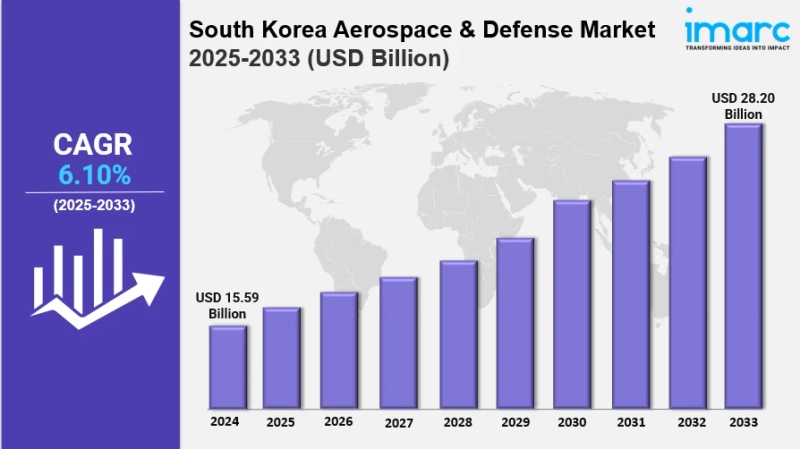
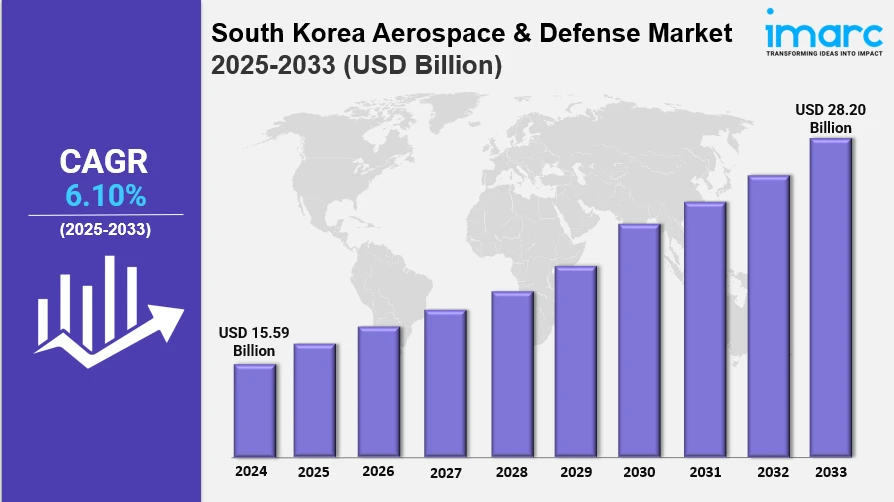
The South Korea aerospace & defense market size was valued at USD 15.59 Billion in 2024 and is expected to reach USD 28.20 Billion by 2033, growing at a CAGR of 6.10% during the forecast period 2025-2033. Growth is driven by an increase in space exploration activities, modernization of military forces with advanced technologies, and an expanding focus on cybersecurity to protect critical military infrastructure. Strategic government investments and enhanced international collaborations further bolster this dynamic sector.
Study Assumption Years
- Base Year: 2024
- Historical Year/Period: 2019-2024
- Forecast Year/Period: 2025-2033
South Korea Aerospace & Defense Market Key Takeaways
- Current Market Size: USD 15.59 Billion in 2024
- CAGR: 6.10%
- Forecast Period: 2025-2033
- The South Korean government committed USD 4 Billion in 2024 for defense upgrades, including USD 2.35 Billion for building Ulsan-class frigates and USD 1.1 Billion for KF-21 fighter aircraft missile development.
- Daily cyberattack attempts hit 1.62 million in 2023, mostly linked to North Korean sources, increasing cybersecurity investments.
- South Korea targets moon and Mars missions by 2032 and 2045, supported by a space budget exceeding KRW 1.5 trillion.
- Cross-border partnerships, such as the Hanwha Aerospace and Poland WB Electronics joint venture, are strengthening defense technology transfer.
- Localized MRO programs, such as Korean Air’s KRW 961.3 billion UH-60 helicopter upgrade project, improve operational readiness.
Sample Request Link: https://www.imarcgroup.com/south-korea-aerospace-defense-market/requestsample
Market Growth Factors
South Korea’s aerospace and defense market is expanding due to extensive modernization initiatives. In 2024, the government allocated USD 4 Billion towards defense upgrades, including USD 2.35 Billion to build advanced Ulsan-class frigates and USD 1.1 Billion for developing long-range air-to-air missiles for the KF-21 fighter. These investments aim to enhance defense readiness and position South Korea as a leader in next-generation land and air defense solutions.
Cybersecurity has become a strategic priority due to increased hostile cyber activities. In 2023, daily cyberattack attempts reached 1.62 million, predominantly from North Korean sources. This has accelerated investments in digital security and secure communication networks to protect critical military infrastructure, driving demand for advanced cybersecurity technologies within the aerospace and defense sector.
The nation is pursuing ambitious space exploration goals with missions planned for the moon by 2032 and Mars by 2045, supported by a space budget exceeding KRW 1.5 trillion. This focus on space exploration complements defense modernization efforts, fostering a tech-driven and resilient ecosystem that propels market growth through integrated government policy support and public-private collaboration.
Market Segmentation
Analysis by Industry:
- Manufacturing, Design, and Engineering: South Korea invests heavily in R&D, designing high-precision systems like aircraft components and guided weapons. Firms such as Korea Aerospace Industries (KAI) and Hanwha lead innovation, supported by government projects and academic partnerships.
- Maintenance, Repair, and Overhaul (MRO): Growth driven by rising military and commercial aircraft fleets. Korean Air and KAI provide lifecycle services and modernization programs, aligning with government efforts to localize defense logistics and reduce foreign dependence.
Analysis by Type:
- Aerospace: Includes space, civil aviation, and domestic aircraft development programs like KF-21 fighter and SSLV. Government-led initiatives target dual-use aerospace systems promoting global competitiveness.
- Defense: Covers army, navy, airforce sectors, focusing on missile systems, unmanned platforms, and integrated battlefield solutions. The sector benefits from rising exports and procurement localization policies.
Regional Insights
The Seoul Capital Area stands as the dominant region, hosting key aerospace companies, government agencies, and R&D institutes. It benefits from major investments in tech hubs, innovation parks, and serves as the center for regulatory approvals and policy execution. This regional advantage accelerates national aerospace and defense projects, supporting both domestic growth and export expansion.
Recent Developments & News
- April 2025: South Korea and UAE signed an MoU for regular bilateral Air Force meetings every six months, including joint training and KF-21 cooperation. UAE is the first Middle Eastern partner to engage at this level.
- March 2025: Shield AI partnered with Korea Aerospace Industries to integrate AI-powered autonomy into manned-unmanned teaming programs, enhancing combat capabilities in GPS- and communication-denied environments.
- March 2025: Hanwha Aerospace announced a USD 2.5 Billion rights offering to expand defense and maritime production, supporting weapons manufacturing, warship development, UAV engine R&D, and facility upgrades, targeting KRW 70 trillion sales by 2035.
Key Players
- Hanwha Aerospace
- Korea Aerospace Industries
- LIG Nex1
- Hyundai Rotem
- Hyundai WIA
- Korea Aerospace Research Institute
- Lockheed Martin
- Boeing
- Raytheon Technologies
- BAE Systems
- Airbus Defense and Space
About Us
IMARC Group is a global management consulting firm that helps the world’s most ambitious changemakers to create a lasting impact. The company provides a comprehensive suite of market entry and expansion services. IMARC offerings include thorough market assessment, feasibility studies, company incorporation assistance, factory setup support, regulatory approvals and licensing navigation, branding, marketing and sales strategies, competitive landscape and benchmarking analyses, pricing and cost research, and procurement research.
Contact Us
IMARC Group,
134 N 4th St. Brooklyn, NY 11249, USA,
Email: sales@imarcgroup.com,
Tel No: (D) +91 120 433 0800,
United States: +1-201971-6302