



Look around the room you are sitting in right now. The jeans you’re wearing, the bread in your pantry, the detergent under your sink, perhaps even the fuel in your car.
On the surface, these everyday items seem unconnected. But beneath the surface, they share a common, invisible secret. They are increasingly being produced, refined, or enhanced by a microscopic workforce that is quietly reshaping the global manufacturing landscape.
Welcome to the industrial enzymes revolution—a shift where the smallest biological molecules are generating the biggest economic and environmental impacts.
For centuries, humans used enzymes without knowing it, fermenting beer and curing cheese. Today, we have moved from accidental discovery to precision engineering, turning these biological catalysts into the cornerstone of modern "Green Chemistry."
Here is how these small molecules are making a massive impact.
The Invisible Engine: What Are Industrial Enzymes?
To put it simply, enzymes are nature’s accelerators. They are specialized proteins that act as biocatalysts, meaning they speed up chemical reactions that would otherwise be too slow, require immense amounts of energy, or demand harsh, toxic chemicals to achieve.
Think of them as a highly skilled workforce where every worker has only one specific job, but they do it perfectly every time. A protease enzyme breaks down proteins (great for stain removal); an amylase enzyme breaks down starches (crucial for brewing and baking).
This specificity is their superpower. Unlike blunt chemical processes that affect everything in a mixture, enzymes target only what they are supposed to, leaving the rest untouched.
Why Now? The Drivers of the Revolution
The industrial enzyme market isn't just growing; it's accelerating. Why is this bio-tech approach taking center stage right now? It comes down to the convergence of economic pressure and environmental necessity.
1. The Rise of "Green Chemistry" Traditional manufacturing often relies on high heat, high pressure, and caustic solvents (like strong acids or alkalis). This is energy-intensive and creates hazardous waste streams.
Enzymes change the equation. They typically work best in mild conditions—often at room temperature and neutral pH levels. By replacing harsh chemicals with biological alternatives, factories can drastically cut energy costs and water usage while reducing their carbon footprint. For companies chasing ambitious ESG (Environmental, Social, and Governance) goals, enzymes are a silver bullet.
2. Efficiency and Yield Because enzymes are so specific, they reduce unwanted side reactions. In industries like pharmaceuticals or biofuel production, this means higher yields of the target product and less wasted raw material. It’s cleaner, faster production.
Where the Revolution is Happening
The impact of industrial enzymes is widespread, but a few sectors are experiencing profound transformation:
The Food & Beverage Shift
Consumers demand "clean labels"—ingredients they recognize and understand. Enzymes allow food processors to improve texture, extend shelf life (reducing food waste), and boost nutritional profiles naturally, without adding synthetic chemicals that scare off consumers. From making oat milk creamy to keeping bread soft for a week, enzymes are the silent chefs of the industry.
Sustainable Textiles and Fashion
The fashion industry is notoriously water and chemical-intensive. Enzymes are cleaning it up. Remember "stone-washed" jeans? Today, that look is rarely achieved with actual stones, which damage the fabric and machinery. Instead, cellulase enzymes gently "eat" the surface fibers of the denim, creating the worn look with a fraction of the water and energy.
The Bio-Economy: Waste to Value
Perhaps the most exciting frontier is the circular economy. Enzymes are the keys to unlocking value from waste. We are now using specialized enzyme cocktails to break down agricultural leftovers—like corn stalks or sugarcane bagasse—into sugars that can be fermented into biofuels or bio-plastics. We are effectively turning trash into treasure using biology.
The Future: Designer Enzymes and AI
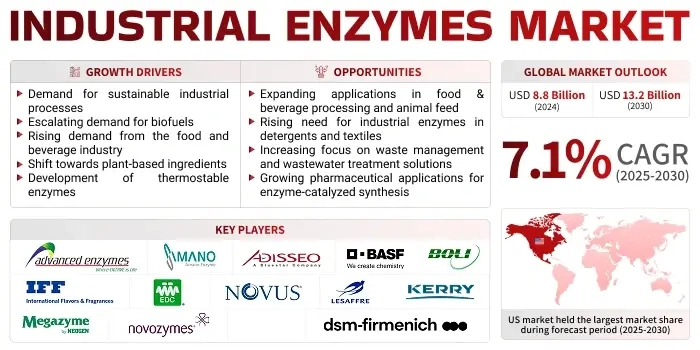
We are no longer limited to the enzymes we find in nature. The revolution is moving into a new phase: Precision Fermentation and Protein Engineering. This is the reality of modern manufacturing. We aren’t just building things with steel and steam anymore; we are growing them with biology. This shift is the driving force behind the booming Industrial Enzymes Market, a sector that is quietly rewriting the rules of the global supply chain, and honestly, it’s the most exciting trend that nobody is talking about.
By combining biotechnology with Artificial Intelligence (AI), scientists can now simulate how enzymes behave and "design" new ones from scratch to withstand higher temperatures or work faster on specific industrial substrates. We aren't just finding the right tool for the job anymore; we are building it.
The Takeaway
The industrial enzymes revolution is more than just a biotech trend; it is a fundamental rethinking of how we make things. It is a move away from the brute force of 20th-century chemical engineering toward the elegant precision of biology.
For investors, manufacturers, and sustainability leaders, paying attention to these small molecules is no longer optional—it’s essential to staying competitive in a future demanded by cleaner, more efficient production. The future of industry is microscopic.