



If you are reading this, chances are you have already felt the pull of signpainting. Maybe you have stopped outside an old shopfront to admire the lettering. Maybe you have watched a brush glide through enamel paint on Instagram and wondered how long it takes to learn that kind of control. Or maybe you are simply tired of everything looking the same and want to learn a craft that still carries a human mark.
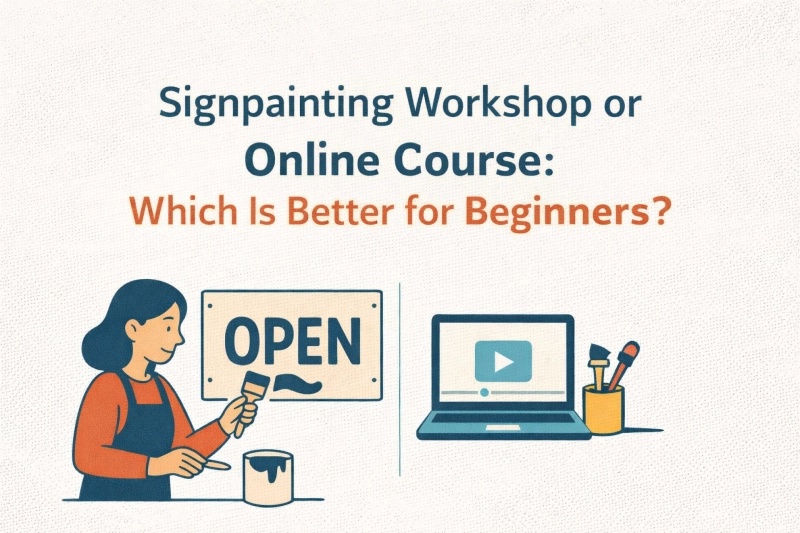
At some point, most beginners hit the same question. Should I go to a signpainting workshop, or should I take an online signpainting course?
It sounds like a simple choice. In practice, it is anything but. I have spoken to many people who feel stuck at this stage, worried about choosing the wrong path or wasting time and money. The truth is that both options have value, but they serve different needs at different stages. Understanding that difference is what makes the decision clearer.
This article is not about hype or quick wins. It is about what actually helps beginners learn to paint signs, based on real experience, real teaching, and the realities of modern life.
The First Attraction to a Signpainting Workshop
A signpainting workshop is often the first thing people think of. There is something deeply appealing about learning a traditional craft in a physical space, surrounded by others, with the smell of paint in the air and a skilled painter standing right next to you.
For many beginners, a workshop feels like the most authentic way to learn signwriting. You show up, you pick up a brush, and you paint. No distractions. No screens. Just you, the paint, and the letters.
Workshops are also intense in a good way. In a single day or weekend, you are fully immersed. You see other people struggle with the same problems. You get immediate feedback. You leave with a finished piece and a sense of momentum.
For some, that experience is the spark. It confirms that signwriting is not just a passing interest. It is something they want to pursue seriously.
There is real value in that.
But workshops also have limits, especially for beginners who want more than a taste.
The Reality of Learning to Paint Signs
Signpainting is not something you learn in a day. Anyone who tells you otherwise is either selling something or has forgotten what it was like to be new.
Brush control takes time. Understanding letterforms takes time. Learning how paint behaves on different surfaces takes time. Developing confidence takes time.
Most beginners leave a workshop feeling inspired, but also a little overwhelmed. You have learned a lot very quickly, but you have not yet had the chance to repeat those skills enough for them to stick. By the time you get home, life takes over again. The brush goes back in the drawer. Weeks pass.
This is where many people quietly give up, not because they lack interest, but because they lack structure.
That is not a failure. It is simply how learning works.
What an Online Signpainting Course Offers Instead
A well-built online signpainting course approaches the problem from the opposite direction. Instead of compressing everything into a short burst, it spreads learning out over time.
At The Signpainters Academy, the focus is on long-term skill building. The aim is not to impress you in a weekend. It is to take you from complete beginner to a painter with enough confidence and ability to earn from your work if that is your goal.
That difference matters.
An online signpainting course for beginners allows you to slow down. You can watch demonstrations as many times as you need. You can pause, rewind, and try again. If your paint goes wrong, you see how to fix it, not how to hide it.
Paul Myerscough, who runs The Signpainters Academy, has over 30 years of real-world experience painting signs. In the course videos, mistakes are not edited out. They are worked through. That honesty builds trust, and it also teaches something workshops often cannot: recovery.
Learning how to correct a wobble or rescue a letter is just as important as learning how to paint it cleanly.
Structure Is What Most Beginners Actually Need
One of the biggest problems beginners face is not motivation. It is direction.
Without a clear path, people tend to jump around. They try a script letter one day, a block letter the next. They buy new brushes instead of practicing with the ones they already have. They watch random videos online without knowing what to focus on.
A structured signpainting course removes that confusion.
The Signpainters Academy starts with fundamentals. Equipment. Paint consistency. Basic brush skills. These may not sound exciting, but they are what everything else is built on. Skipping them almost always leads to frustration later.
From there, students learn the four core lettering styles: casual, block, script, and Roman. These styles form the backbone of traditional signwriting. Once you understand them, everything else becomes easier.
This approach mirrors how the craft has always been passed down. Slowly, methodically, with repetition.
That is part of the sign painting legacy. There are no shortcuts.
The Role of The 26 Letters
One of the most valuable resources for beginners is The 26 Letters series. This is not about copying alphabets blindly. It is about understanding how letters are constructed, how strokes flow, and how proportion works in real paint.
Each letter is painted in real time with full commentary, sharing techniques developed over decades of professional work. This level of detail is rarely available in workshops simply because there is not enough time.
For beginners who struggle with letterforms, this resource alone can be transformative.
Workshops Still Matter, Just Not in the Way People Think
None of this means that signpainting workshops are a bad idea. Quite the opposite.
Workshops are excellent once you have some foundation. When you understand basic brush handling and letter structure, a workshop becomes a place to refine, ask better questions, and absorb subtle techniques.
This is why The Signpainters Academy offers students discounted access to in-person workshops. By the time you attend, you are prepared to get real value from the experience.
For beginners, though, workshops often work best as inspiration rather than education. Online learning provides the repetition and feedback loop that turns inspiration into skill.
Learning in the Real World, Not a Vacuum
One of the strengths of The Signpainters Academy is its emphasis on learning in a real-world context. Many students are working jobs while they learn. The course is designed to fit around that reality.
Modules are released weekly, encouraging steady progress without overwhelm. Projects are set so that students build a portfolio as they go. This matters because signwriting is a visual craft. Clients want to see work, not certificates.
Students also have direct access to guidance. Work can be shared, feedback given, and progress tracked. That level of support builds confidence and accountability.
The Beginners Bootcamp as a Starting Point
For those who are unsure about committing to a full year of training, the Beginners Bootcamp offers a focused introduction. It is designed to build confidence quickly while laying proper foundations.
This option suits people who want structure but need to test whether signpainting fits into their life before going further.
Trust Comes From Transparency
One of the reasons people hesitate to invest in an online signpainting course is trust. There is a lot of noise online, and not all of it is honest.
What builds trust here is transparency. The course content is clearly laid out. There is a 30-day money-back guarantee. Student testimonials are specific and grounded in real outcomes, not vague praise.
People like Jason in Ireland or Robert in the USA speak openly about how structure and guidance changed their approach. These are not beginners chasing a fantasy. Many already had experience but lacked direction.
That matters when evaluating expertise.
Community and Continuity
Another overlooked aspect of online learning is community. Through peer-to-peer platforms, students see what others are working on. They learn from mistakes and successes that are not their own.
This mirrors the old workshop environment in a modern way, without geographic limits. Students join from the UK, USA, Canada, Europe, and Australia. The shared language is the craft.
For many, this sense of belonging keeps them going when motivation dips.
YouTube and Social Media as Supporting Tools
Paul Myerscough’s YouTube channel offers insight into teaching style and philosophy. Watching these videos helps beginners understand what real instruction looks like before committing.
You can explore the channel here:
Instagram also plays a role, not as a teaching platform but as a window into ongoing work and student progress. It reinforces that learning is happening daily, not just in polished highlights.
Follow along here:
So Which Is Better for Beginners?
If the goal is to dabble, attend a workshop. You will enjoy it, learn something, and meet like-minded people.
If the goal is to actually learn to paint signs, build confidence, and develop a usable skill, a structured signpainting course is the better starting point.
That is not theory. It is experience.
Most people who stick with signwriting long term do so because they had guidance, repetition, and support early on. That is what turns curiosity into capability.
The Long View
Signpainting is not just a technique. It is a way of seeing letters, space, and rhythm. It connects you to a lineage of craftspeople who learned through practice, patience, and mentorship.
Whether you choose a workshop, an online course, or both, the important thing is to commit to the process. Paint often. Make mistakes. Learn how to fix them.
The Sign Painting Legacy lives on not because it is easy, but because it is worth the effort.
If you want to learn in a way that respects that legacy while fitting into modern life, The Signpainters Academy offers a clear, honest path forward.