



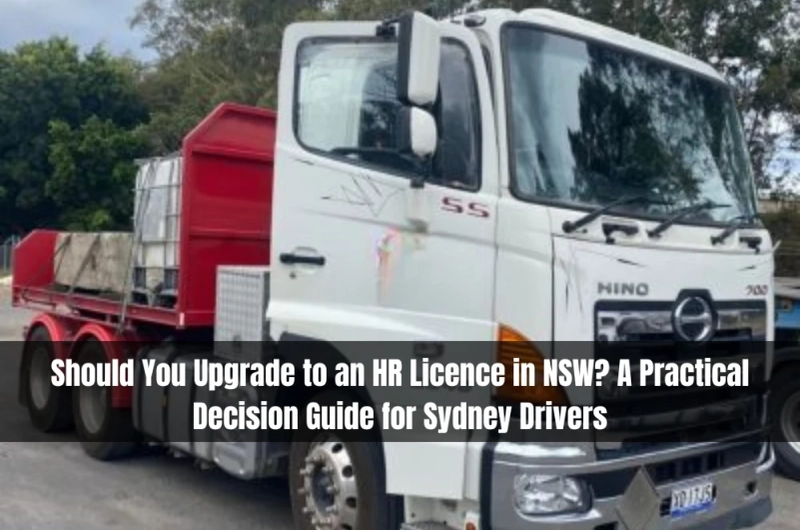
Upgrading to an HR licence can be the smartest move you make this year.
It can also be a time-and-money sink if you do it “just in case” and then don’t touch a rigid vehicle again for months.
In Sydney, the people who feel best about the upgrade usually have a simple reason: the work they want (or the work their employer is lining up) genuinely needs HR.
What HR changes once you’re behind the wheel
An HR licence is where “bigger vehicle” stops being a brag and starts being a responsibility you feel in your hands and feet.
A rigid truck asks more of your planning: braking earlier, leaving space you didn’t need in a car, and paying attention to what the back end is doing when you turn.
You can’t rely on late fixes.
If you’re used to squeezing into a gap and sorting it out afterwards, HR will punish that habit fast—especially around tight city corners and busy merge lanes.
HR also doesn’t make someone instantly job-ready.
It’s a licence class, not a guarantee of competence or work.
But it does tell an employer you’ve been assessed for heavier rigid vehicles, and you’re serious about stepping up.
Who HR is usually for (and who it isn’t)
HR often makes sense for people heading toward:
- civil support roles (tipper work, site runs)
- metro deliveries with heavier rigid trucks
- waste and council-adjacent contractors
- construction suppliers who need reliable on-road support
It also makes sense when a supervisor is already saying, “We need more people who can take the bigger truck.”
That’s not subtle.
Where people go wrong is upgrading when the day-to-day reality is still ute-and-trailer, forklift time, or short hops in smaller vehicles.
Could HR still help? Sure.
But if it’s not going to be used soon, skills fade and confidence drops, and the licence becomes something you “have” rather than something you can actually operate comfortably.
One simple check: pull up five job ads you’d genuinely accept.
Count how many explicitly mention HR.
If it’s one out of five, pause.
If it’s four out of five, you already know the answer.
The common mistakes that waste training time
The big one: treating HR like a paperwork step.
People turn up thinking, “I’ve driven for years,” and then get caught out by the stuff assessors watch closely—consistent mirror routines, early scanning, calm lane positioning, and being predictable.
Another mistake is ignoring the “Sydney factor”.
Sydney traffic doesn’t forgive hesitation, but it also doesn’t forgive aggression.
If you’re already stressed by lane merges, roundabouts, and tight arterial turns in a car, a heavier vehicle can crank that stress up a notch.
There’s also the mental load.
Even when the drive feels smooth, you’re tracking speed, stopping distance, signage, pedestrians, cyclists, other drivers cutting in, and what your vehicle is doing behind you.
It adds up.
And then there’s admin.
Medical checks, identity documents, bookings—leave those to the last minute and you can lose weeks, not days.
Picking a pathway and training provider without getting sold to
The best choice isn’t “fastest”.
It’s “closest match to the work you’ll do afterwards”.
Start with the boring questions, because they’re the ones that save you:
- What kind of rigid vehicle will you actually be driving after you upgrade?
- Is the work mostly metro, mostly regional, or a mix?
- Are you more worried about handling the vehicle… or handling traffic pressure?
Then look at how the training is structured.
You want a provider who makes expectations clear: what gets assessed, what habits matter, and how feedback is delivered.
That’s what stops the day from feeling like a surprise test.
If it helps to see how a typical program is laid out before comparing options, the Core Truck Driving School HR licence guide is a useful reference for the kind of structure and focus areas to look for.
Operator Experience Moment
A small thing instructors do well (the good ones, anyway) is explain the why.
Not “do this because I said so,” but “do this because it keeps the vehicle stable and buys you time.”
You can watch someone’s whole drive change when they start scanning earlier and braking earlier.
Less busy. More controlled. And honestly, less tiring.
What people do in practice that shows up in assessments
Late braking is the classic problem.
It often comes with a second problem: rushing decisions, then correcting hard, which makes the vehicle feel unsettled.
Mirror checks are another.
Not “I checked once,” but “I check as a routine”—especially before lane changes, intersections, and any time traffic compresses.
Over-correcting steering is common, too, especially when nerves kick in.
In a larger vehicle, smooth beats sharp.
And in Sydney traffic, the tricky part is committing to safe gaps without freezing.
Hesitation can create risk just as quickly as pushing too hard.
A simple plan for the next 7–14 days
Day 1–2: Save the job ads you want and highlight licence class requirements, shifts, and vehicle type.
Day 3–4: Get admin sorted early—documents, any checks, scheduling—so you’re not stuck waiting later.
Day 5–7: Do a “skills audit” in normal driving: mirrors, braking smoothness, lane discipline, and decision timing at lights and intersections.
Day 8–10: Shortlist training options and ask direct questions about assessment focus, vehicle type, and lesson structure.
Day 11–14: Lock training dates that work with your life (and your energy), and avoid stacking stress the week before.
If nerves are part of it, don’t cram.
Do shorter, calmer drives in slightly more complex areas, more often.
A Sydney SMB mini-walkthrough (what this looks like in real life)
A small trades business in Western Sydney wins a maintenance contract with tighter time windows.
They start using a rigid vehicle for gear runs and pickup jobs.
The owner doesn’t want subcontract drivers because the schedule shifts daily.
They choose one steady team member and map the most common routes: industrial estates, arterial roads, and a few awkward customer driveways.
They plan training around quieter weeks so nobody is squeezing lessons between long shifts.
They also tighten internal basics: load security checks, reversing with a spotter when needed, and a hard rule against rushing near schools and busy shopping strips.
Practical Opinions
If HR is genuinely showing up in the jobs you want, don’t wait for the “perfect time.”
If traffic confidence is the weak spot, build it steadily—small reps beat one big push.
If you’re choosing between providers, clear coaching usually beats flashy marketing.
Key Takeaways
- HR is a capability step: smoother planning, earlier braking, and consistent routines matter.
- Upgrade when job demand is real, not hypothetical.
- Choose training based on structure, coaching quality, and fit for the routes you’ll drive.
- A two-week plan prevents admin delays and reduces pre-training stress.
Common questions we hear from Australian businesses
Q1) Do we need HR for every rigid-truck role?
Usually, it depends on the vehicle being used and what the role actually requires. A practical next step is to list the vehicles in use (including rentals) and match them to licence requirements before scheduling training. In Sydney, businesses often find that one “bigger” vehicle quietly drives the whole rostering decision.
Q2) How long does it take for a driver to feel confident after upgrading?
In most cases, confidence comes from repetition and routine, not one intense day. A practical next step is to plan a fortnight of regular, low-stress driving exposure (predictable routes, quieter times) after training. In metro NSW conditions, traffic patterns change fast, so consistency matters.
Q3) What should we look for when choosing training for a staff member?
It depends on the staff member’s baseline skill, nerves, and the work environment they’ll drive in. A practical next step is to ask what behaviours are assessed and how feedback is given, so expectations are clear before day one. Around Sydney, merges, tight turns, and busy intersections are common pressure points worth addressing early.
Q4) Is it better to license one senior worker or multiple team members?
It depends on how often the rigid vehicle is needed and how fragile the roster is. A practical next step is to identify peak weeks and decide whether having only one HR-capable person creates a single point of failure. In NSW SMBs, that risk shows up quickly when someone is away or work spikes unexpectedly.