




Deadlines are closing, your Python team is overloaded and an important module is still not ready. Sound familiar?
For CTOs juggling multiple high-stakes projects, scaling Python development quickly without compromising quality is a constant challenge. The question is: which one to choose, a Python freelancer or an outsourced team?
Here, we’ll unpack:
- Where freelancers shine (and fall short)
- What outsourced teams offer at scale
- How to choose based on your delivery, security, and codebase needs
Let’s break it down so you can make the right call for your stack and your roadmap.
Why Python Hiring Needs a Strategic Approach?
Python isn’t just a “nice-to-have” scripting language anymore. It’s everywhere:
- Powering backend APIs
- Running data science pipelines
- Enabling machine learning models
- Automating internal workflows
This means your top Python developers aren’t just coders, they’re contributing directly to product performance, scalability and time-to-market.
A misstеp in hiring doеsn’t just dеlay dеlivеry. It can affеct your systеm’s sеcurity posturе, introducе tеch dеbt, or slow down cross-functional collaboration with DеvOps and Product tеams.
So, whеthеr you'rе scaling a high-traffic platform or spinning up a nеw ML initiativе, your choicе bеtwееn a Python frееlancеr or an outsourcеd tеam has rеal implications for codе quality, vеlocity and risk.
Python Development Freelancers vs Outsourced Python Team
Choosing bеtwееn a frееlancеr and an outsourcеd tеam isn’t just about who’s chеapеr or fastеr. It’s about what fits bеst with your product goals, tеam structurе and timеlinе. Hеrе’s a dееpеr look at how thеy comparе:
1. Speed to Hire

If you’re looking to get someone on board immediately, freelancers are hard to beat. You can post a gig, browse portfolios, and sometimes start the very same week. They’re perfect when you’ve got a fire to put out.
Outsourced teams take a little longer, usually 1-2 weeks for onboarding. Why? Because you’re not just hiring a Python development services provider, you’re plugging into a structured delivery process. That means understanding your product, aligning with your workflows, and assembling the right mix of engineers.
2. Scalability
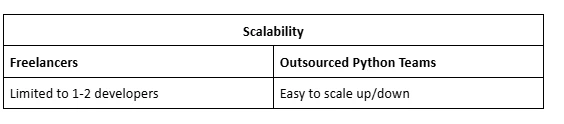
A freelancer can only do so much. You might start with one person, but as the project grows, you’ll find yourself juggling multiple freelancers or worse, rewriting what someone else started.
With an outsourced team, you can scale up (or down) as your needs evolve. Need two Python developers today and a DevOps engineer next sprint? No problem, they’ve got that bench strength.
3. Management Overhead
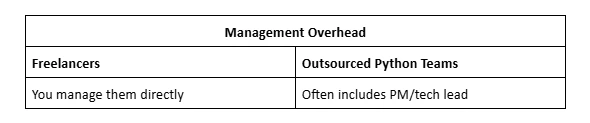
Freelancers need close supervision, task assignment, check-ins, QA and sometimes even code reviews. That’s fine if you have bandwidth. But if you’re already stretched thin, it adds up quickly.
Outsourced teams often come with a project manager or technical lead who owns delivery. They handle the day-to-day coordination, so you’re not acting as the bottleneck.
4. Continuity

Freelancers can vanish sometimes with little or no notice. If they’re the only one who knows your codebase, you’re left scrambling.
On the other hand, Outsourced teams have redundancy. If a developer drops out, they can slot in a replacement with minimal disruption. Plus, they tend to follow shared coding standards and documentation practices, so no one person holds the keys.
5. Security & Compliance

If you’re operating in fintech, healthcare or enterprise SaaS, you’re likely dealing with data protection, compliance audits and regulatory scrutiny. Freelancers may not always be equipped for that. You’ll need to set up NDAs, access controls, and audit trails manually.
Outsourced teams usually have baked-in security protocols, secure environments, data handling processes, compliance support (like SOC2 or GDPR), and even ISO certifications if you need them.
When to Hire Python Freelancers?
There’s a reason freelance platforms are so popular. If you need something small, fast, and isolated, Python development freelancers can be a lifesaver.
Here’s when freelancers shine:
- You need a quick fix, say, a script to automate a report.
- You’re working on a proof of concept (PoC) or an early-stage feature.
- The task doesn’t affect core infrastructure or sensitive data.
- You have internal bandwidth to manage them hands-on.
When to Choose an Outsourced Python Team?
Now let’s talk scale, velocity and complexity.
If you’re building or scaling a Python-heavy application, running multiple microservices, or working with ML workflows in production, you’ll need more than a single contributor. You’ll need a team and ideally, one that doesn’t slow you down with recruitment and onboarding headaches.
Here’s when hiring a Python development team is a smarter bet:
- You’re working on a production-level product with backend infrastructure, not just scripts.
- You need dedicated software development capacity without hiring full-time.
- You don’t want the overhead of managing freelancers.
- You need built-in redundancy, QA and documentation.
How CTOs Can Decide What’s Right?
Still not sure which path to take? Here’s a quick decision framework:
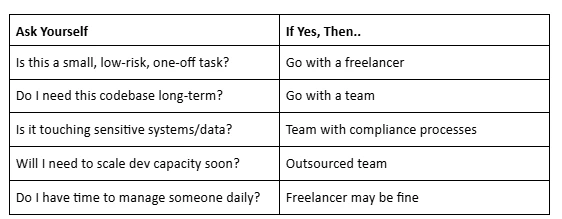
Moreover, you can also consider a hybrid model:
- Use freelancers for early prototypes or experiments
- Bring in an outsourced team for production delivery and scaling
- Move to in-house hires once you hit critical velocity
Wrapping Up
Hiring Python talent isn’t just about filling roles, it’s about building momentum. Whether you choose a freelancer or a full outsourced team, the real goal is to:
- Ship faster with fewer roadblocks
- Maintain code quality and architecture standards
- Scale without burning out your internal teams
If you’re leading a fast-moving tech organization, choosing the right IT outsourcing service provider can mean the difference between staying ahead of the curve or getting buried under tech debt.