



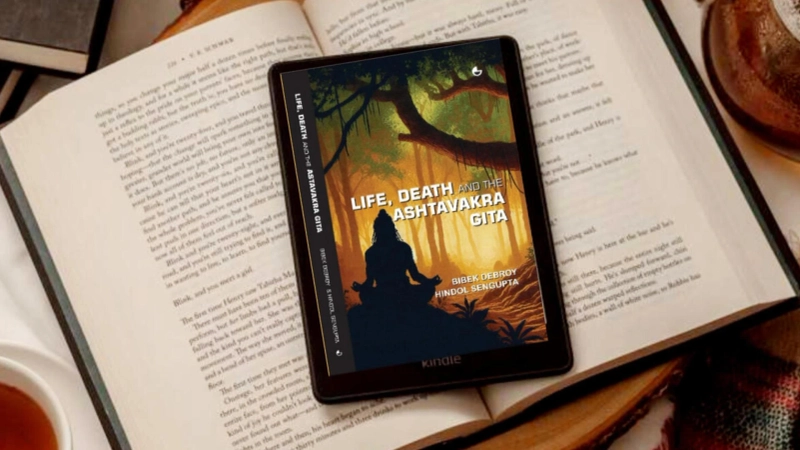
I did not read this book in a single sitting. In fact, I don’t think it’s meant to be read like that. There’s a kind of stillness built into it, the kind that makes you stop mid-page, look away, and let a sentence echo for a while. Life, Death and the Ashtavakra Gita does not offer a journey from point A to point B. It offers silence. Not emptiness, but a silence that holds something.
The book is presented in two parts. The first is a careful translation of the Ashtavakra Gita by Bibek Debroy. The second is a reflective and deeply personal interpretation by Hindol Sengupta.
When the Questions Come First
The Ashtavakra Gita begins not with a dramatic scene, but with a question. A simple, clear question.
“How does one acquire jnana? How does one obtain mukti? How does one obtain vairagya?”
That’s the voice of King Janaka, opening the dialogue. It is a voice that does not pretend to know. It asks honestly. It does not try to perform wisdom. It simply asks.
And the reply from Ashtavakra is just as direct:
“If you desire mukti, cast aside material objects as if they are poison. Like nectar, practise forgiveness, uprightness, compassion, contentment and truth.”
There is no buildup, no backstory, no explanation of how we got here. Just a question. Then an answer. The text flows in this clear rhythm. No ornament. No argument.
Bibek Debroy’s translation respects that rhythm. The verses are not buried under layers of commentary. Each shloka is given space. Sanskrit transliteration is followed by a clean English translation. Occasionally, a short footnote appears, but only when needed.
There’s something quiet and dignified about the way this part of the book has been handled. It doesn’t hurry the reader. It doesn’t try to impress. It simply lays down the words and allows you to sit with them.
Something I Held On To
One of the verses that stayed with me long after I finished reading is this:
“You are neither earth, nor water, nor fire, nor air, nor space. Know that you are the observer of all these and be free.” (1.3)
There is no urgency in this verse. No demand to become something. It just invites you to see. And that shift from doing to seeing is what makes this text different from many others I have come across.
It doesn’t tell you to improve. It asks you to witness.
When Reflection Becomes the Second Half
The second part of the book is where the voice changes. Hindol Sengupta steps in, and the pace softens. His chapters are not commentary. They are reflection. They carry the weight of personal experience, especially during the period of lockdowns and loss brought by the COVID-19 pandemic.
He writes about grief. About losing his father. About sitting with verses not as philosophy but as quiet companions during a time when the world had paused. He doesn’t turn the text into a tool. He shares how he lived with it.
Each chapter blends something from his own life with a teaching from the Gita. Titles like Nothing is Mine, Everything is Mine and The Happiness of the Bad Son show that he isn’t trying to present conclusions. He’s exploring the spaces between understanding and acceptance.
What I appreciated most was the way he speaks about Advaita. There’s no oversimplification. He doesn’t turn it into an easy idea. He sits with the complexity of it. The idea that the self and the world are not separate. That what we hold onto as identity might itself be the illusion. And he never treats these ideas as abstract. They are tied into daily questions, memory, family, and even confusion.
At one point, he writes about how even the desire to let go can become another form of attachment. That line stayed with me. Because it felt real. It didn’t try to be clever. It simply named a pattern most of us know, but rarely say aloud.
A Thought That Shifted Something
Early in the book, there’s a section that describes how the Ashtavakra Gita stands apart from other Gitas. It is not embedded in an epic. It does not have a narrative arc. It is a standalone text. Just a direct dialogue.
There’s a sentence that describes this as a dialogue among equals. That changed something for me. The idea that Janaka and Ashtavakra were not locked into roles of teacher and student, but were speaking on equal ground, gave the verses a different kind of weight. It made the questions feel valid. It allowed the space for not knowing.
And that is something many of us need more of.
What the Book Gave Me
I didn’t come away with answers. I don’t think the book expects that. What I did come away with was a kind of shift in pace. A permission to slow down thought. A reminder that stillness is not a break from life, but sometimes the most alive we can be.
Some books ask for your time. This one asked for my attention.
It did not explain how to change. It did not ask me to fix anything. It simply invited me to see what I already was, beneath everything I had built up.
For Anyone Wondering If This Is the Right Book
If you are looking for noise, this is not your book. If you are looking for something to fill the silence, this will not help.
But if you are someone who is starting to turn inward, or someone who has already begun and does not know where the path is taking you, this book might be good company.
It does not pull you forward. It sits beside you.
It listens more than it speaks.
And maybe that is enough.