



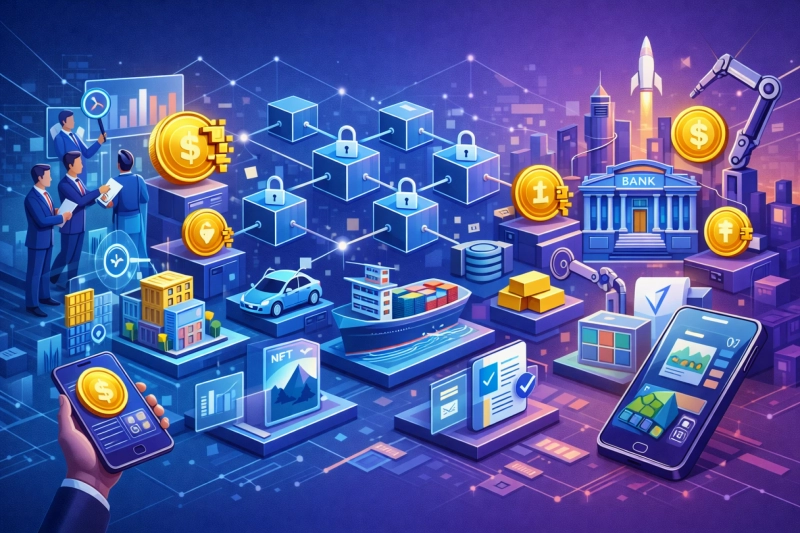
By 2026, real world asset tokenization is no longer an experimental concept discussed only in blockchain circles. It has matured into a serious financial and technological framework that enterprises, asset managers, governments, and fintech innovators are actively deploying to unlock liquidity, expand investor access, and modernize capital formation. What began as a proof of concept has evolved into a full-scale capital engine capable of transforming how assets are issued, owned, traded, and governed.
This shift is being driven by the convergence of regulatory clarity, enterprise-grade blockchain infrastructure, and growing institutional confidence in tokenized markets. Real World Asset Tokenization is now seen as a strategic tool rather than a speculative trend. As a result, tokenization offerings in 2026 are broader, deeper, and more operationally mature than ever before.
This article explores how Real world asset tokenization platform development has progressed from idea to execution, the types of offerings shaping the market, and how organizations are using tokenization as a scalable financial engine.
Understanding Real World Asset Tokenization Beyond the Basics
At its core, Real World Asset Tokenization involves converting ownership or economic rights of physical or traditional financial assets into blockchain-based tokens. These assets may include real estate, commodities, invoices, bonds, private equity, carbon credits, or infrastructure projects. The token represents a verifiable, programmable claim on the underlying asset.
In 2026, the focus has shifted from simply digitizing assets to building compliant, interoperable, and revenue-generating ecosystems around them. Tokenization is no longer limited to fractional ownership. It now supports complex financial logic, automated compliance, cross-border settlement, and real-time reporting.
Enterprises working with a Real world asset tokenization platform company today expect end-to-end solutions that cover asset onboarding, token issuance, lifecycle management, investor access, and secondary market integration.
The Evolution From Concept to Capital Engine
In the early stages, RWA Tokenization initiatives were largely experimental. Projects focused on technical feasibility and pilot programs with limited scale. Liquidity was fragmented, and regulatory uncertainty slowed adoption.
By 2026, that landscape has changed dramatically. Tokenized assets are now designed from the outset to function as capital engines. This means they are structured to attract institutional capital, support long-term governance, and integrate seamlessly with traditional financial systems.
A modern rwa tokenization platform development approach prioritizes scalability, compliance, and monetization. Tokenized assets are embedded into broader financial strategies rather than existing as isolated digital instruments.
Core Real World Asset Tokenization Offerings in 2026
Asset Digitization and Structuring Services
One of the most critical offerings in 2026 is asset digitization combined with financial structuring. Tokenization is not a simple technical process. Assets must be legally structured, valued, and mapped into digital representations that align with jurisdictional regulations.
RWA Tokenization Services in this area typically include due diligence, asset classification, legal wrapper design, and token economics modeling. A professional RWA Tokenization Company works closely with legal and financial advisors to ensure that tokens accurately reflect ownership rights, cash flows, and governance rules.
This phase sets the foundation for everything that follows. Poor structuring can undermine investor trust and regulatory compliance.
Token Issuance and RWA Token Development
Token issuance has evolved significantly by 2026. Modern RWA token development focuses on creating programmable tokens that embed compliance rules, transfer restrictions, dividend logic, and voting rights directly into smart contracts.
RWA token development is no longer a one-size-fits-all process. Tokens are tailored based on asset class, investor type, and market geography. For example, a tokenized real estate asset may emphasize rental yield distribution, while a tokenized bond focuses on coupon automation and maturity redemption.
An experienced RWA tokenization development company ensures that token design aligns with both regulatory frameworks and investor expectations.
Compliance and Regulatory Enablement
Compliance has become a core offering rather than an afterthought. In 2026, Real World Asset Tokenization Services are deeply integrated with identity verification, investor accreditation, transaction monitoring, and audit trails.
Tokenization platforms now support jurisdiction-specific compliance logic, allowing assets to be offered globally while respecting local regulations. This capability is a major reason why institutional players are increasingly comfortable with tokenized assets.
A mature rwa tokenization platform development company builds compliance directly into the infrastructure, reducing operational risk and regulatory friction.
Investor Onboarding and Access Management
Another critical offering is streamlined investor onboarding. Tokenized assets are designed to expand access while maintaining strict controls over who can participate.
Platforms in 2026 provide digital onboarding flows that verify identity, assess eligibility, and grant access to appropriate investment opportunities. This process is faster, more transparent, and more cost-efficient than traditional onboarding models.
Real world asset tokenization platform development now emphasizes user experience alongside security, ensuring that both retail and institutional investors can interact with tokenized assets confidently.
Expanding Asset Classes Driving Tokenization Growth
Real Estate and Infrastructure Assets
Real estate remains one of the most mature and widely adopted use cases. Tokenization enables fractional ownership, global investor participation, and improved liquidity for traditionally illiquid assets.
In 2026, infrastructure assets such as renewable energy projects, transportation networks, and data centers are also being tokenized. These long-term assets benefit from predictable cash flows and strong investor demand.
A Real world asset tokenization platform company specializing in these sectors focuses on yield transparency, governance rights, and lifecycle management.
Financial Instruments and Private Markets
Private equity, private credit, and structured finance products are increasingly being tokenized. These offerings allow issuers to access a broader investor base while providing investors with improved visibility and liquidity options.
RWA Tokenization Services in private markets often include secondary trading frameworks, automated reporting, and smart contract-based distributions.
This expansion is turning tokenized assets into powerful tools for capital formation beyond traditional public markets.
Commodities and Alternative Assets
Commodities such as gold, agricultural products, and energy resources are also being tokenized in 2026. Tokenization improves traceability, reduces settlement times, and enhances price transparency.
Alternative assets like art, collectibles, and intellectual property are benefiting from fractionalization and global reach enabled by tokenization platforms.
These offerings are opening new asset classes to investors who were previously excluded due to high entry barriers.
Methods and Frameworks Used in Modern Tokenization Projects
While tokenization offerings vary, successful projects in 2026 follow structured methodologies. Common methods include:
- Asset readiness assessment to evaluate legal, financial, and operational feasibility
- Token economics modeling to define supply, valuation, and incentive structures
- Modular smart contract architecture for flexibility and upgradeability
- Embedded compliance logic tailored to target jurisdictions
- Integration with custody, payment, and reporting systems
These methods ensure that tokenized assets are robust, compliant, and scalable from launch.
The Role of Technology in Scaling Tokenization Offerings
Technology is the backbone of modern tokenization. In 2026, platforms leverage advanced blockchain protocols, interoperable standards, and automation tools to support large-scale deployments.
Real world asset tokenization platform development now includes features such as real-time asset tracking, automated reconciliation, and analytics dashboards. These capabilities provide issuers and investors with unprecedented transparency and control.
A reliable rwa tokenization platform development company prioritizes security, performance, and interoperability to support long-term growth.
Turning Tokenized Assets Into Sustainable Capital Engines
What truly differentiates 2026 offerings is the focus on sustainability and capital efficiency. Tokenized assets are designed to generate ongoing value rather than one-time issuance events.
Capital engines built on tokenization support continuous fundraising, reinvestment, and secondary market activity. Smart contracts automate distributions and governance, reducing operational overhead and increasing trust.
This shift enables organizations to deploy capital more efficiently while offering investors dynamic participation opportunities.
Strategic Advantages for Enterprises and Issuers
Enterprises adopting tokenization in 2026 gain several strategic advantages. These include faster access to capital, reduced intermediaries, improved transparency, and global investor reach.
By working with a specialized RWA Tokenization Company, issuers can launch compliant offerings faster and adapt to changing market conditions.
Tokenization also supports innovation in product design, allowing enterprises to create hybrid instruments that blend features of equity, debt, and utility tokens.
Challenges Still Shaping the Tokenization Landscape
Despite its maturity, tokenization still faces challenges. Regulatory alignment across jurisdictions, investor education, and interoperability between platforms remain ongoing concerns.
However, the presence of experienced RWA Tokenization Services providers has significantly reduced these risks. Best practices, standardized frameworks, and improved tooling are helping the ecosystem evolve responsibly.
Organizations entering the space in 2026 benefit from lessons learned during earlier adoption phases.
Choosing the Right Partner for Tokenization Initiatives
Selecting the right partner is critical for success. A capable Real world asset tokenization platform company brings not only technical expertise but also regulatory insight and market understanding.
An established RWA tokenization development company supports clients throughout the entire lifecycle, from concept validation to post-launch optimization.
The goal is not just to tokenize an asset but to build a sustainable financial product that delivers long-term value.
The Future Outlook Beyond 2026
Looking ahead, tokenization is expected to become a standard component of global financial infrastructure. As adoption grows, tokenized assets will integrate more deeply with traditional systems, blurring the lines between digital and conventional finance.
Real World Asset Tokenization will continue to expand into new asset classes and geographies, supported by evolving regulations and technological innovation.
Organizations that invest early in robust Real world asset tokenization platform development are positioning themselves at the forefront of this transformation.
Conclusion: From Digital Experiment to Financial Foundation
In 2026, real world asset tokenization offerings represent a decisive shift from experimentation to execution. Tokenization has proven its ability to unlock capital, democratize access, and modernize asset management at scale.
By combining strong legal frameworks, advanced technology, and strategic design, tokenized assets are now functioning as reliable capital engines. For enterprises, investors, and innovators alike, the opportunity lies not just in adopting tokenization but in leveraging it thoughtfully and responsibly.
As the ecosystem continues to mature, Real World Asset Tokenization will play a central role in shaping the future of global finance.