



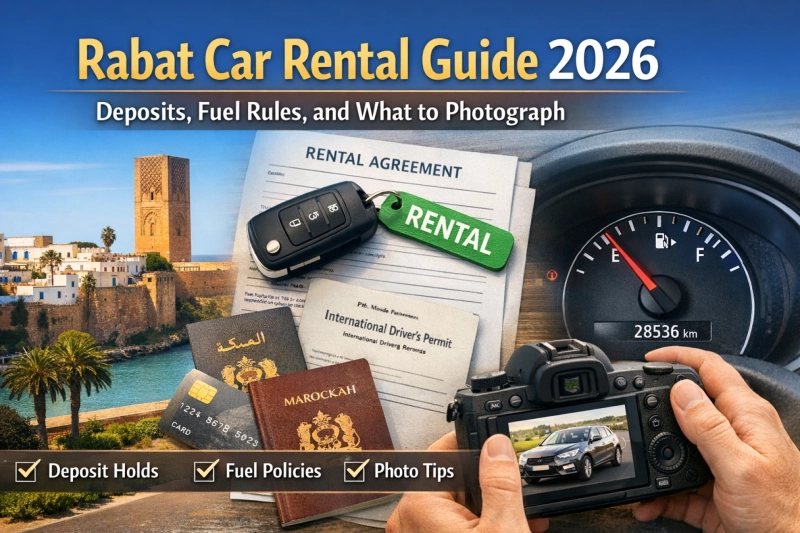
Rabat is one of the easiest Moroccan cities to drive, wide boulevards, calmer traffic than Casablanca, and a layout that makes sense once you’ve done two or three roundabouts. But “easy to drive” doesn’t automatically mean “easy to rent.” Most rental headaches in Rabat come from three things: deposit misunderstandings, fuel-policy confusion, and leaving the pickup without solid photos.
This 2026 guide is built for real life: you’re tired from travel, you just want to get the keys, and you don’t want any surprise charges later. If you’re comparing options first, start with MarHire, then browse car rental so you can see what’s available across Morocco before narrowing down to Rabat.
1) Deposits in Rabat: what they are (and what people get wrong)
A deposit is not “extra money.” It’s a temporary security hold or guarantee, used to cover potential damage, traffic fines, missing fuel, late returns, or contract breaches. The problem is that travelers hear “deposit” and assume it’s a single universal rule. In Rabat, it varies by:
- vehicle category (economy vs SUV vs luxury)
- insurance level (basic vs expanded coverage)
- driver profile (age, license type, sometimes experience)
- pickup point (airport vs downtown delivery)
The 3 deposit types you’ll see in practice
1) Card pre-authorization (hold)
A hold is placed on your card and released later (timing depends on banks and the provider). This is the most common structure.
2) Cash deposit (less common, but it happens)
Cash deposits can exist with certain offers, but they require extra caution: always get a receipt and confirm the exact refund process and timing.
3) Reduced deposit with higher coverage
Sometimes the deposit is smaller when you take broader coverage, because the renter’s risk is reduced.
What to ask at pickup (30 seconds that saves hours):
- “Is this a hold or a charge?”
- “How much is the excess (deductible) if there’s damage?”
- “When is the hold released on your side, and what’s the typical bank delay?”
If you want city-specific options and typical pickup styles, start here: Rabat car rental.
2) Fuel rules: the #1 cause of “surprise fees”
Fuel is where otherwise-happy rentals go sideways, because it feels “small” at pickup and becomes “expensive” at return.
The most common fuel policies in Rabat
Full-to-full (best for most travelers)
You receive the car full (or near full) and return it full. Simple, if you refuel close to the return point.
Same-to-same
You return it at the same level you received it (e.g., 7/8). This sounds easy until you realize matching “7/8” precisely is harder than it looks.
Prepaid / “return empty” (often bad value)
You pay for a tank upfront and return with any level. This can be convenient, but it’s frequently not cost-effective unless you truly plan to use most of the tank.
The Rabat reality: why travelers still get charged on “full-to-full”
- They refuel too far from the return location and burn fuel in traffic.
- They refuel, but don’t keep the receipt.
- They assume “almost full” equals full.
Your simple fuel system (works every time):
- Photograph the fuel gauge at pickup (dashboard photo).
- Refuel within the last 10–20 km before return when possible.
- Keep the receipt (photo is fine).
- Photograph the fuel gauge again at return.
That’s it. No arguments needed later.
3) What to photograph in Rabat: the exact checklist
Photos aren’t about mistrust, they’re about clarity. In busy handovers, staff may not have time to note every scuff. Your photos become a shared reference point.
The 90-second photo set (do this before you drive away)
Take wide shots first (proof of overall condition), then close-ups (proof of detail).
Wide shots (4):
- Full front (centered)
- Full rear (centered)
- Driver side (full length)
- Passenger side (full length)
Detail shots (at least 6):
5) Each rim/wheel (2 close-ups minimum, front left and rear right are the most common curb-contact points)
6) Windshield (close-up; chips matter)
7) Front bumper corners (close-up; easy to scratch)
8) Rear bumper corners (close-up; parking taps happen)
9) Dashboard showing fuel + mileage
10) Any existing scratch/dent: one close-up + one wider shot showing where it is
Bonus that’s insanely useful:
A 10-second walkaround video in good light.
Interior photos (quick but smart)
Take 2–3 shots of:
- driver seat area and dashboard
- back seats (if traveling with kids or luggage)
- trunk (especially if you’re loading suitcases)
Interior claims are rarer than exterior claims, but photos keep everything simple.
4) Rabat pickup locations: what feels “normal” in 2026
Rabat rentals are commonly picked up:
- downtown/central neighborhoods (easy access to hotels)
- delivery to your accommodation (convenient, confirm exact time)
- via Rabat–Salé Airport (RBA) if you’re flying in/out
If you’re flying, it can help to check the airport’s access and passenger info on the official ONDA page for Rabat–Salé Airport: Onda
This is useful for understanding terminal access, parking, and general passenger services.
5) Cheap in Rabat can be great—if you use the right filters
“Cheap” should mean good value, not “mystery rules.” If you’re price-focused, begin with cheap car rental in Rabat and scan for these deal-killers:
- unclear fuel policy
- unclear deposit language
- “insurance included” but no mention of the deductible/excess
- extra fees triggered by late return (even by 30–60 minutes)
The practical way to choose the right car for Rabat
- Economy/compact: best for city parking, medina edges, quick errands, and day trips with light luggage.
- Small SUV: better if you want comfort on highways, more luggage space, or you’re doing longer drives with passengers.
- Luxury: great for comfort, but be stricter with inspection (rims and bumpers especially).
A compact car often wins in Rabat because it reduces parking stress and makes tight maneuvers easier.
6) Driving and parking in Rabat: the local “don’t panic” rules
Rabat is calmer than many cities, but you’ll still meet classic Morocco driving patterns: confident lane changes, roundabouts that require commitment, and occasional informal parking guidance.
Parking: what to expect
- In some areas, you may see local parking attendants (“guardians”) helping organize spaces. If you use the spot, it’s common to tip a small amount, keep it friendly and simple.
- Prefer well-lit, clearly marked areas when possible, especially at night.
- Avoid blocking entrances, curb corners, and tight street turns, these are the spots where minor scrapes happen.
The one road-safety habit that saves you money
Slow down for speed control zones and keep your attention up in roundabouts. For general national road safety guidance in Morocco, NARSA’s official site is a solid reference: https://www.narsa.ma/fr
7) Return day: the 4-minute routine that prevents disputes
Returns go smoothly when you reverse your pickup steps:
- Refuel close to return and keep the receipt
- Take a dashboard photo (fuel + mileage)
- Repeat the same 4 wide shots (front, rear, both sides)
- Do a quick walkaround video again
If staff are rushed, your documentation keeps everything clean and calm.
Mini-FAQ (quick answers)
Do I always need a credit card deposit in Rabat?
Not always, but many rentals use a card hold. The rules depend on provider, car type, and coverage.
What fuel policy should I choose?
Full-to-full is usually simplest and fairest if you refuel near return and keep the receipt.
What photos matter most?
Wide shots of all sides, rims close-ups, windshield close-up, and dashboard fuel+mileage—plus a short walkaround video.
Is driving in Rabat hard for visitors?
Generally no, Rabat is one of Morocco’s easier cities to drive, especially if you stay calm in roundabouts and park smart.