



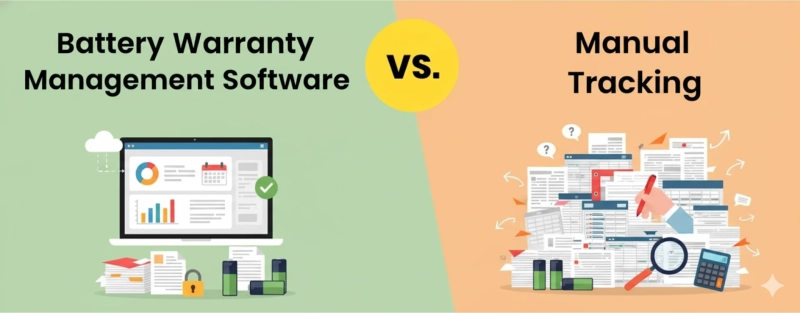
Imagine a manufacturer trying to manage hundreds of battery warranty claims at once. Spreadsheets, emails, and printed documents are all fighting for attention. At first, it looks manageable. However, as the numbers increase, mistakes, delays, and customer complaints start to mount.
It is not about effort. It’s about efficiency. Manual tracking worked when operations were smaller, but it slows everything down today. The manufacturing industry has evolved, and so have customer expectations. The question now isn’t how much work is being done, but how smartly it is being managed.
This is where the shift begins. Manual tracking versus automation. Two methods with the same goal but very different outcomes.
The Hidden Costs of Manual Warranty Tracking
Manual warranty tracking feels familiar. It gives a sense of control. But beneath that comfort lies a silent cost that many manufacturers underestimate.
Teams spend hours entering data, reconciling claims, and following up on disputes. Every claim needs attention, and every mistake adds to the delay. What seems like a routine process often turns into a financial drain.
Manufacturers in the battery industry spend up to 40 percent more time resolving claims manually compared to those using battery warranty management software.
Due to repeated claim handling and rework, human errors and disputes increase costs by roughly ₹2–3 lakh per month for mid-sized companies. Automation reduces this burden by cutting resolution time by nearly 30 per cent and minimising costly errors that affect warranty compliance. For larger manufacturers, these losses can scale into crores annually.
The real price of manual tracking isn’t just time. It’s missed opportunities, delayed customer trust, and wasted operational potential.
The contrast becomes even clearer when automation steps into the picture.
How Battery Warranty Management Software Changes the Game
Automation simplifies what manual processes complicate. Instead of scattered spreadsheets, every claim, customer record, and warranty detail is stored in one connected system.
With a modern warranty management system, manufacturers can register claims instantly, track product lifecycles in real time, and receive alerts about recurring issues. This visibility turns warranty handling from a reactive task into a proactive strategy.
It’s not about replacing people, it’s about helping teams focus on decisions that matter improving quality, managing relationships, and planning growth.
And when both approaches are compared side by side, the differences speak for themselves.
Manual Tracking vs Battery Warranty Management Software
- Data Accuracy and Consistency:- Manual processes rely on human input, which means errors are inevitable. Automated systems validate information instantly, reducing inaccuracies and keeping data consistent.
- Claim Resolution Time:- Manual workflows stretch across days, often weeks. Automation processes the same claim in hours, saving valuable time for both manufacturers and customers.
- Cost Efficiency:- Every recheck, every correction adds cost. A battery warranty management software eliminates repetitive tasks and brings measurable savings over time.
- Data Insights:- Manual tracking hides trends in paperwork. A digital warranty management system provides dashboards highlighting recurring defects and performance issues before escalating.
- Customer Experience:- Delayed claims frustrate customers. Automation ensures faster resolutions and transparent communication, helping businesses build lasting trust.
Automation is no longer an upgrade; but a standard for staying competitive.
These advantages are not just operational; they create a foundation for smarter business decisions.
Automation as a Strategy, Not Just Technology
Many businesses see automation as a convenience. But it is much more strategic. When warranty processes go digital, data starts working as a decision-making tool.
Manufacturers can identify defect patterns early, adjust production, and improve products before issues spread. Reports become real-time insights, not monthly surprises. A warranty management system doesn’t just process claims it helps predict and prevent them.
The global trend reflects this shift. The extended warranty market in India, especially in electronics, was valued at USD 3,584 million in 2023 and is projected to reach USD 8,803 million by 2032, growing at 10.5 per cent. The automated warranty management sector is also expanding, expected to grow from USD 1.4 billion in 2025 to USD 3.2 billion by 2032, with ROI ranging between 30 and 200 per cent within the first year of implementation.
Automation now saves an average of 22 per cent of operating costs while improving customer satisfaction. For manufacturers, that’s not just progress it’s performance.
The results are already visible across industries that are adopting digital transformation.
The Real-World Impact of Automation
Manufacturers transitioning from manual systems to battery warranty management software consistently report measurable improvements.
Claim handling times reduce by up to 60 per cent, error rates drop significantly, and customers receive faster responses. Transparency improves because every claim is tracked and recorded.
Businesses also experience a ripple effect better forecasting, improved product reliability, and stronger brand reputation. Some mid-sized manufacturers have even seen a 30 per cent rise in customer satisfaction and a 40 per cent drop in disputes after moving to automated warranty systems.
The transformation isn’t just about speed but control, consistency, and trust.
However, before any manufacturer makes this move, key factors must be considered.
What to Consider Before Making the Switch
Every change begins with an honest look at the current system.
- How often do claims get delayed?
- How much time does your team spend managing data manually?
- Do you have clear visibility into warranty performance?
It is time to reconsider the process if the answers point to frustration. A digital warranty management system does not have to replace your entire setup. It integrates smoothly, helping businesses modernise without disruption.
And when this transition happens, operations look very different smoother, faster, and far more reliable.
The Future of Warranty Management Is Digital
Manual tracking has served its purpose, but it no longer meets the pace or precision modern manufacturers require. Automation brings clarity, accuracy, and consistency that manual processes can’t match.
A battery warranty management software is not just a tool. It is a long-term solution for cutting costs, improving workflows, and ensuring customers get the attention they deserve.
Manufacturers who act today will lead tomorrow’s markets with systems built for reliability and speed.
If your team is still buried under spreadsheets and claim logs, maybe it’s time to simplify the process. Explore how automation can change how you manage warranties efficiently, accurately, and effortlessly.