



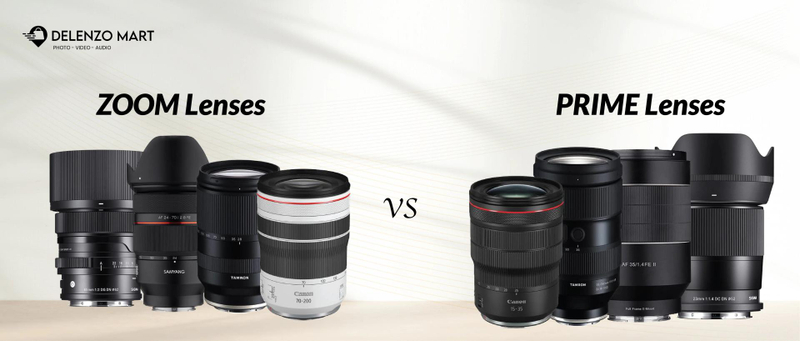
Prime Lenses vs Zoom Lenses: What Should You Choose for Your Photography Journey?
The lens debate between primes and zooms has existed since the earliest days of interchangeable lens photography, with passionate advocates on both sides presenting compelling arguments for their preferred approach. This decision represents one of the most significant choices photographers face when building their lens collections, influencing everything from image quality and creative possibilities to shooting workflow and equipment investment strategies.
Understanding the fundamental differences between these two lens categories, their respective strengths and limitations, and how each aligns with different photographic disciplines helps photographers make informed decisions that support rather than hinder their creative vision. The choice between prime and zoom lenses isn't simply a technical specification comparison—it's a decision about photographic philosophy, working method, and the type of images you aspire to create.
This comprehensive exploration examines both lens categories from multiple perspectives, analyzing optical performance, practical handling characteristics, creative implications, and financial considerations. Whether you're purchasing your first interchangeable lens beyond a kit zoom, expanding an existing collection, or reconsidering your entire lens strategy, this guide provides the knowledge necessary to make choices aligned with your photographic goals and shooting style preferences.
Understanding Prime Lenses and Their Characteristics
Prime lenses, defined by their fixed focal lengths, represent the oldest lens design category in photography. Without the complex optical arrangements required for zoom functionality, primes typically feature simpler construction that often translates into specific performance advantages and distinctive handling characteristics.
The optical simplicity of prime lenses allows engineers to optimize designs for specific focal lengths rather than compromising across zoom ranges. This focused optimization frequently results in superior image quality compared to zoom lenses at equivalent price points. Fewer optical elements generally mean less glass for light to pass through, reducing opportunities for quality degradation and allowing more light transmission to the sensor.
Maximum aperture specifications distinguish primes from most zoom alternatives. While zoom lenses typically offer maximum apertures between f/2.8 and f/5.6, prime lenses commonly feature much wider apertures ranging from f/1.4 to f/2. This additional light-gathering capability provides both technical advantages in challenging lighting conditions and creative opportunities through extremely shallow depth of field effects.
Physical size and weight generally favor prime lenses compared to zoom alternatives covering similar focal ranges. A fast 50mm f/1.8 prime typically weighs significantly less than a 24-70mm f/2.8 zoom while occupying less space in camera bags. This compactness appeals to photographers prioritizing portability, whether traveling light for personal projects or reducing equipment burden during extended shooting sessions.
The fixed focal length that defines prime lenses simultaneously represents both limitation and creative discipline. Without zoom capability, photographers must physically move to adjust composition and framing. This requirement encourages more deliberate compositional thinking and often results in more carefully considered images compared to the ease with which zoom lenses enable compositional adjustments.
Exploring Zoom Lens Advantages
Zoom lenses offering variable focal lengths within single optical packages provide versatility that makes them indispensable tools for many photographic applications. The ability to adjust focal length without changing lenses delivers practical advantages that often outweigh the modest optical compromises inherent in zoom lens designs.
Compositional flexibility represents the most obvious zoom lens advantage. The ability to quickly adjust framing from wide environmental coverage to tighter subject isolation without physically moving proves invaluable in numerous shooting scenarios. Event photographers covering weddings or corporate functions, photojournalists documenting fast-moving situations, and travel photographers working in crowded or constrained environments all benefit enormously from zoom versatility.
Reduced lens changes during shooting sessions offer both practical convenience and technical benefits. Fewer lens swaps mean less time spent managing equipment and more time actually photographing. Additionally, minimizing lens changes reduces sensor exposure to environmental dust and moisture that accumulate on sensors and degrade image quality over time.
Single lens coverage of multiple prime focal lengths reduces total equipment requirements, particularly valuable for photographers working with limited budgets or prioritizing minimal kit size. A quality 24-70mm zoom effectively replaces 24mm, 35mm, 50mm, and 70mm primes, consolidating four lenses into one package. This consolidation simplifies purchasing decisions while reducing the total investment required for comprehensive focal length coverage.
Modern zoom lens optical quality has improved dramatically over recent decades, with current high-end zooms delivering image quality that rivals prime lenses in many situations. While subtle differences remain detectable in careful testing, practical real-world performance differences have narrowed considerably, making zoom lenses viable choices even for professional applications where image quality cannot be compromised.
Optical Performance Considerations
Image quality comparisons between prime and zoom lenses require nuanced understanding beyond simple generalizations. While primes traditionally offered superior optical performance, modern zoom designs have closed quality gaps substantially, though specific differences remain worth considering.
Sharpness testing typically reveals prime lens advantages, particularly at maximum apertures and in frame corners. The optimized optical formulas possible with fixed focal lengths allow engineers to correct aberrations more thoroughly across the image circle. However, premium zoom lenses from respected manufacturers now achieve impressive sharpness that satisfies professional standards, with differences becoming apparent primarily in demanding applications or extreme enlargements.
Chromatic aberration control varies significantly between individual lens models regardless of category. Some well-designed zoom lenses exhibit better chromatic aberration correction than mediocre prime lenses, though top-tier primes generally show superior performance. Modern lens coatings and aspherical element designs have improved chromatic aberration control across both categories, making this less of a differentiating factor than in previous eras.
Distortion characteristics differ between primes and zooms in predictable patterns. Prime lenses typically show minimal distortion, with well-corrected designs producing nearly straight lines across the frame. Zoom lenses exhibit varying distortion patterns across their zoom ranges, often showing barrel distortion at wide focal lengths and pincushion distortion at longer focal lengths. Modern cameras frequently correct these distortion patterns automatically, reducing practical impact on final images.
Flare resistance and contrast maintenance when shooting toward bright light sources generally favor prime lenses with their simpler optical constructions and fewer air-to-glass surfaces. Fewer elements mean fewer opportunities for internal reflections that reduce contrast and create ghost images. However, modern multi-layer lens coatings have improved flare resistance dramatically across all lens categories, making even complex zoom lenses usable in backlit situations that would have caused serious problems with older designs.
Creative Implications of Lens Choice
Beyond technical performance differences, the choice between prime and zoom lenses influences creative processes and photographic results in ways that extend well beyond optical quality measurements. Understanding these creative implications helps photographers select lenses that support rather than constrain their artistic vision.
The fixed focal length of prime lenses encourages photographers to develop intimate familiarity with specific perspectives. Shooting extensively with a single focal length trains your eye to pre-visualize how scenes will render at that particular perspective, allowing more intuitive composition without constantly checking viewfinders. This deep familiarity with specific focal lengths enables more confident, decisive shooting compared to the endless focal length options zoom lenses present.
Compositional discipline required when shooting with primes forces photographers to engage more actively with their environments. Without zoom capability allowing easy composition adjustment from a single position, prime lens users must physically move to find optimal vantage points. This movement encourages exploring different angles, heights, and distances that often yield more interesting compositions than simply zooming in or out from static positions.
Maximum aperture advantages of prime lenses enable creative possibilities unavailable with typical zoom alternatives. The extremely shallow depth of field possible at f/1.4 or f/1.8 allows subject isolation effects and background blur that f/2.8 or slower zoom lenses cannot match. This capability proves particularly valuable in portrait photography, where ultra-thin depth of field creates striking visual separation between subjects and backgrounds.
For photographers exploring creative options across different focal length perspectives and aperture ranges, examining various prime lens alternatives reveals how different specifications influence creative possibilities. The samyang 35mm 1.4 price in pakistan demonstrates how accessible fast prime lenses have become, enabling photographers to experiment with wide-aperture creative techniques without prohibitive financial investment.
Zoom lens versatility encourages experimentation with varied perspectives during single shooting sessions. The ability to quickly explore how different focal lengths render scenes helps develop understanding of focal length characteristics while providing editors with diverse framing options. This experimental freedom particularly benefits photographers still developing their stylistic preferences and those working in unpredictable documentary situations.
Practical Workflow Considerations
The ways prime and zoom lenses integrate into actual shooting workflows significantly impact user experience and productivity. Understanding how lens choice affects operational efficiency helps photographers select options that enhance rather than complicate their working methods.
Shooting speed and responsiveness often favor zoom lenses in fast-paced environments where missing moments isn't acceptable. Event photographers covering weddings need to capture fleeting expressions and interactions across varied distances, making the instant framing adjustment zoom lenses provide essential for comprehensive coverage. The seconds saved by zooming versus changing lenses often determine whether critical moments get captured or missed.
Weight and portability considerations produce varying results depending on specific focal length requirements. A single 24-70mm zoom weighs less than carrying 24mm, 35mm, 50mm, and 70mm primes, making zooms more practical for photographers needing that focal range coverage. However, photographers primarily shooting at one or two specific focal lengths find carrying only the necessary primes reduces total kit weight compared to versatile but heavier zoom alternatives.
Backup equipment strategies influence lens selection differently for prime and zoom users. Photographers relying heavily on single zoom lenses face significant vulnerability if that lens fails during critical shoots, necessitating backup zoom purchases that double equipment investment. Prime users naturally develop multi-lens kits providing inherent redundancy, allowing continued shooting at alternative focal lengths if any single prime encounters problems.
Learning curve and technical mastery differ between lens categories in ways that affect photographer development. Prime lenses with their limited focal lengths and manual aperture rings often accelerate understanding of exposure fundamentals and compositional principles. The constraints force active engagement with photographic concepts rather than allowing reliance on zoom convenience to compensate for less developed technical knowledge.
Financial and Investment Perspectives
Budget considerations significantly influence lens purchasing decisions, with prime and zoom lenses presenting different value propositions depending on individual requirements and financial resources. Understanding the economic implications of each approach helps photographers allocate limited budgets most effectively.
Initial purchase costs typically favor prime lenses when comparing single lenses, though total system costs require more complex analysis. A quality 50mm f/1.8 prime costs considerably less than a 24-70mm f/2.8 zoom, making primes attractive for budget-conscious photographers. However, achieving comprehensive focal length coverage requires purchasing multiple primes, potentially exceeding the cost of a single versatile zoom covering similar focal ranges.
Cost-per-focal-length calculations favor zoom lenses when considering coverage breadth. A 24-70mm zoom effectively provides dozens of different focal lengths within its range, while prime lenses offer only their specific focal length. Photographers requiring varied focal lengths find zoom lenses deliver better value despite higher individual lens prices compared to any single prime alternative.
Resale value considerations slightly favor prime lenses in general photography markets. Fast prime lenses maintain strong used market demand due to their popularity among enthusiasts and professionals, typically retaining higher percentages of original purchase prices compared to zoom lenses. However, professional-grade zoom lenses from respected manufacturers also hold value well, making this difference less significant than other purchasing factors.
Long-term system building strategies differ between prime and zoom approaches. Photographers starting with zoom lenses often eventually add fast primes for specific applications where maximum aperture or optimal image quality matters most. Conversely, prime-first photographers frequently add versatile zooms to complement their prime collections when shooting scenarios demand greater flexibility than fixed focal lengths provide.
For photographers researching options across both categories and comparing prices across different specifications, exploring comprehensive lenses price in pakistan listings helps identify which lenses fit within budget constraints while meeting performance requirements. The current market offers unprecedented choice across prime and zoom categories at various price points.
Specialized Applications and Lens Selection
Different photographic disciplines place varying emphasis on qualities that prime and zoom lenses deliver differently, making certain lens categories more or less suitable for specific applications. Understanding these application-specific requirements helps photographers select lenses aligned with their primary shooting activities.
Portrait photography traditionally favors prime lenses for their superior maximum apertures and exceptional optical quality. The ability to shoot at f/1.4 or f/1.8 creates beautiful background separation while gathering sufficient light for indoor and low-light shooting scenarios common in portrait work. The fixed focal lengths that portrait photographers favor most—typically 50mm, 85mm, or 135mm—see frequent use that justifies dedicated prime lens purchases.
Wedding and event photography heavily favors zoom lenses despite their modest maximum aperture limitations compared to primes. The unpredictable, fast-paced nature of events demands instant focal length adjustment to capture fleeting moments across varied distances. Professional wedding photographers commonly use 24-70mm and 70-200mm zooms as their primary tools, occasionally supplementing with fast primes for specific creative shots during controlled portrait sessions.
Landscape photography produces mixed preferences depending on individual shooting styles and priorities. Photographers prioritizing ultimate image quality and minimal weight for backcountry hiking often prefer carrying several lightweight wide-angle primes. Those favoring compositional flexibility and shooting from roadside locations without extensive hiking tend toward versatile wide-to-standard zoom lenses that enable exploring various compositions without lens changes.
Street photography divides practitioners between prime and zoom advocates based on shooting philosophy. Documentary-style street photographers often favor compact 35mm or 28mm primes that encourage decisive moment capture and provide unobtrusive tools for candid work. Photojournalistic street shooters frequently choose moderate zoom lenses offering compositional flexibility while remaining discrete enough for public spaces.
Wildlife and sports photography overwhelmingly favor zoom lenses despite the maximum aperture compromises compared to theoretical long prime alternatives. The unpredictable subject distances and constant movement characteristic of these genres make zoom flexibility essential. While 400mm, 500mm, and 600mm prime telephotos exist, their extreme cost and single-focal-length limitation make them specialized tools while 100-400mm and 150-600mm zooms serve most photographers better.
Building Balanced Lens Collections
Rather than viewing prime versus zoom as an either-or decision, many photographers eventually develop hybrid collections incorporating both lens types to serve different needs and shooting scenarios. Understanding how to build balanced collections maximizes versatility while controlling costs and kit weight.
Starting with versatile zoom lenses provides comprehensive focal length coverage that handles diverse shooting scenarios while photographers develop stylistic preferences and identify which focal lengths they use most frequently. A 24-70mm or 24-105mm standard zoom effectively covers the most commonly used focal range, allowing photographers to explore various perspectives before committing to specific prime focal lengths.
Adding fast primes in frequently used focal lengths supplements zoom versatility with superior maximum aperture capabilities. After identifying through zoom lens shooting that you consistently gravitate toward 35mm or 50mm perspectives, investing in fast primes at those focal lengths provides creative capabilities your zoom cannot match while maintaining the zoom for situations demanding flexibility over maximum aperture.
Specialized lenses for specific applications round out mature collections based on actual shooting requirements rather than theoretical coverage gaps. Macro lenses for close-up work, ultra-wide lenses for architecture and landscapes, or long telephotos for distant subjects get added when specific projects or regular assignments justify their specialized capabilities.
Budget allocation across prime and zoom categories should reflect actual usage patterns and shooting priorities. Photographers shooting 80% event work and 20% creative portraits might invest more heavily in professional zoom lenses while adding one or two fast primes for portrait sessions. Conversely, primarily portrait and studio photographers might build extensive prime collections supplemented with a single versatile zoom for occasional event coverage or environmental work.
Technology Trends and Future Considerations
Lens technology continues advancing, with innovations gradually narrowing performance gaps between prime and zoom categories while introducing new capabilities that influence purchasing decisions. Understanding current trends helps photographers make forward-looking investments that remain relevant as technology evolves.
Mirrorless camera systems have enabled lens designs previously impossible or impractical with DSLR mirror box constraints. Shorter flange distances allow optical engineers greater freedom in lens design, resulting in compact, high-performance lenses across both prime and zoom categories. This design freedom particularly benefits wide-angle lenses, enabling shorter, lighter designs with superior optical performance.
Autofocus motor improvements have eliminated the speed advantage prime lenses once held over zooms in terms of focusing performance. Modern linear motors and stepping motor designs in quality zoom lenses now focus as quickly and accurately as prime alternatives, removing what was once a significant prime lens advantage. This performance parity makes zoom lenses viable for action and wildlife photography where autofocus speed directly impacts successful capture rates.
Electronic aperture and focus-by-wire systems are replacing mechanical connections in modern lens designs, enabling features like silent operation for video work and precise computer control of lens functions. These technologies appear in both prime and zoom lenses, though the benefits particularly enhance zoom usability for hybrid photo-video shooters who need smooth, quiet operation during video recording.
Lens correction profiles built into modern cameras and editing software reduce the practical impact of optical compromises that once clearly differentiated prime and zoom performance. Automatic correction of distortion, vignetting, and chromatic aberration means zoom lens weaknesses in these areas become invisible in final images, narrowing the visible quality gap between categories.
Making Your Personal Decision
The prime versus zoom decision ultimately depends on your specific photographic needs, shooting style preferences, budget constraints, and creative priorities. No universal answer exists because different photographers with varied requirements will arrive at different optimal solutions.
Photographers should honestly assess their typical shooting scenarios and identify which lens characteristics matter most for their work. Those regularly encountering unpredictable subjects at varying distances where missing shots isn't acceptable will find zoom lenses essential regardless of modest optical compromises. Photographers working in controlled environments with predictable subjects may prefer prime lens optical advantages and creative capabilities despite limited focal length flexibility.
Testing both lens categories through rental programs or borrowing from photographer friends provides invaluable real-world experience that specifications cannot convey. Actually shooting with 35mm and 50mm primes versus using a 24-70mm zoom in your typical working environments reveals which approach feels more natural and produces results matching your vision.
Budget realities influence decisions significantly, though photographers should consider long-term system building rather than only immediate purchase affordability. Sometimes purchasing one excellent zoom lens serves better than spreading the same budget across multiple mediocre primes, while other situations favor starting with one exceptional prime and adding others gradually as finances permit.
Access to quality optics through established distribution channels ensures photographers can make informed decisions while receiving proper warranty coverage and technical support. Fusion Max camera shop in Lahore serves as the official distributor for LK Samyang products in Pakistan, providing photographers with local access to both prime and zoom lenses across various focal lengths and specifications, all backed by manufacturer warranty protection.
Conclusion and Final Recommendations
The debate between prime and zoom lenses will likely continue as long as interchangeable lens photography exists, with both categories offering legitimate advantages depending on application and priorities. Rather than seeking a definitive winner, photographers benefit more from understanding how each lens type serves different needs and building collections that leverage the strengths of both approaches.
Prime lenses excel when maximum optical quality, widest possible apertures, or minimal size and weight take priority. Their fixed focal lengths encourage compositional discipline while their typically superior maximum apertures enable creative possibilities and low-light performance that zoom alternatives cannot match. Photographers working primarily at one or two focal lengths, prioritizing ultimate image quality, or seeking the most compact kit will find prime lenses align well with their requirements.
Zoom lenses prove indispensable when focal length versatility, comprehensive coverage from minimal equipment, or shooting unpredictable subjects matters most. Their ability to instantly adjust framing without lens changes makes them essential for event coverage, travel photography, and any situation where missing moments costs more than the modest optical compromises zoom designs require. Photographers needing to respond quickly to changing situations or those wanting comprehensive focal length coverage from minimal investment will favor zoom approaches.
Most photographers eventually develop hybrid collections incorporating both prime and zoom lenses, using each category where its strengths provide greatest advantage. This balanced approach maximizes versatility while controlling costs and kit complexity, allowing responsive adaptation to varied shooting scenarios without forcing compromises that limit creative possibilities or operational effectiveness.
The right choice emerges from honest assessment of your actual shooting needs, budget realities, and creative priorities rather than following conventional wisdom or popular opinions. Test various options when possible, trust your instincts about what feels right for your working style, and remember that lens choices aren't permanent commitments—collections evolve as your photography develops and your needs change over time.