



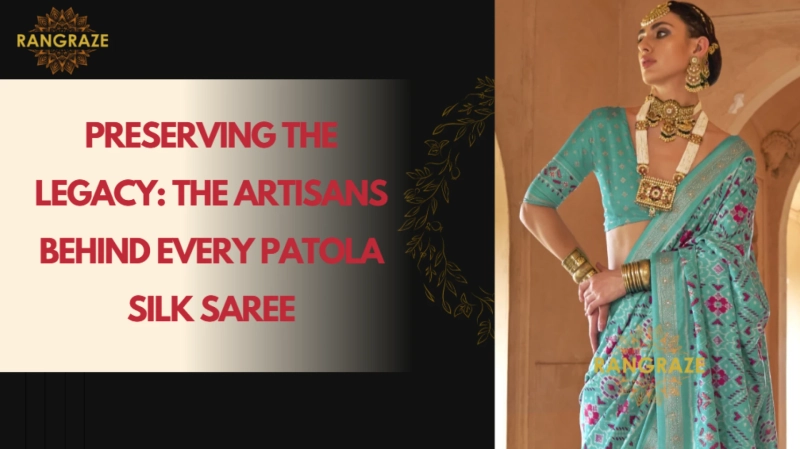
The soul behind the weave
A Patola silk saree isn’t just a garment — it’s a lifetime of skill passed down through generations. When you hold one, you’re not just touching silk; you’re touching years of dedication, rhythm, and memory stitched into color. Each saree tells the story of an artisan’s patience — the kind that can’t be rushed or replicated by machines.
The weavers from Gujarat, especially those from Patan, still follow the ancient double ikat technique. It’s a complicated dance of precision, where both the warp and weft threads are dyed before weaving. One mistake, even a small smudge of color, can throw off the entire pattern. And yet, they keep at it — day after day — creating what the world now calls Patola silk saree or Patola pattu sarees.
Threads that take years
A single Patola saree can take anywhere from six months to a year to complete. Imagine repeating a single motion hundreds of times a day, your hands knowing the pattern better than your eyes. There’s something almost meditative about it. The artisans often sit cross-legged on wooden looms, surrounded by bundles of silk, with dye pots simmering nearby.
They don’t work with patterns printed on paper. Every motif — elephants, flowers, parrots, geometric shapes — lives in their memory. It’s almost like painting without ever touching a brush.
And the best part? Each saree is reversible — both sides look identical. That’s the kind of craftsmanship that earns quiet respect.
A legacy worth holding onto
Many of these artisans learned the craft as children, watching their parents at the loom. But the truth is, fewer young people are stepping into the tradition now. Some prefer modern jobs, where the money comes faster. Keeping the Patola alive, then, has become both an art and a mission.
A few families still weave from home workshops, refusing to let this heritage fade. They don’t talk about fame. They talk about perfection — about getting that one shade of red just right, about how the border meets the body seamlessly.
This isn’t about nostalgia. It’s about respect — for the time, for the hands, and for the people behind the threads.
Why the world still cares
You might see a Patola silk saree in a fashion show or on a celebrity now, but for the artisans, it’s still deeply personal. Every saree they send out into the world carries their identity. The texture, the tiny variations in weave, the faint smell of natural dyes — these are the signatures no machine could ever forge.
Buyers often ask why Patola sarees cost more than others. The answer is simple — you’re paying for mastery, not just material. You’re helping sustain a dying craft and honoring the weavers who make beauty look effortless.
The modern bridge
Brands like Rangraze are trying to bridge that gap — keeping the tradition alive while making Patola pattu sarees more accessible to modern buyers. Every purchase becomes part of the story, helping another artisan continue their work, another loom stay in motion.
Because once you understand what goes into a Patola, you stop seeing it as fabric.
You see it as a legacy — one that’s meant to be worn, loved, and passed on.