



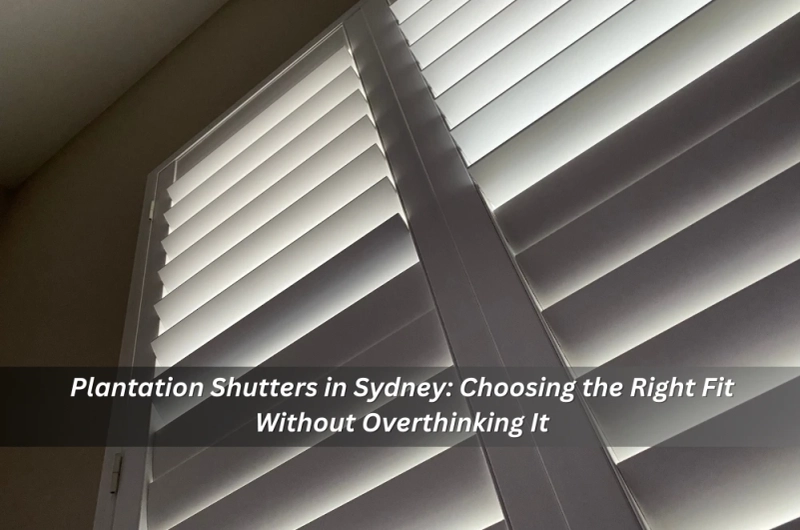
Plantation shutters look straightforward until you’re standing in a hallway with a tape measure, a window winder that sticks out farther than you remembered, and three rooms that all need different things.
They’re popular in Sydney for good reasons: privacy without turning the house into a cave, tidy lines, and a finish that doesn’t flap around in a breeze.
But shutters only feel “high-end” when the choices match real life in the home — how windows open, how the light moves across the rooms, and how much cleaning anyone is honestly going to do.
What plantation shutters are great at (and what they’re not)
Shutters are excellent for daytime privacy while still letting in light. That matters in front rooms, bedrooms that face neighbours, or any place where blinds feel a bit flimsy.
They’re also good when the aim is a cleaner look. No puddling curtains, no cords, no stacking fabric.
The let-down usually comes from expecting shutters to do every job perfectly. They aren’t always true “blackout” in the way heavy curtains can be, and they won’t fix a draughty window frame by themselves.
If the window hardware fights the shutter frame, you’ll notice it every single day.
The decisions that actually matter in Sydney homes
Room-by-room priorities beat “one choice for the whole house”
Living areas often need flexible light control and privacy during the day.
Bedrooms are about early morning light and evening privacy, and bathrooms are basically a humidity test.
Trying to force one material and one mounting style across every room is where projects start to feel compromised.
Sun direction changes the experience
North and west light can be harsh, especially in warmer months when glare creeps across floors and screens.
Louvres help you steer light, not just block it, but they work best when the shutters fit properly and aren’t forced around awkward reveals.
Window function is non-negotiable
Casements, awnings, sliders, bays, and doors all come with their own quirks.
A shutter that looks perfect but gets in the way of a winder handle is the kind of “small” mistake that becomes a daily irritation.
Moisture and cleaning aren’t glamorous, but they matter
If a room gets steamy, or the household wants wipe-and-go cleaning, that should steer material choice more than aesthetics.
Sydney homes vary a lot — newer builds with big bathrooms and older places with tighter ventilation — but moisture doesn’t really care about style preferences.
Lighting at night can surprise people
A crisp white shutter can look amazing in daylight and then a bit stark under warm lighting at night.
Off-whites and softer neutrals can read more consistently if the home has warm LEDs or mixed lighting temperatures.
Timber, PVC, and composites: picking based on reality
Most regrets come from a material choice that didn’t match the room.
Timber can look beautiful and warm, especially in living spaces where it’s part of the design. It’s often the pick for that “classic” feel. The catch is that timber usually asks for a bit more respect around regular steam and dampness.
PVC (and similar moisture-resistant options) tends to shine in bathrooms, laundries, and other wipe-down zones. It can be the most stress-free choice if humidity is a daily thing. The trade-off is that build quality matters — rigidity, finish, and how cleanly it’s made and fitted.
Composites sit in the middle in theory, but “composite” can mean different constructions depending on who’s supplying it. It’s worth clarifying what’s actually being installed, not just what the label says.
A practical approach in a typical Sydney home is mixing materials by room conditions while keeping the finish colour consistent so it still feels cohesive.
Fit and measuring: where most projects win or lose
This is the part people want to rush, and it’s the part that makes shutters feel custom.
Inside mount sits within the window recess. It’s a clean, built-in look — when the recess depth and squareness cooperate.
Outside mount sits on the wall or architrave. It’s more forgiving for older windows or shallow reveals, and it can cover imperfections, but it changes the visual lines and can affect how trims and handles behave.
The big “gotchas” are usually small: winders, protruding tiles, security screens, odd architraves, or a window that isn’t as square as it looks until you measure three points instead of one.
If it helps to check the basics before ordering, the Shutters Australia measuring guide walks through the key measurements and the common obstructions worth spotting early.
Also, don’t assume every window in the same room is identical. Even in newer builds, reveals can vary just enough to matter.
Louvre size and controls: how the room feels day to day
Louvre size changes the vibe more than most people expect.
Wider louvres tend to feel more modern and can give a more open view when angled. Narrower louvres can feel more traditional and can suit smaller windows or more detailed interiors.
Controls matter too. A visible tilt rod is simple and familiar. More minimal control styles can look cleaner, but the best choice is the one people will actually use without fuss.
If a room is about the view — a garden-facing living area, for example — prioritise how “open” the shutters feel when tilted, not only how they look fully closed.
Common mistakes
- Picking a material because it matches the lounge, then installing it in a room that gets daily steam.
- Forgetting that louvres need clearance, then discovering a handle or winder clashes with the frame.
- Measuring once, quickly, and assuming the window is square.
- Choosing a bright white without checking it under warm lighting at night.
- Ignoring flyscreens, security screens, and door clearance until installation day.
- Choosing a control style that looks sleek but becomes annoying in daily use.
Practical Opinions
If privacy is the main driver, nail the fit first and worry about “perfect colour” second.
If a room gets steamy, choose the material that stays stable — it’s the least exciting choice and often the smartest.
If the household is busy, pick the simplest control and cleaning routine that will actually happen.
Local Sydney mini-walkthrough: a sensible way to decide
Start with the rooms that annoy you most: street-facing areas, bedrooms with early sun, and bathrooms with daily showers.
Walk through once in late morning, then again after sunset, and notice where glare and privacy feel hardest.
Measure every window with obstructions in mind — handles, winders, screens, tiles, trims — and take quick photos so nothing is “remembered wrong”.
Choose louvre size based on how open the room needs to feel when angled, not just what looks nice in a sample.
Pick materials based on room conditions first, then align finishes so the whole home still feels like one plan.
Time the project around painting and other finishing work so you don’t end up reinstalling or touching up.
Operator Experience Moment
Most of the smooth installs come from one unglamorous habit: checking how each window opens and what sticks out around it before anyone commits to a mount style. There’s often one “odd” window in a room — a deeper sill, a different winder, a screen that’s been replaced — and catching it early prevents that domino effect of last-minute changes. It’s not about perfection; it’s about avoiding the kind of compromise you notice every morning.
A simple 7–14 day plan (without turning it into a major project)
Days 1–2: Write one line per room about what matters most (privacy, glare, moisture, view, easy cleaning).
Days 3–4: Measure properly and list obstructions, including anything that could interfere with louvre movement.
Days 5–7: Decide material by room conditions, then pick louvre size based on openness and style.
Days 8–10: Check the finish against the room in daylight and at night (especially with warm LEDs).
Days 11–14: Finalise scope and installation timing around painting, flooring, and other trades.
Key Takeaways
- Shutters feel “right” when they match how the room is used, not just a showroom look.
- Measure with obstructions in mind; inside vs outside mount changes everything.
- Choose materials by moisture and sun exposure, then keep finishes consistent for a cohesive feel.
- Louvre size and control style shape how the room looks and works every day.
Common questions we hear from Aussie business owners
Do plantation shutters suit apartments as well as houses?
Usually they do, particularly for privacy and glare in higher-density areas. A practical next step is to confirm clearance around sliding doors and any existing screens before choosing a mount style. In many Sydney apartments, window and balcony door access dictates the design more than aesthetics.
Are plantation shutters blockout for bedrooms?
It depends on fit, mount style, and how sensitive someone is to light. A practical next step is to check the room at night and early morning and decide whether a secondary solution is needed for true darkness. In Sydney, street lighting and early summer sun can make small gaps feel bigger than they are.
What’s the one thing to get right before ordering?
In most cases it’s accurate measuring plus spotting anything that will clash — winders, handles, screens, tiles, trims. A practical next step is to photograph each window open and closed and note the points where movement happens. In older Sydney homes, reveals can be less square than expected, so measuring multiple points helps.
How do you choose timber vs PVC across a mixed home?
Usually it comes down to room conditions and cleaning reality: wet zones and wipe-down areas first, feature rooms second. A practical next step is to categorise rooms into “wet/high-use” and “dry/low-moisture” and choose materials accordingly. In Sydney, bathrooms and laundries (and some coastal-adjacent areas) often benefit from more moisture-tolerant options.