



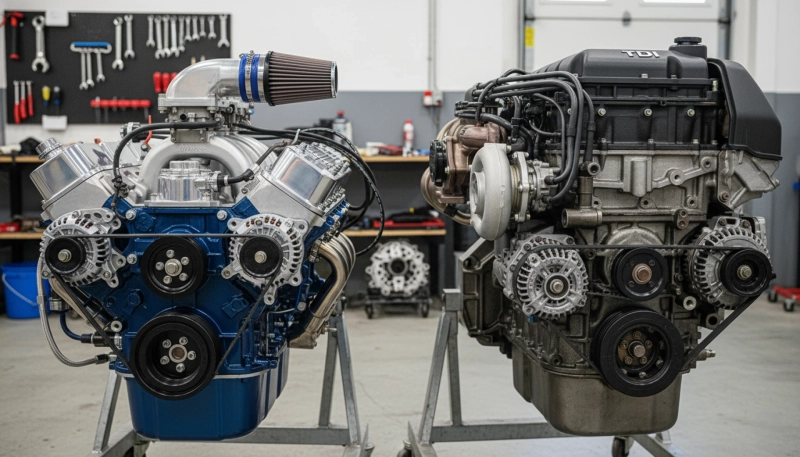
Petrol vs Diesel Engine? a question that still divides buyers, fleet managers, and car enthusiasts. The answer is seldom a simple preference. It depends on how you drive, what you expect from the vehicle, and which compromises you are willing to accept. Below I compare petrol and diesel engines on the mechanics, fuel and thermal physics, real-world performance, maintenance and cost, emissions, and typical use cases. Think of this as a frank, expert conversation over coffee: specific, evidence based, and practical.
How the engines ignite fuel
At the most basic level, petrol engines use spark ignition. A precise mixture of air and petrol is compressed and then ignited by a spark plug. Diesel engines use compression ignition. They compress air to a much higher ratio so that when diesel is injected it ignites under pressure and heat. That difference in how combustion begins drives many of the downstream tradeoffs between the two engine types. Diesel engines typically run at higher compression ratios, which raises thermal efficiency and explains much of diesel’s fuel economy advantage.
Energy in the tank and why it matters
Diesel fuel contains more energy per liter than petrol. Measured by energy density, diesel provides roughly 10 to 15 percent more energy per unit volume. In practice that means, for the same tank size, a diesel vehicle will usually travel farther between fill ups. Energy density alone does not tell the whole story because engine design, gearing, and emissions hardware also influence real-world economy. Still, the higher energy content of diesel is a consistent physical advantage.
Thermal efficiency and torque
Because of higher compression ratios and the leaner combustion mixtures diesel engines extract more usable work from each liter of fuel. That translates into higher thermal efficiency compared to comparable petrol engines. The practical consequence is that diesel engines deliver more torque at low engine speeds. If you tow heavy loads or frequently drive at highway speeds with a full load, diesel’s low end grunt makes life easier and can reduce wear on the transmission and drivetrain. For drivers who mostly do short, urban trips the diesel torque advantage is less meaningful and the higher complexity of diesel after-treatment systems can become a drawback.
Real-world fuel economy and total CO2
It is tempting to assume that better fuel economy always means lower carbon emissions. The reality is more nuanced. On a liter per 100 kilometers basis diesel cars frequently consume less fuel than petrol cars. But diesel fuel contains more carbon per liter, so the CO2 emitted per liter is slightly higher. Depending on vehicle design and driving cycle a modern petrol car can sometimes match or even beat a diesel on real world CO2 figures. That is one reason manufacturers have been able to deliver very efficient petrol engines and hybrids that rival diesels for running costs and emissions in everyday driving. For a buyer choosing between the two, look at real-world or independent test figures for the exact models you are considering rather than relying on fuel type alone.
Pollutants that matter: NOx and particulates
Diesel engines historically produce more nitrogen oxides and particulate matter than petrol engines. Those pollutants have immediate public health consequences in cities, which is why urban regulators have targeted diesels with restrictions and low emission zones. Modern diesel cars use particulate filters and selective catalytic reduction systems that inject urea to cut NOx dramatically. These systems work well when the vehicle is used as intended, on longer runs that keep exhaust temperatures high, but they add cost, complexity and periodic servicing requirements. Petrol engines produce less NOx and far fewer solid particulates, although direct injection petrol engines can still make fine particulates under some conditions. If you live or drive primarily in dense urban environments with lots of stop start traffic, the particulate and NOx profile of diesels is a real practical consideration.
Maintenance, reliability and lifecycle costs
Diesel engines are robust by design. Their blocks and internal components are typically built to withstand higher pressures and temperatures, and that generally translates into longer lifespans for well maintained diesel powertrains. Examples from commercial and heavy duty applications show diesels lasting hundreds of thousands of miles. That durability does not come for free. Diesel vehicles tend to cost more up front, and modern diesel after-treatment hardware such as diesel particulate filters and SCR catalysts require occasional maintenance and can be expensive to repair or replace if neglected. For owners who do long distances each year the fuel and longevity advantages often outweigh the higher service bills. For low mileage or city-only drivers petrol is often cheaper to own over typical ownership horizons.
Driving feel and refinement
Petrol engines tend to rev more freely, and that contributes to a lighter, more refined driving feel. They are quieter under light load and have historically been preferred in small cars, sports cars and for drivers who enjoy responsiveness across the rev range. Diesel engines are noisier at idle and can feel heavier, but their torque delivery makes them feel powerful at low revs without needing to change gears frequently. Turbocharged petrol engines narrow that gap in mid band torque, which is why many modern petrols feel nearly as usable as diesels in everyday conditions.
When diesel is the right choice
Choose diesel if you regularly do long distances, need towing capacity, carry heavy loads, or want a vehicle intended to run for a long time with heavy use. Fleets, commercial buyers and many long-distance commuters still prefer diesel because of lower fuel bills per kilometer and proven longevity. When calculating total cost of ownership include likely servicing for the particulate filter and SCR system, diesel fuel price differentials in your country, and resale values for the specific model.
When petrol is the right choice
Pick petrol if you drive mostly short daily trips, want lower upfront costs, or want the quiet, crisp feel of a petrol powertrain. Petrol cars typically require simpler maintenance and they are a safer bet in urban economies where diesels face restrictions or higher taxes. Recent developments in petrol technology such as direct injection combined with mild hybrid systems and advanced combustion strategies are closing the fuel economy gap, making petrol a practical and often cheaper choice for many buyers.
Practical tips for buyers
If you are choosing between petrol and diesel, compare real world fuel economy figures for the exact models you are considering. Factor in your annual mileage, typical journeys, resale trends in your market, and local regulations such as low emission zones. If you select a diesel, plan for occasional long runs to help keep the particulate filter clean, and budget for periodic servicing of after-treatment components. For petrol cars consider a turbocharged unit with a mild hybrid assist if you want better economy without diesel complexity.
The future context
Internal combustion engines are not standing still. Manufacturers keep improving petrol engines with techniques that borrow from diesel principles. At the same time diesel is becoming cleaner thanks to better after-treatment. Broader shifts toward electrification and tighter urban emissions policy will change the calculus over the next decade, but for the moment engineers and buyers must still choose between the real, present tradeoffs of petrol and diesel.
Conclusion
Petrol vs diesel engine is not a question of which is universally better, but which is better for you. Diesel wins on torque, energy density and long distance economy. Petrol wins on refinement, lower upfront cost, and simpler maintenance for city and low mileage use. Assess your driving pattern, check independent fuel and emissions tests for the models you like, and make the choice that matches how you actually use the car. If you want, tell me the make and model you are considering and I will pull used and real-world economy figures so you can compare apples to apples.