




In today’s fast-paced digital world, businesses and organizations depend on efficient data transmission more than ever. At the core of high-performance networks lie fiber optic jumpers—essential components that enable rapid, reliable data transfer over long distances. In this article, we explore the types, applications, advantages, and key considerations for installing and maintaining fiber optic jumpers, with a special focus on the high-performing MPO-MPO OM3 variants.

What Are Fiber Optic Jumpers?
Fiber optic jumpers are short, pre-terminated segments of fiber optic cable designed to connect devices like switches, routers, and servers. Their primary purpose is to maintain smooth, uninterrupted data transmission, a critical requirement in data centers, enterprise networks, and other high-demand environments.
Types of Fiber Optic Jumpers
Choosing the right fiber optic jumper depends on connector type, network requirements, and equipment compatibility. Common types include:
- LC Connectors: Compact and ideal for high-density environments, offering excellent space efficiency.
- SC Connectors: Durable and user-friendly, featuring a convenient push-pull mechanism.
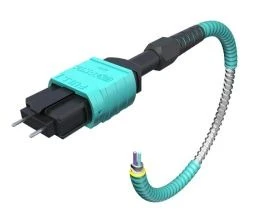
- MPO Connectors: Multi-fiber push-on connectors designed for high-bandwidth applications, perfect for modern data-heavy networks.
- ST Connectors: Bayonet-style connectors often found in legacy systems.
Selecting the right connector type ensures optimal performance and compatibility with your network devices.
Key Cable Specifications
Several technical specifications influence the performance of fiber optic jumpers:
- Core Size: The fiber core diameter directly affects transmission capacity. Multi-mode fibers typically have larger cores than single-mode fibers.
- Fiber Type: Single-mode fibers excel at long-distance transmission, while multi-mode fibers are better suited for shorter-range applications.
- Cable Jacket Material: Protective materials vary; armored jumpers provide additional durability for harsh environments, while non-armored versions work well for controlled settings.
Applications of Fiber Optic Jumpers
Fiber optic jumpers are vital across multiple sectors:
- Data Centers: Facilitate high-density connectivity and reliable data flow.
- Enterprise Networks: Connect critical devices for fast, efficient communication.
- Telecommunications: Support robust voice and data transmission across networks.
Among these, MPO-MPO OM3 jumpers are increasingly favored for high-bandwidth applications due to their speed, efficiency, and reliability.
Advantages of Fiber Optic Jumpers
Fiber optic jumpers offer numerous benefits over traditional copper cabling:
- High Data Transmission Rates: Transmit large volumes of data rapidly, minimizing delays.
- Reduced Latency: Faster response times for applications like cloud computing and real-time collaboration.
- Increased Bandwidth: Handle more data channels to support growing network demands.
- Resistance to Electromagnetic Interference (EMI): Ensure signal integrity even in electrically noisy environments.
Armored variants, including MPO-MPO jumpers, also provide superior protection in demanding conditions, making them ideal for critical infrastructure.
Installation and Maintenance Considerations
Proper installation and maintenance are key to maximizing performance:
- Handle With Care: Avoid bending or twisting fibers excessively.
- Follow Manufacturer Guidelines: Adhere to recommended installation procedures for optimal results.
- Routine Inspections: Regular checks help identify and resolve issues before they disrupt network operations.
These practices ensure longevity, performance, and consistent network reliability.
Conclusion
Understanding fiber optic jumpers—their types, applications, and advantages—is essential for organizations seeking to optimize their network infrastructure. Investing in high-quality jumpers, particularly MPO-MPO OM3 variants, can significantly enhance performance, reliability, and scalability.
With the right fiber optic jumpers in place, your organization can achieve efficient, high-speed data transmission, supporting seamless communication and future-proofing your network in an increasingly data-driven world.