



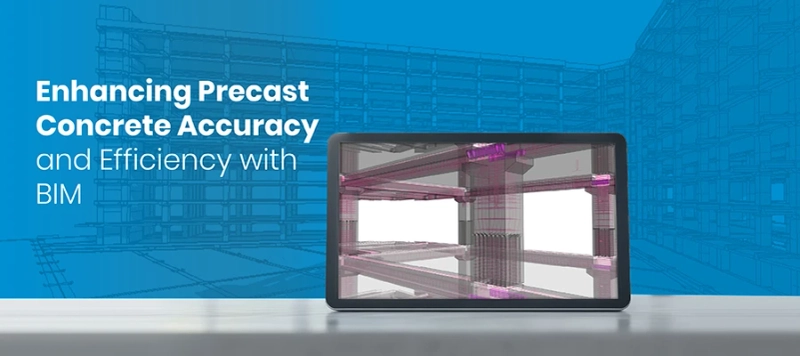
Precast concrete includes casting concrete members in an offsite and controlled environment before moving them to the actual construction site. It provides improved quality control, expedited construction timelines and mitigated on-site labor expenses. Precast members are critical in creating high-performance buildings driven by strength, durability and flexibility.
Legacy precast design leads to various obstacles, including limited design flexibility, coordination problems, and material waste, which impede efficiency. Extended lead times and on-site integration issues arise due to traditional processes. Greater labor costs and variability in quality control complicate precast production. These issues emphasize the requirement for precast concrete detailing.
BIM combines every aspect of a construction project, which includes planning, design and construction. BIM enables real-time collaboration, faster coordination and enhanced visualization for the complete project. It helps reduce conflicts, enhances accuracy and augments resource allocation for the entire lifecycle.
How BIM integrates with precast concrete workflows
BIM in precast concrete includes detailing, design, fabrication and construction by generating smart 3D models driven by accurate material and geometrical data. 3D parametric modeling automates reinforcement detailing, embed placements, and connection points to ensure fabrication accuracy.
BIM software, like Revit, integrates with CNC machines and formwork automation to reduce manual input issues. Clash detection tools are applied to precast concrete modeling to flag design issues and mitigate rework and modifications that could happen during construction. Moreover, BIM-enabled scheduling connects production timelines with site needs, optimizes logistics, and reduces storage requirements for on-time delivery of precast members.
Key benefits of BIM adoption in precast concrete projects
BIM benefits for precast concrete include improved coordination, greater precision, and higher efficiency for the entire lifecycle, across planning, design, fabrication and construction.
- Higher accuracy and precision in design and prefabrication
- Improvements in material utilization and lower waste
- Seamless coordination between various teams
- Automated error detection to reduce rework and costs
- Real-time tracking for greater quality control
- 5D BIM for accurate budgeting
- Faster production cycles and enhanced scheduling
Enhancing accuracy with BIM in precast concrete
BIM improves accuracy in precast concrete through detailed 3D models that lead to accurate prefabrication and installation. It mitigates errors using real-time coordination and interference detection,which ensures precast members fit accurately and align with design specifications.
Use of BIM for detailed precast component Revit modeling
BIM integration in precast concrete enables accurate 3D modeling of precast members, while including reinforcement details, material attributes, and dimensional specifications. This method provides accurate prefabrication instructions, connects workflows and removes ambiguities between design and construction for precast production.
Reduction of errors through digital prototypes
Advanced modeling of precast elements helps precast manufacturers simulate behavior in virtual space. This ensures accurate alignment and fitment with design needs. This approach helps with quick detection of structural and dimensional errors while lowering defects and ensuring a greater level of fabrication accuracy.
Identifying and resolving design conflicts before manufacturing using Revit and Navisworks
Revit and Navisworks enable the use of integrated workflows by flagging design conflicts between architectural, structural and MEP components before physical fabrication begins. Performing interference detection and resolution in digital space helps teams address issues in the preconstruction phase. This leads to the seamless production and installation of precast concrete elements.
Reducing costly modifications and rework on-site
Digital precast concrete solutions help coordinate models in virtual spaces, which prevents design discrepancies during on-site construction. Quick identification of issues and errors mitigates the need for rework and modifications, which ensures adherence to schedules and budgets.
BIM-driven automation, including Dynamo, ensuring compliance with industry standards in Revit
Dynamo automation scripts within Revit refine repetitive design tasks while adhering to industry standards. These scripts help with dynamic updates of reinforcement layouts, accurate material specifications, and precise geometry. This guarantees precision, consistency and compliance with regulatory needs across every precast component.
Improved accuracy in material estimation and specifications
BIM fosters precise material takeoffs by connecting 3D models to comprehensive member specifications in Revit. This integration enhances quantity estimation, ensures accurate material ordering, and lowers waste while delivering updated costs and specification data for improved project planning.
Improving efficiency in precast concrete with BIM
BIM for Precast Concrete leads to streamlined precast production by automating the design and fabrication. This leads to lower manual intervention and error mitigation. It improves coordination, expedites production schedules, and ensures project-wide integration during design, manufacturing and construction to enhance project workflows.
How Revit BIM facilitates automated fabrication workflows
Advanced modeling for precast members using Revit is reinforced with fabrication software to achieve detailed precast member creation and to link 3D models to robotic systems and CNC machines. This lowers manual design intervention, speeds up production workflows, and ensures greater accuracy in fabrication and assembly.
Reducing material waste and enhancing manufacturing efficiency with structural concrete modeling
BIM in precast concrete modeling improves material use through accurate dimensioning and in-depth reinforcement layout creation. This mitigates material waste and improves production efficiency by making the fabrication process seamless, to ensure every precast member is produced according to specifications.
BIM’s role in scheduling, transportation and just-in-time delivery
BIM aids precast manufacturing firms with accurate scheduling by connecting production schedules with real-time data on transport, manufacturing and site needs. This leads to faster handovers, reduces storage costs, and ensures every precast concrete member is delivered when required for effective on-site assembly.
Reduction of project timelines with BIM-driven scheduling
BIM-led scheduling using 4D enables real-time monitoring of project progress and adjusts schedules based on prefabrication and installation. Using Navisworks, teams can utilize tools like the Timeline for a complete visualization of project schedules,which leads to quick decision-making and completion of precast concrete.
Financial benefits of minimizing rework and material wastage
The use of BIM reduces rework and material waste by delivering precise, data-driven precast models that ensure faster manufacturing and assembly. 5D cost estimation capabilities link cost data to the 3D precast model, which enables real-time cost monitoring, the overuse of materials, and streamlining production that results in cost savings.
Challenges and solutions in implementing BIM for precast concrete
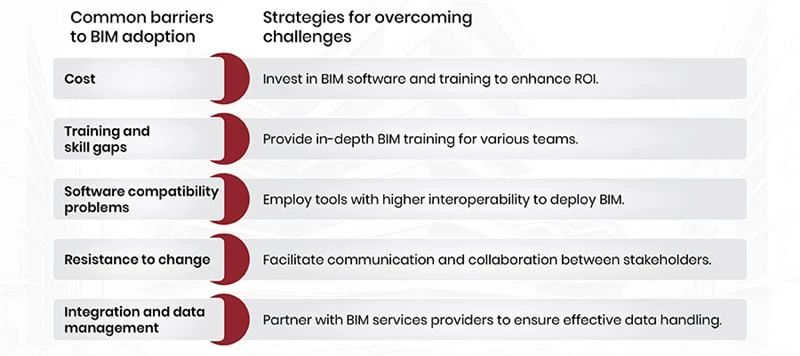
Implementing BIM for precast concrete is challenging based on integration complexities, information management issues and the requirement for skilled personnel. Solutions to overcome these challenges include the adoption of standardized protocols, investment in training, and the use of interoperable tools to streamline workflows and improve collaboration across various teams.
Conclusion
BIM plays an important role in improving the accuracy and efficiency of precast concrete. 3D modeling, automated workflows, and improved collaboration help precast manufacturers reduce manufacturing errors, enhance material use, and refine schedules, which leads to quick project delivery, reduced costs, and improved outcomes in precast design and construction.