



OLED displays have reshaped expectations around image quality, power consumption, and mechanical flexibility across modern display systems. Unlike traditional architectures that rely on external illumination, OLED technology produces light at the pixel level. This fundamental difference allows displays to achieve deeper contrast, faster response times, and greater freedom in form factor design.
As OLED technology matures, it is increasingly evaluated not only for consumer electronics but also for industrial, medical, and mission-critical environments. Understanding how self-emissive pixels work and how they influence performance characteristics helps clarify where OLED excels and where careful engineering decisions are required.
What Is an OLED Display?
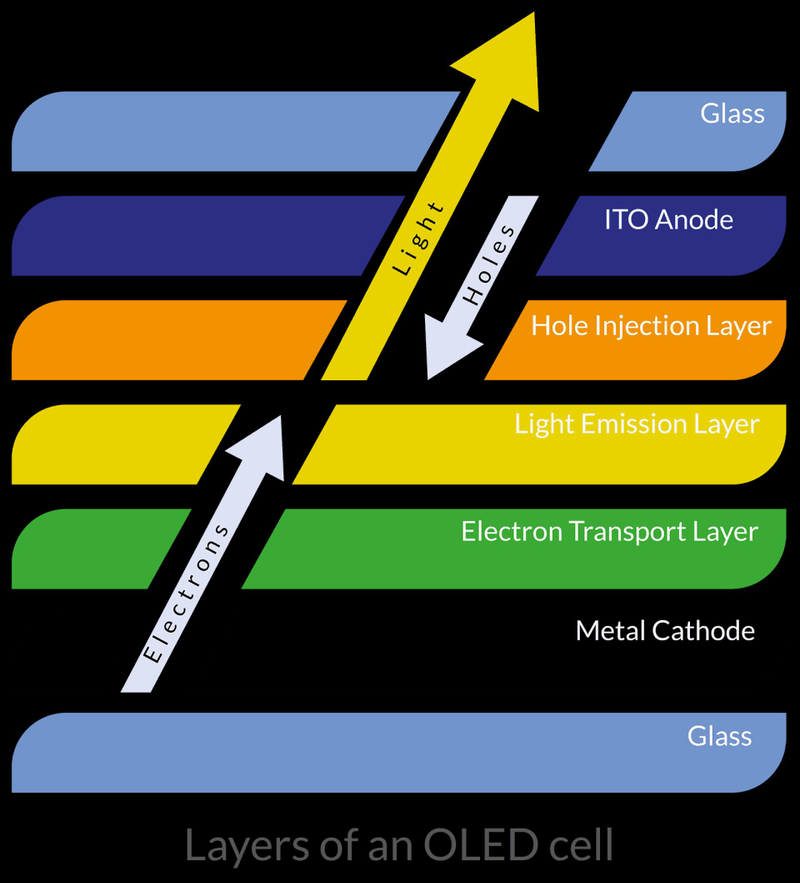
An OLED display uses organic light-emitting diodes, in which each pixel emits its own light when electrically driven. Unlike LCDs, OLEDs do not require a backlight or light guide. This direct emission model simplifies the display stack while enabling unique optical and mechanical properties.
OLED panels can be manufactured in various configurations, including rigid glass-based structures and flexible substrates, supporting a wide range of integration possibilities.
How Self-Emissive Pixels Work
Self-emissive pixels are the defining feature of OLED technology. Each pixel contains organic compounds that emit light when current passes through them. Brightness and color are controlled at the pixel level, allowing precise modulation of luminance and color output.
When a pixel is turned off, it emits no light. This capability directly enables actual black levels and high contrast ratios without reliance on backlight dimming techniques.
OLED Displays vs LCD Displays: Architectural Differences
LCDs depend on a constant backlight that passes through liquid crystal layers to form an image. Even dark scenes require active backlighting. OLED displays eliminate this dependency, replacing it with pixel-level emission.
This architectural difference reduces stack complexity, improves optical efficiency, and removes several failure points associated with backlight components.
Contrast and Black Levels in OLED Displays
Because inactive pixels emit no light, OLED displays achieve near-infinite contrast ratios. Black areas remain truly black rather than appearing gray due to backlight leakage. This characteristic is especially valuable in applications where subtle visual details and depth perception are important.
High contrast also improves readability in low-light environments and enhances overall image clarity.
Color Performance and Viewing Angles
OLED displays maintain consistent color and brightness across wide viewing angles. Without reliance on light diffusion or polarizer alignment, color shift is minimal even at extreme angles. This makes OLED suitable for multi-viewer environments and angled installations.
Color reproduction benefits from direct pixel emission, enabling rich, saturated colors with accurate tonal control.
Response Time and Motion Performance
OLED pixels respond significantly faster than liquid crystal elements. Rapid on-off switching minimizes motion blur and ghosting, supporting smooth transitions and high-refresh-rate operation. This advantage is particularly noticeable in dynamic interfaces and motion-heavy content.
Fast response times also reduce latency in interactive systems.
Power Consumption Characteristics of OLED Displays
OLED power consumption depends heavily on the displayed content. Dark images consume very little power since inactive pixels draw no current. Bright, full-screen content increases power consumption in proportion.
This behavior differs from LCDs, where backlight power remains relatively constant regardless of content. In applications with predominantly dark interfaces, OLED can offer meaningful power savings.
Form Factor and Mechanical Design Advantages
The absence of a backlight allows OLED displays to be thinner and lighter than comparable LCDs. Flexible substrates further expand mechanical design options, supporting curved, conformal, or space-constrained installations.
These characteristics are particularly valuable in compact systems and designs where depth and weight are critical constraints.
OLED Displays in Low-Light and Night-Mode Applications
OLED technology performs exceptionally well in low-light environments. True black levels prevent unintended light emission, reducing glare and preserving night vision. This makes OLED suitable for medical devices, control panels, and systems operating in dark or dim conditions.
Brightness control at the pixel level enables fine-grained luminance management without sacrificing contrast.
Environmental and Reliability Considerations
Environmental performance depends on encapsulation quality and material selection. OLED materials are sensitive to moisture and oxygen, requiring robust sealing for long-term reliability. Temperature behavior must also be carefully managed, particularly in wide-temperature applications.
With proper engineering, OLED displays can achieve stable performance across demanding operating conditions.
OLED Displays in Industrial and Mission-Critical Applications
Industrial and mission-critical environments value OLEDs for their high contrast, fast response times, and flexible form factors. Applications include medical imaging, avionics displays, portable instruments, and advanced human-machine interfaces.
In these settings, OLED display modules are often customized for brightness levels, interface requirements, and environmental protection.
Limitations and Trade-Offs of OLED Displays
Despite their advantages, OLED displays present trade-offs. Peak brightness may be lower than some high-output LCDs, particularly for sustained full-screen white content. Long-term luminance degradation must also be managed through design and usage patterns.
These factors require careful evaluation during system specification.
OLED Displays vs Emerging Display Technologies
OLED competes with emerging technologies such as MicroLED. While MicroLED promises high brightness and durability, manufacturing complexity and cost currently limit widespread adoption. OLED remains a more accessible solution for many high-performance applications.
When OLED Displays Are the Right Choice
OLED displays are well-suited for applications that prioritize contrast, fast response times, thin form factors, and controlled power consumption. Systems with dark user interfaces, low-light operation, or space constraints often benefit most from OLED integration.
Custom OLED displays allow further optimization for specific use cases, aligning performance with system-level requirements.
How Self-Emissive Pixels Redefine Display Performance
Self-emissive pixel architecture fundamentally changes how displays handle contrast, motion, and mechanical integration. With thoughtful engineering, OLED technology delivers performance advantages that are difficult to replicate with traditional display architectures. E3 Displays designs and integrates OLED solutions tailored for industrial, medical, and mission-critical applications.
Partnering with E3 Displays ensures that advanced OLED implementations, including transparent OLED display technologies, are engineered for reliability, clarity, and long-term performance.