


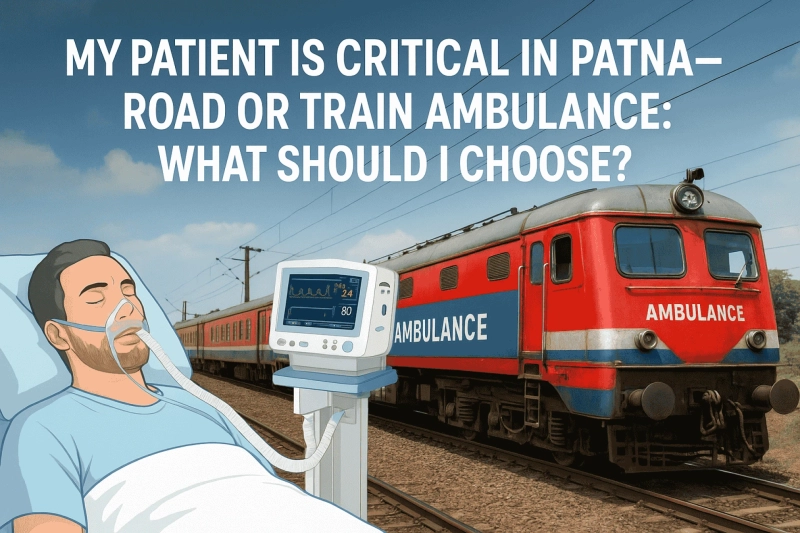
When a loved one is lying on a hospital bed in Patna and doctors suggest shifting them to a better-equipped hospital in another city, everything suddenly feels overwhelming. You may hear names like Delhi, Kolkata, or Mumbai. Time feels limited. Family members are anxious. Everyone is asking questions, but no one seems to have clear answers.
One of the biggest confusions families face at this moment is deciding how to move the patient safely.
Should you choose a road ambulance immediately, or is a train ambulance service in Patna a better option?
If you are going through this situation right now, you are not alone. Thousands of families in Patna face this same dilemma every year.
When Panic Meets Decision-Making
In an emergency, our instinct is to act fast. Road ambulance often feels like the quickest solution because it is familiar and immediately available. But when the distance is long and the patient is critical, speed alone should not guide the decision.
At this stage, families usually struggle with thoughts like:
- What if the patient’s condition worsens on the way?
- Will oxygen or monitoring be enough during the journey?
- Is train travel even safe for a critical patient?
- What if traffic causes delays?
These concerns are completely valid, and they deserve straightforward, honest explanations.
The Patient’s Condition Matters More Than the Distance
Before choosing between a road ambulance and a train ambulance, it is important to understand one thing clearly: the patient’s medical condition comes first.
Ask yourself or the treating doctor:
- Is the patient on oxygen or ventilator support?
- Do they need continuous monitoring of vitals?
- Are there chances of sudden complications?
- Can the patient tolerate long hours of travel?
For stable patients traveling short distances, road ambulance works well. But for critical patients who need constant medical care over long distances, the mode of transport can make a big difference.
Why Road Ambulance Feels Like the Obvious Choice
Road ambulances are familiar and easily accessible. For local transfers within Patna or nearby districts, they are often the right option.
Families usually prefer road ambulances because:
- They can be arranged quickly
- No dependency on train schedules
- Suitable for short or medium distances
However, when the journey involves 800–1200 kilometers or more, the challenges start to appear.
The Hidden Risks of Long-Distance Road Ambulance Travel
Long road journeys can be physically exhausting for a patient, especially one in a critical condition. From Patna to cities like Delhi or Mumbai, road travel can take 15 to 20 hours or even longer.
Some common challenges include:
- Traffic congestion and unpredictable delays
- Continuous vibrations and jerks on highways
- Limited space for medical staff to manage emergencies
- Fatigue affecting both patient and caregivers
For patients requiring intensive care, these factors increase risk, even if the ambulance is well-equipped.
Why Doctors Often Suggest Train Ambulance for Long Distances
This is where Train Ambulance Service in Patna becomes a preferred option for many doctors and families.
A train ambulance is not about speed alone—it is about stability, safety, and continuity of care.
Rail travel offers:
- Smooth and steady movement compared to highways
- Less physical stress on the patient
- Adequate space for medical equipment and staff
- Better environment for monitoring and medical intervention
For patients who need long-distance transfer with medical supervision, train ambulances provide a balanced and safer solution.
What Happens During an ICU Train Ambulance Transfer?
Many families hesitate because they do not understand how the process works. Once you know the steps, the fear reduces.
In an ICU Train Ambulance Service in Patna, the process usually includes:
- Patient pickup from hospital or home in an ICU-equipped road ambulance
- Safe transfer to the railway station with medical supervision
- Shifting the patient on a stretcher into a reserved AC coach
- Round-the-clock observation of oxygen saturation, heart function, and vital signs throughout the journey
- Medical staff managing medications and emergency needs during the journey
- Ambulance waiting at the destination station for hospital transfer
The patient remains under medical care throughout the journey, just like in a moving ICU setup.
Road Ambulance vs Train Ambulance: Which Is Safer for Your Patient?
Instead of thinking in terms of “fast” or “slow,” think in terms of risk reduction.
Road ambulance is usually suitable when:
- The distance is short
- The patient is stable
- No intensive monitoring is required
Train ambulance is often better when:
- The journey is long and overnight
- The patient is critical or on ventilator
- Continuous medical care is needed
- Comfort and stability are priorities
This is why many families searching for the best train ambulance service in Patna are actually looking for peace of mind, not just transport.
A Situation Many Families Can Relate To
Consider a common scenario. A patient in Patna suffers a serious medical complication and needs advanced treatment in Delhi. Initially, the family plans a road ambulance, thinking it will be quicker. However, after discussing with doctors, they realize that 18 hours of road travel may strain the patient.
They opt for a Train Ambulance in Patna, ensuring stable movement, proper medical supervision, and less physical stress. The patient reaches the destination safely and continues treatment without complications.
- This kind of decision often makes a real difference.
- The Most Important Question You Should Ask Yourself
At this moment, the most important question is not:
“How fast can we reach?”
It is:
“Which choice will protect my patient’s health and stability throughout the entire journey?”
When you look at the situation from this perspective, the choice often becomes clearer.
You Don’t Have to Decide Alone
If you are unsure, speak to medical professionals who understand patient transfer needs. Discuss the patient’s condition honestly and ask what option minimizes risk.
Choosing the right Train Ambulance Service in Patna is not about rushing—it is about making an informed decision during a stressful time.
Final Thoughts for Families Facing This Tough Choice
Making decisions for a critical patient is emotionally draining. Every family wants to do what is best, and confusion is natural. There is no one-size-fits-all answer for every situation.
But when long-distance travel and critical care are involved, train ambulances often offer a safer, more controlled environment for the patient.
If you are looking for the best train ambulance service in Patna, focus on experience, medical support, and coordination—not just availability.
Your decision today can play a vital role in your loved one’s recovery tomorrow.