



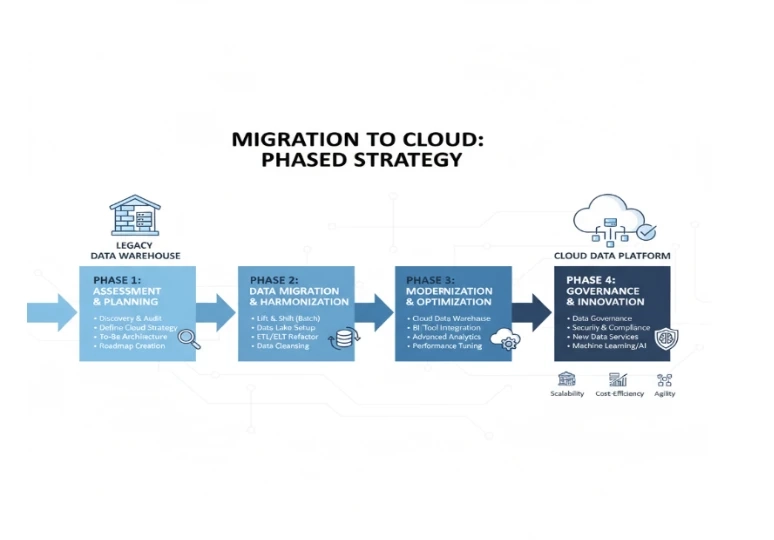
Most businesses today are sitting on years of data stored in old, rigid systems. These legacy data warehouses were once powerful, but now they slow things down. They’re expensive to maintain, hard to scale, and can’t keep up with modern analytics or AI needs.
That’s why more organizations are moving their data warehouses to the cloud — to gain flexibility, speed, and long-term savings. But cloud migration isn’t simple. It takes careful planning, smart execution, and strong data governance to get it right.
Here’s what real-world projects have taught companies about what works — and what doesn’t.

Why Companies Are Moving to the Cloud?
1. Faster Insights and Better Performance
Traditional warehouses like Oracle, SQL Server, or Teradata often struggle with large datasets. Cloud platforms such as AWS Redshift, Snowflake, or Azure Synapse deliver results faster because of their modern, scalable design.
For example, a healthcare analytics firm reported 35% faster query speeds and 50% faster dashboard refresh times after moving to Snowflake.
2. Lower Costs and Easier Scaling
On-premise systems need constant upgrades and expensive maintenance. Cloud platforms replace this with a pay-as-you-go model, so you only pay for what you use.
One financial services company saw a 45% drop in infrastructure costs and 30% quicker reporting cycles after shifting from Oracle to AWS.
3. Ready for AI and Advanced Analytics
Legacy systems can’t easily support machine learning or real-time analytics. Cloud data platforms integrate with AI tools like AWS SageMaker or Azure ML, making it easier to turn raw data into predictive insights.

Common Challenges During Migration
Migrating to the cloud isn’t just about copying data over. It often reveals hidden complexities. Here are a few of the biggest hurdles:
1. Old and Complex Systems
Legacy warehouses often have years of outdated scripts, old data formats, and undocumented code. One company moving from SQL Server to Azure had to rework 390 tables and 115 stored procedures, delaying the project by several weeks.
2. Data Accuracy Issues
When billions of records move from one system to another, even small mismatches can create big problems. Manual checks are slow and unreliable. Automated testing helps — one Netezza-to-Snowflake project used automation and finished testing 4.8x faster, with zero major defects.
3. Risk of Downtime
If the migration isn’t planned carefully, critical dashboards and reports may stop working temporarily. Running both systems in parallel during migration helps reduce this risk.
4. Internal Resistance
Teams used to on-prem tools may be hesitant to change. Training and clear communication are key to getting everyone on board.
What Successful Cloud Migrations Have in Common?
1. Start Small, Then Scale Up
Avoid the “big bang” approach — don’t move everything at once. Instead, migrate one area or business domain at a time.
A global retail company started with its inventory data, then moved sales and customer analytics. Each step-built confidence and delivered visible results.
2. Use the 6 R’s Framework
Every application doesn’t need the same approach.
- Rehost: Move as-is (“lift and shift”).
- Replatform: Make small changes for better performance.
- Refactor: Rebuild for full cloud capabilities.
- Retire or Retain: Drop or keep systems based on business need.
This method keeps costs low and avoids unnecessary rework.
3. Automate Data Testing
Manual validation is time-consuming and error prone. Automating checks for schema, row counts, and aggregates saves time and ensures quality.
For example, Hexaview implemented automated testing for a financial client moving 12 TB of data — reducing validation time by 60% and maintaining complete accuracy.
4. Focus on Security from Day One
Cloud doesn’t automatically mean secure. Encryption, access controls, and data lineage should be built in from the start.
A large insurance company migrating to Azure Synapse used private endpoints and role-based access to stay fully compliant with GDPR regulations.
5. Test with a Proof of Concept (PoC)
A PoC is a small, controlled project that validates your migration plan. It helps uncover hidden issues before full rollout.
One logistics firm ran a 12-week PoC to migrate an 800 GB SQL Server warehouse to Azure. The result? Reports ran 65% faster, and data access became seamless across teams.
What Businesses Gain After Migration?
When done right, cloud migration delivers measurable results. Real-world examples show:
- 40% reduction in infrastructure costs
- 20–30% faster data processing and reporting
- Real-time analytics through streaming pipelines
- Better SLA compliance and fewer outages
In one case, a manufacturing company built a real-time production dashboard using AWS Glue and Redshift, predicting machine failures before they happened and saving millions in downtime.

Key Takeaways from Real Projects
- Don’t treat migration as simple “lift and shift.” Plan to re-engineer parts of your system for better cloud performance.
- Expect delays from large data transfers — plan buffer time.
- Keep projects agile with short cycles and small wins.
- Have strong executive sponsorship to maintain support when challenges arise.

Moving Forward with Hexaview Technologies
Migrating to the cloud isn’t just an IT upgrade — it’s a business transformation. It opens the door to faster insights, better decision-making, and innovation at scale.
At Hexaview Technologies, we help enterprises modernize their data ecosystems through:
- End-to-end data assessment and modernization
- Automation-first migration and validation frameworks
- Built-in security and compliance practices
- Deep expertise in AWS, Azure, Snowflake, and Databricks platforms
With Hexaview, you don’t just move your data — you move your business forward.