



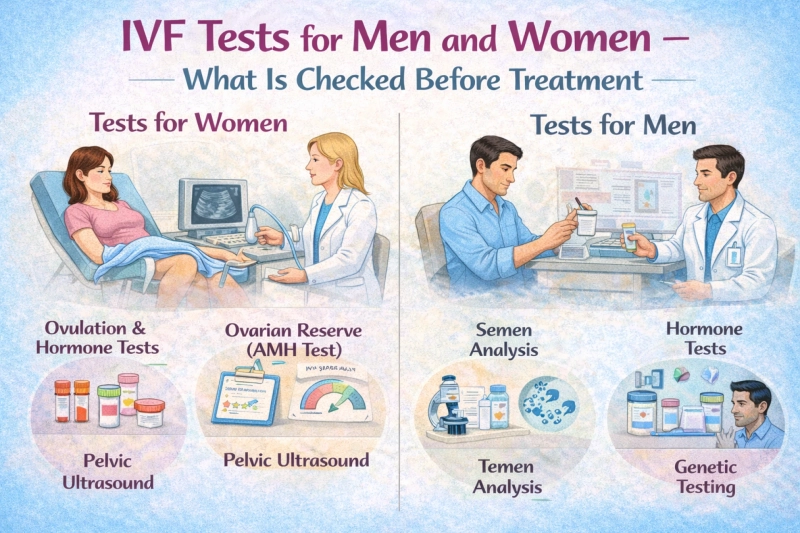
Before starting IVF treatment, many couples hear one word again and again — tests. Blood tests, scans, reports, semen analysis. This phase can feel confusing and sometimes scary. Some couples worry, “Why so many tests?” or “What if something serious is found?”
In reality, IVF tests are not meant to find faults. They are done to understand your body better, plan treatment correctly, and avoid unnecessary trial and error. Think of them as a roadmap before starting an important journey.
This guide explains what tests are done for men and women before IVF, and why each one matters.
Why Are IVF Tests Necessary?
IVF is not a one-size-fits-all treatment. These tests help doctors:
- Identify the cause of infertility
- Understand egg and sperm health
- Check hormone balance
- Plan the right IVF protocol
- Improve success chances
- Avoid avoidable complications
A Trusted Fertility centre in Bangalore focuses on doing only the required tests, not unnecessary ones, and explains everything clearly to the couple.
IVF Tests for Women
1. Hormone Blood Tests
Hormone tests are usually done on specific days of the menstrual cycle. These help doctors understand how the ovaries and hormones are functioning.
Common hormone tests include:
- AMH (Anti-Müllerian Hormone) – shows ovarian reserve (egg quantity)
- FSH & LH – indicate how the ovaries respond
- TSH (Thyroid test) – thyroid imbalance can affect fertility
- Prolactin – high levels may disturb ovulation
- Estrogen & Progesterone – hormone balance
These results help doctors decide medication dosage and IVF strategy.
2. Ultrasound Scan (Pelvic Scan)
A vaginal ultrasound scan is done to check:
- Uterus shape and lining thickness
- Ovaries and follicle count
- Fibroids, cysts, or polyps
This scan is painless and plays a major role in IVF planning.
3. Infection Screening
Blood tests are done to rule out infections such as:
- HIV
- Hepatitis B
- Hepatitis C
- Syphilis
These tests are mandatory for safety and legal reasons before IVF treatment.
4. Uterine Evaluation (If Required)
If there is a history of miscarriage, implantation failure, or abnormal scans, doctors may advise:
- Hysteroscopy
- Sonohysterography
These tests check if the uterus is healthy enough for embryo implantation. Not every woman needs them — only when necessary.
5. General Health Tests
Some additional tests may be done to check overall health:
- Hemoglobin (to rule out anemia)
- Blood sugar levels
- Vitamin deficiencies
General health directly affects IVF outcomes.
IVF Tests for Men
1. Semen Analysis (Most Important Test)
This is the main fertility test for men. It checks:
- Sperm count – number of sperm
- Motility – how well sperm move
- Morphology – sperm shape
Even if results are low, it does not mean IVF won’t work. It helps doctors decide whether IVF or ICSI is more suitable.
2. Sperm DNA Fragmentation Test (If Advised)
This test checks the quality of sperm DNA and is usually advised when:
- There are repeated IVF failures
- Recurrent miscarriages have occurred
It is not needed for everyone.
3. Hormone Tests (In Some Cases)
If sperm count is very low, doctors may suggest hormone tests such as:
- Testosterone
- FSH
- LH
These help identify hormonal causes of male infertility.
4. Infection Screening
Just like women, men are also tested for:
- HIV
- Hepatitis B & C
This ensures safety during IVF procedures.
Do All Couples Need All These Tests?
No. IVF testing is personalised.
Some couples may only need basic tests, while others may need additional evaluation based on:
- Age
- Medical history
- Duration of infertility
- Previous treatment results
A Trusted Fertility centre in Bangalore will always explain why a test is needed instead of ordering everything at once.
Are IVF Tests Painful?
Most tests involve:
- Blood samples
- Ultrasound scans
- Semen sample
They are not painful, just mildly uncomfortable at times. Doctors usually plan tests in a way that reduces stress and repetition.
How Long Does the Testing Phase Take?
Most IVF tests are completed within:
- 1 to 2 menstrual cycles
Once done, many reports remain valid for several months, so tests usually don’t need to be repeated unless necessary.
Emotional Side of IVF Testing
The testing phase can be emotionally heavy. Reports may bring anxiety, fear, or self-blame.
It’s important to remember:
- A report is information, not a judgment
- Test results guide treatment — they don’t define you
- Many fertility issues are treatable with IVF
Support from doctors and your partner makes a big difference during this phase.
Questions Couples Should Ask Their Doctor
Don’t hesitate to ask:
- What does this test result mean for IVF?
- Does this affect success chances?
- Can this be improved?
- Are all these tests necessary now?
Clear communication reduces unnecessary worry.
Final Thoughts
IVF tests are the foundation of safe and effective treatment. They help doctors understand your body, plan the right approach, and avoid unnecessary procedures later.
Instead of fearing tests, see them as preparation — a way to start IVF with clarity and confidence.
Choosing a Trusted Fertility centre in Bangalore ensures that testing is done with care, transparency, and respect for your emotional well-being.
Take it one step at a time. You are not being tested — your journey is being planned.