



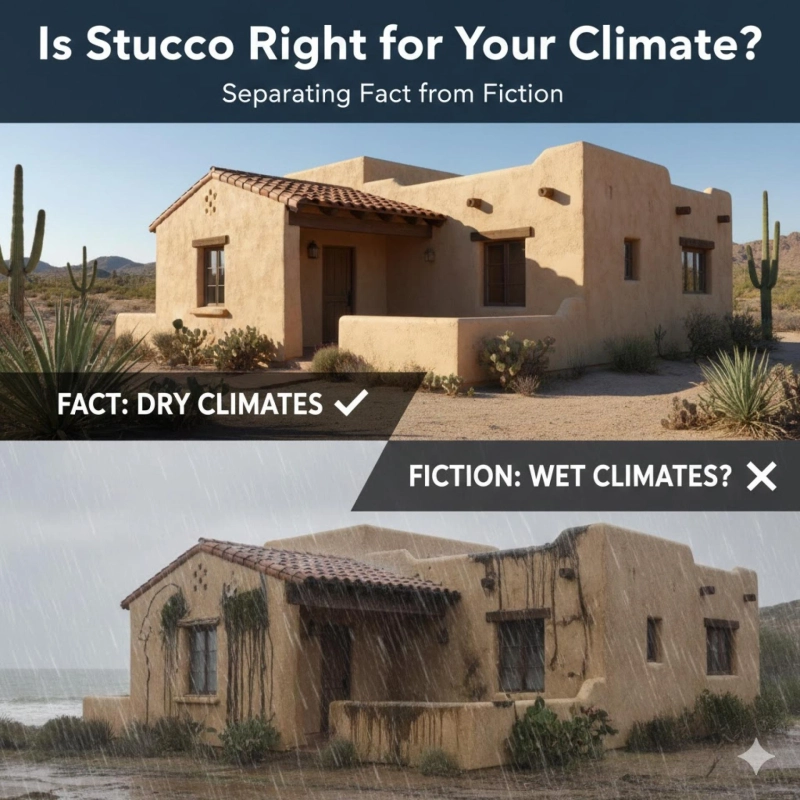
Stucco has been used as a building material for centuries, yet it remains one of the most misunderstood exterior finishes today. Some homeowners swear by it, praising its durability and timeless appearance. Others avoid it entirely, convinced it will crack, trap moisture, or fail miserably in their climate. So what’s the truth?
If you’ve ever wondered whether stucco is right for your climate, you’re not alone. This question comes up constantly among homeowners, builders, and designers alike. The short answer? Stucco can work in many climates—but only when done correctly. The long answer is exactly what we’ll unpack in this in-depth guide.
In this article, we’ll separate fact from fiction, explore how stucco performs in different environments, and help you decide whether it’s the right choice for your home—no matter where you live.
What Is Stucco, Really?
Before we talk climate, it’s important to understand what stucco actually is.
Traditional stucco is a cement-based exterior finish made from Portland cement, sand, lime, and water. It’s applied in multiple layers over a solid substrate, creating a hard, durable shell once cured.
Modern variations include:
- Traditional (cement-based) stucco
- Synthetic stucco (EIFS – Exterior Insulation and Finish Systems)
While these two systems look similar, they behave very differently—especially when it comes to moisture and climate performance. Many stucco horror stories stem from confusing these two systems.
Key takeaway: Not all stucco is the same, and climate performance depends heavily on the type used and how it’s installed.
Why Climate Matters So Much for Stucco
Stucco isn’t a “set it and forget it” material. It responds to:
- Temperature fluctuations
- Humidity levels
- Rain and snow exposure
- Freeze-thaw cycles
- Solar heat and UV exposure
When stucco fails, it’s rarely because stucco itself is bad. It’s usually because:
- The system wasn’t designed for the local climate
- Moisture management was poor
- Expansion and contraction weren’t accounted for
- Installation shortcuts were taken
Understanding how stucco interacts with your local environment is the difference between a façade that lasts 50+ years and one that fails prematurely.
Myth #1: Stucco Is Only Good for Dry, Warm Climates
This is one of the most common misconceptions—and it’s only partially true.
The Reality
Stucco originated in dry Mediterranean climates, which is why it’s so common in the Southwest. However, modern stucco systems can perform well in many regions, including colder and wetter areas, when properly designed.
What matters most is:
- Drainage
- Vapor permeability
- Proper detailing around windows, doors, and rooflines
Stucco isn’t limited to deserts—it just needs smarter installation elsewhere.
Stucco in Hot and Dry Climates
Why Stucco Thrives Here
Hot, arid regions are where stucco truly shines.
Benefits include:
- Excellent resistance to UV exposure
- Minimal moisture-related issues
- Natural breathability
- Long lifespan with minimal maintenance
In places like the Southwest, stucco’s ability to reflect heat and resist sun damage makes it a top-tier choice.
Potential Concerns
- Hairline cracking from thermal expansion
- Fading if low-quality pigments are used
Both issues are cosmetic and easily managed with proper materials and control joints.
Verdict: Stucco is an excellent choice for hot, dry climates.
Stucco in Humid and Rainy Climates
This is where opinions get heated—and where most myths are born.
The Big Fear: Moisture Trapping
People often claim stucco “traps moisture,” leading to rot and mold. The truth is more nuanced.
Traditional stucco is vapor-permeable, meaning it can breathe. Problems arise when:
- There’s no drainage plane
- Flashing is poorly installed
- Water gets behind the stucco and has nowhere to go
What Works in Wet Climates
- Proper weather-resistive barriers (WRB)
- Drainage mats or rain screens
- Sloped sills and kick-out flashing
- Skilled installation
When these elements are present, stucco can perform just as well as siding or brick.
Verdict: Stucco can work in wet climates—but only with excellent moisture management.
Stucco in Cold and Freezing Climates
Cold climates introduce a new challenge: freeze-thaw cycles.
Why Freeze-Thaw Matters
When water penetrates stucco and freezes, it expands. Over time, this can cause:
- Cracking
- Delamination
- Surface spalling
How Modern Stucco Solves This
- Air-entrained mixes to accommodate expansion
- Proper curing times
- Strategic control joints
- Enhanced drainage systems
Many older stucco failures in cold climates were due to outdated practices—not the material itself.
Verdict: Stucco can succeed in cold climates when designed for freeze-thaw resistance.
Myth #2: Stucco Always Cracks
Let’s clear this up once and for all.
The Truth About Cracking
Yes, stucco can crack—but not all cracks are structural or problematic.
There are two main types:
- Hairline cracks (cosmetic)
- Structural cracks (cause for concern)
Hairline cracks are normal and often caused by:
- Minor settling
- Temperature changes
- Natural curing shrinkage
Proper use of control joints and reinforcement dramatically reduces cracking risks.
Bottom line: Cracking is not a failure—it’s often a normal characteristic.
Traditional Stucco vs. EIFS: Climate Makes the Difference
Many stucco-related climate problems are actually EIFS problems.
Traditional Stucco
- Cement-based
- Breathable
- Better for wet and mixed climates
- More forgiving if moisture enters
EIFS (Synthetic Stucco)
- Foam-based
- Highly insulating
- Less forgiving with water intrusion
- Requires perfect detailing
EIFS can work beautifully—but when it fails, it fails badly. Climate suitability depends heavily on installer expertise.
Pro tip: If you live in a wet or cold climate, traditional stucco is often the safer option.
Myth #3: Stucco Is a High-Maintenance Exterior
Compared to wood siding, stucco is actually low maintenance.
Typical Stucco Maintenance Includes
- Periodic inspections
- Repainting every 10–15 years
- Sealing hairline cracks if needed
There’s no rot, no insects, and no frequent replacement like some siding materials.
Fact: Stucco requires less maintenance than many alternatives over its lifespan.
Energy Efficiency and Climate Performance
Stucco contributes to energy efficiency in several ways:
- Thermal mass helps regulate indoor temperatures
- Reflective finishes reduce heat gain
- EIFS systems provide continuous insulation
In hot climates, stucco helps keep homes cooler. In cooler climates, paired with proper insulation, it helps retain warmth.
Energy efficiency is not just about insulation—it’s about smart material combinations.
How Installation Quality Impacts Climate Performance
This cannot be overstated: installation matters more than climate.
Poor installation can doom stucco in any environment, while expert workmanship can make it thrive almost anywhere.
Key installation factors include:
- Proper lath attachment
- Adequate curing time between coats
- Correct flashing details
- High-quality sealants
- Climate-appropriate mix design
If stucco has a bad reputation in your area, chances are it’s due to poor workmanship—not climate incompatibility.
Myth #4: Stucco Lowers Home Value
In reality, stucco often increases curb appeal and perceived value—especially when well-maintained.
Buyers associate stucco with:
- Durability
- Fire resistance
- Upscale aesthetics
- Energy efficiency
Problems only arise when visible damage or moisture issues are present.
Well-installed stucco is a value-add, not a liability.
Signs Stucco Is Right for Your Climate
Stucco may be a great choice if:
- You want a long-lasting exterior
- Your builder understands local climate challenges
- Proper moisture control is planned
- You value aesthetics and durability
It may not be ideal if:
- You plan to cut corners on installation
- You ignore local building codes
- You choose the wrong stucco system for your region
How to Make Stucco Work in Any Climate
Regardless of where you live, these best practices matter:
- Hire experienced stucco professionals
- Choose climate-appropriate materials
- Insist on proper drainage systems
- Schedule regular inspections
- Address small issues before they grow
Stucco isn’t fragile—it just demands respect.
The Biggest Stucco Mistakes Homeowners Make
Avoid these common pitfalls:
- Choosing the cheapest bid
- Ignoring flashing and waterproofing details
- Skipping inspections
- Assuming all stucco systems are the same
- Believing outdated myths
Education is your best protection.
Conclusion: So, Is Stucco Right for Your Climate?
The idea that stucco only works in certain climates is outdated. Stucco is not inherently good or bad for any environment—it’s all about design, materials, and installation. Working with experienced professionals, such as those at https://www.stuccoportland.com/, ensures the system is tailored correctly for the local climate.
When properly installed and maintained, stucco can perform exceptionally well in hot, cold, dry, or wet climates. Most failures blamed on weather are actually the result of human error.
If you separate fact from fiction, choose the right system, and work with knowledgeable professionals, stucco can be one of the most durable, attractive, and climate-resilient exterior finishes available.
In the end, the real question isn’t “Is stucco right for your climate?”
It’s “Is stucco being done the right way for your climate?”
When the answer is yes, stucco doesn’t just survive—it thrives.