



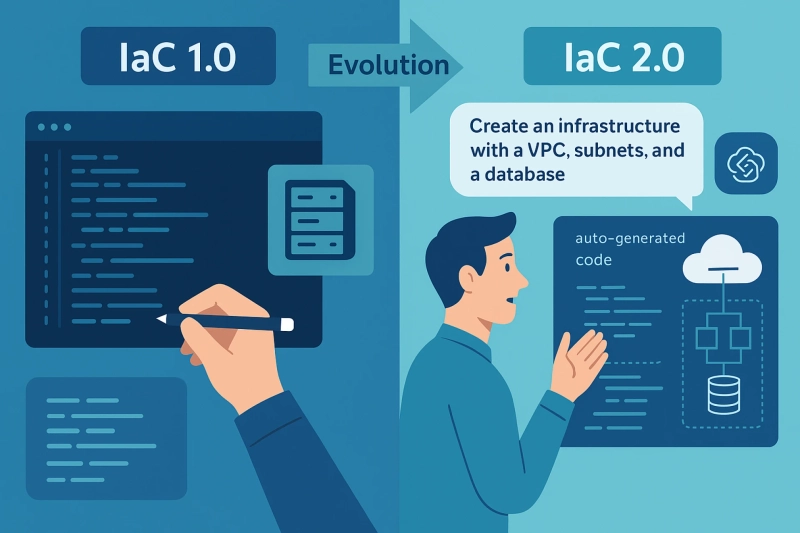
Infrastructure as Code changed how teams provision, configure, and operate infrastructure. What used to be a collection of scripts and templates has become the backbone of reliable, repeatable cloud operations. Now IaC is entering a new phase. Artificial intelligence is moving from assistant to co-author, and IaC 2.0 is emerging as a smart, context-aware system that can design, validate, and even repair infrastructure with minimal human intervention. In this piece I explore what that future looks like, what is already happening, and how teams can adopt AI-powered IaC responsibly to unlock faster delivery, stronger compliance, and measurable cost efficiencies.
Why IaC 2.0 matters now
Adoption of IaC is near ubiquitous but maturity varies. A 2025 industry survey shows that while the vast majority of organizations have adopted IaC in some form, only a small fraction has full coverage or continuous drift monitoring. This gap creates risk as cloud environments scale and change rapidly. The modern cloud era, characterized by multi-cloud deployments, microservices, and stateful data platforms, raises complexity that manual processes cannot keep pace with. AI can reduce that cognitive load by learning patterns, surfacing potential misconfigurations, and automating routine tasks.
Market signals back this transition. Analysts estimate the global Infrastructure as Code market at roughly a billion dollars in 2024 with steady growth into 2025 and beyond, driven by cloud expansion and automation investments. That market growth reflects not only tool adoption but also organizational willingness to pay for systems that reduce risk and speed delivery.
What AI brings to IaC: four practical capabilities
AI is not magic. It is a set of capabilities that, when applied to IaC, close real operational gaps. The most practical areas where AI is already adding value are
- Template and policy generation at scale
- AI-assisted generators take high-level requirements and produce starter IaC modules, complete with recommended resources, tagging, and security controls. This reduces boilerplate and accelerates onboarding of new services.
- Drift detection and remediation
- Traditional drift detection reports differences between declared state and real state. AI 2.0 adds intent understanding, predicting whether a detected drift is dangerous, likely to recur, or safe to ignore. It can even propose or apply safe remediation steps after passing policy checks.
- Context-aware code suggestions
- Like code completion for application developers, AI can autocomplete IaC modules with provider-specific idioms, cost estimates, and sizing recommendations. This helps keep templates cloud-provider-idiomatic and performant.
- Automated testing and validation
- AI can synthesize test scenarios, run simulated deployments, and surface the most likely failure modes before anything reaches prod. Combining static analysis with learned operational signals yields faster feedback loops.
Together these capabilities move IaC from static templates to living blueprints that understand context and intent.
Real-world workflows: examples
Here are three practical workflows teams can adopt today.
- Requirement to deployment in one flow
- A product owner writes a short spec: "Create a highly available API cluster with autoscaling, encryption at rest, and VPC isolation." An AI-powered IaC generator outputs a Terraform or CloudFormation module, includes recommended resource tags, a cost estimate, and planting points for CI/CD integration. The generated code is reviewed by an engineer, tested in a sandbox, and merged into a branch that triggers a pipeline. The end result is consistent, auditable infrastructure that started from a short human prompt.
- Continuous compliance enforcement
- Policies are expressed as code. An AI layer monitors pull requests and running state, compares them to both policies and historical operational data, and flags risky changes. If a change violates a critical security rule or is likely to spike costs, automated gates can block merges or create remediation tasks.
- Autonomous remediation
- For low-risk issues such as expired certificates or minor scaling misconfigurations, the system proposes a fix and, if configured, applies it automatically with full audit trails. For higher-risk scenarios, AI provides a prioritized to-do list for operators, including the smallest safe change needed to restore compliance.
The role of Agile DevOps Tools and Business Process Automation AI
AI-powered IaC does not operate in isolation. It integrates into a broader toolchain that includes Agile DevOps Tools and Business Process Automation AI. These components close the loop between code, teams, and business outcomes.
Agile DevOps Tools benefit from IaC 2.0 in several ways. Automated infrastructure generation speeds sprint planning and reduces friction when teams need ephemeral environments for feature development. Integration with issue trackers and CI pipelines ensures infrastructure changes follow the same agile rituals as application code. At the same time, Business Process Automation AI elevates operational tasks by automating repetitive workflows such as environment provisioning approvals, cost allocation tagging, and incident ticket creation. When these systems are tied together, infrastructure becomes a first-class citizen of product delivery rather than a separate operational concern.
Market research shows the DevOps and automation sectors are growing rapidly, which indicates strong demand for integrated stacks that combine IaC, DevOps workflows, and process automation. Investing in this integrated approach multiplies the value of each piece.
Measurable benefits you can expect
Teams that adopt AI-assisted IaC report several consistent benefits.
- Faster time-to-environment: What took days or weeks can become hours when templates are generated and pipelines are pre-wired.
- Reduced incidents from misconfiguration: Contextual validation and learned best practices help catch mistakes before they reach production.
- Lower operational toil: Automated remediation and process automation reduce manual tickets and repetitive work.
- Better governance and auditability: Everything is code, and AI-generated changes can be fully traced, reviewed, and tied back to business requests.
These benefits convert to tangible business metrics: fewer incident-related hours, faster feature delivery, and more predictable cloud spend.
Risks and guardrails
AI can accelerate IaC, but it also brings new risks. The most important to consider are
- Silent misconfigurations
- If AI suggests code that appears valid but violates subtle security rules, you may get a false sense of safety. Never bypass code review and policy enforcement.
- Overtrust and blind automation
- Autonomous remediation is useful, but you must partition low-risk actions from high-risk ones. Maintain human-in-the-loop for changes that affect stateful data or large network boundaries.
- Model drift and stale recommendations
- AI models need fresh operational data. If models are trained on outdated patterns, their recommendations will become irrelevant. Plan for regular retraining and validation.
- Compliance transparency
- Regulations and internal policies may require explicit documentation of decisions. Ensure your AI systems produce explainable reasons for each suggested change.
To manage these risks create layered guardrails: policy-as-code gates, mandatory peer review for sensitive resources, automated canary deployments, and robust logging.
Implementation roadmap: start small, scale safely
Adopting IaC 2.0 is a journey. A pragmatic rollout plan looks like this.
- Inventory and baseline
- Catalog existing templates, cloud accounts, and manual procedures. Understand where drift occurs and which resources cause the most incidents.
- Policy foundation
- Express security and cost policies as code. This creates a safety net as you introduce AI suggestions.
- Introduce AI for generation only
- Start with AI as a helper for generating initial templates. Require human review and CI tests before merging.
- Add contextual validations
- Integrate AI-driven static analysis and runbook generation into pull request checks.
- Pilot autonomous remediation for low-risk items
- Allow the system to automatically fix expired certificates or non-critical tagging gaps, with full audit trails.
- Expand coverage and retrain
- As confidence grows, expand AI responsibilities and continuously retrain models on production feedback.
- Measure and refine
- Track key metrics such as mean time to provision, mean time to remediate, incident counts, and cost deviation from budget. Use these to refine models and policies.
Tooling landscape and vendor patterns
The IaC ecosystem is maturing quickly. Standalone IaC tooling remains important, but we see three clear vendor patterns.
- Platform integrators
- These vendors provide end-to-end platforms that combine IaC, CI/CD, drift detection, and AI-powered features. They appeal to teams seeking a managed experience.
- Best-of-breed combiners
- Organizations assemble specialized tools for templating, secret management, policy-as-code, and AI modules. This approach offers flexibility for complex enterprises.
- Cloud-native providers
- Major cloud vendors are embedding smarter IaC capabilities directly into their clouds, often with first-party AI features that understand provider-specific semantics.
Selecting between these patterns depends on team size, regulatory constraints, and in-house platform engineering capabilities.
Case study sketches
Two short sketches illustrate how teams use IaC 2.0.
- Start-up platform team
- A growth-stage start-up used AI to generate secure baseline modules for new services. That reduced environment setup time by 70 percent and cut cloud waste from overprovisioning by 30 percent during the first six months.
- Enterprise financial services
- A bank integrated AI IaC validation with policy-as-code and saw a 40 percent reduction in misconfiguration incidents related to network exposure. The AI also automated compliance documentation, saving auditor hours.
These outcomes are representative of early adopters who combine governance with automation.
Measuring ROI
Quantifying ROI requires tracking both engineering and business metrics. Useful indicators include
- Reduction in mean time to provision
- Time saved per ticket thanks to automated remediation
- Decrease in incident volume tied to configuration errors
- Reduction in unexpected cloud spend
- Faster feature delivery cadence
When you convert time saved into salary-equivalent hours and combine that with lower incident costs, many organizations find IaC 2.0 pays for itself within months for targeted workloads.
Practical tips for engineers and leaders
- Treat AI outputs as proposals, not final answers.
- Start with non-critical environments to build trust.
- Maintain human review processes for sensitive resources.
- Keep IaC modules modular and versioned so you can roll back changes easily.
- Use cost estimation in templates to avoid surprise spend.
- Instrument everything. The more feedback your AI system receives from real deployments, the better its recommendations become.
The future: autonomous infrastructure with human oversight
IaC 2.0 will not make engineers obsolete. Instead it will change their role from manual operators to system designers and policy authors. Engineers will spend less time typing boilerplate and more time defining guardrails, building resilient architectures, and coaching AI systems with domain knowledge.
Generative models are bringing infrastructure design closer to natural language. In five years we can expect tight integrations where product intent, sprint planning systems, Agile DevOps Tools, and Business Process Automation AI combine to provision compliant environments as part of the delivery lifecycle. That vision depends on responsible guardrails, continuous validation, and measurable accountability.
Closing thoughts
AI-powered IaC generation is the next logical step in infrastructure automation. It accelerates delivery, reduces toil, and raises the bar for security and governance when implemented with careful controls. Teams that combine modular IaC practices, strong policy-as-code, and the right AI guardrails will enjoy faster delivery and more predictable operations. The journey requires cultural change as much as technology change, but the payoff is infrastructure that behaves more like a reliable, observable product than a collection of scripts.