



Introduction: The Label That Saves Lives
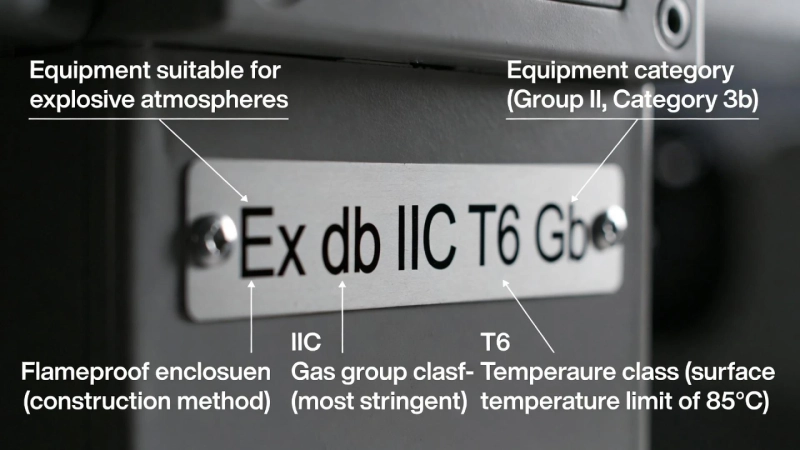
That small metal plate on electrical equipment in hazardous areas isn't just a formality—it's a compressed safety manual. The cryptic code Ex db IIC T6 Gb tells you exactly where equipment can safely operate and what hazards it can handle.
Misreading or ignoring these markings leads to equipment failures, explosions, and fatalities. Yet many engineers struggle to decode them. This guide changes that—in 15 minutes, you'll understand how to read any IECEx marking and verify it's correct for your application.
The Anatomy of an IECEx Marking
Let's dissect the most common marking format: Ex db IIC T6 Gb
Each element provides critical safety information. Miss one, and you might install equipment in the wrong location with catastrophic consequences.
Breaking Down Each Component
🔹 "Ex" - The Foundation
What it means: Equipment is certified for explosive atmospheres
Why it matters: Without "Ex" prefix, the device should never enter a hazardous area. This confirms the equipment underwent rigorous testing and certification.
Red Flag: Equipment without "Ex" marking in hazardous areas is a serious violation.
🔹 "db" - The Protection Concept
What it means: Combination of protection methods
- d = Flameproof enclosure
- b = Increased safety
Why it matters: Tells you HOW the equipment prevents ignition. In this case, the main housing uses flameproof containment while terminal compartments use increased safety principles.
Common Combinations:
- d = Pure flameproof
- e = Pure increased safety
- db = Flameproof with increased safety terminals
- eb = Increased safety with terminal protection
- ia or ib = Intrinsic safety (different protection levels)
Real Example: Motors commonly show "db" because the motor housing is flameproof while the terminal box is increased safety.
🔹 "IIC" - The Gas Group Classification
What it means: Compatible with the most hazardous gas group
The Gas Group Hierarchy:
Gas GroupExamplesIgnition SensitivityIICHydrogen, AcetyleneMost easily ignitedIIBEthylene, Hydrogen SulfideModerately ignitableIIAPropane, Methane, GasolineLeast easily ignited
Critical Selection Rule:
- IIC equipment works in IIC, IIB, and IIA environments ✓
- IIB equipment works in IIB and IIA environments only ✓
- IIA equipment works in IIA environments only ✓
- Never use lower-rated equipment in higher-classified gas groups! ✗
Why it matters: Gas groups relate to how easily gases ignite and how explosive they are. Hydrogen (IIC) ignites much more easily than propane (IIA). Equipment must provide adequate protection for the specific gases present.
Common Mistake: Installing IIA-rated equipment in an area with ethylene (IIB). This creates immediate ignition risk.
🔹 "T6" - Temperature Classification
What it means: Maximum surface temperature of 85°C
Complete Temperature Class Scale:
T-ClassMax Surface TempExample GasesT1450°CAmmonia, EthaneT2300°CAviation Fuel, GasolineT3200°CDiesel FuelT4135°CAcetaldehydeT5100°CCarbon DisulfideT685°CMost restrictive
Important Note: Lower T-numbers mean HIGHER temperatures! (T1 is hottest, T6 is coolest)
Selection Principle: Equipment maximum surface temperature must stay below the auto-ignition temperature of process materials with adequate safety margin.
Example: If handling a chemical that auto-ignites at 120°C, T4 equipment (135°C max) is unsafe. Use T5 (100°C) or T6 (85°C) instead.
Real-World Consideration: Calculate actual surface temperatures including:
- Ambient temperature
- Internal heat generation
- Solar radiation (outdoor installations)
- Process heat transfer
🔹 "Gb" - Equipment Protection Level (EPL)
What it means: High protection suitable for Zone 1
EPL Hierarchy:
EPLProtection LevelSuitable ZoneTypical UseGaVery HighZone 0Continuous hazard areasGbHighZone 1Occasional hazard areasGcEnhancedZone 2Abnormal condition hazards
Installation Rule:
- Gb equipment → Zone 1 or Zone 2 ✓
- Gc equipment → Zone 2 only ✓
- Never install Gc in Zone 1! ✗
For comprehensive understanding of how EPL maps to zones, read: IECEx Certification Zones and Protection Concepts
Real-World Marking Examples Decoded
Example 1: Motor Installation
Marking: Ex db IIB T4 Gb
Translation:
- Ex = Certified for explosive atmospheres
- db = Flameproof motor with increased safety terminals
- IIB = Suitable for Group IIB gases (ethylene, etc.)
- T4 = Maximum surface temperature 135°C
- Gb = Zone 1 approved
Where to Use: Process areas handling ethylene or similar Group IIB gases where explosive atmospheres occur occasionally during normal operation.
Where NOT to Use:
- ✗ Areas with hydrogen (needs IIC)
- ✗ Areas with low auto-ignition temperature gases (needs lower T-class)
- ✗ Zone 0 (needs Ga rating)
Example 2: Intrinsically Safe Transmitter
Marking: Ex ia IIC T6 Ga
Translation:
- Ex = Explosive atmosphere certified
- ia = Intrinsic safety (highest IS protection level)
- IIC = Compatible with most hazardous gases including hydrogen
- T6 = Maximum 85°C surface temperature
- Ga = Suitable for Zone 0 (continuous hazard)
Where to Use: Instrumentation in the most hazardous areas, including Zone 0 where explosive atmospheres exist continuously.
Advantages: Can be installed anywhere (Zone 0, 1, or 2) with any gas group.
Example 3: Junction Box
Marking: Ex eb IIC T6 Gb
Translation:
- Ex = Explosive atmosphere certified
- eb = Increased safety with enhanced terminal protection
- IIC = Hydrogen and acetylene compatible
- T6 = 85°C maximum surface temperature
- Gb = Zone 1 suitable
Where to Use: Cable connection points in Zone 1 areas handling various gases including highly ignitable ones.
Installation Note: Requires proper cable gland selection, correct torqueing, and maintained ingress protection.
Field Verification Checklist
Use this systematic approach during site inspections and commissioning:
✅ Step 1: Photograph Every Nameplate
- Clear, readable images
- Include certification numbers
- Document equipment tag and location
- Create digital archive
Why: Provides evidence for audits, maintenance records, and future reference.
✅ Step 2: Verify EPL-Zone Match
- Check area classification drawings
- Confirm installed location zone
- Verify EPL meets or exceeds requirement
- Document any deviations
Common Error: Gc equipment installed in Zone 1 areas
✅ Step 3: Confirm Gas Group Compatibility
- Review process hazard analysis
- Identify gases present
- Verify equipment gas group is adequate
- Check for process changes since original design
Common Error: IIA equipment in IIB gas environments
✅ Step 4: Validate Temperature Class
- Determine auto-ignition temperatures of all process materials
- Calculate actual equipment surface temperatures
- Verify adequate safety margin
- Consider worst-case scenarios (high ambient, maximum load)
Common Error: Not accounting for ambient temperature plus internal heating
✅ Step 5: Check Certification Validity
- Verify certificate numbers against IECEx database online
- Confirm certification is current
- Check for any recalls or updates
- Validate certification body is accredited
Red Flag: Certificates that can't be verified online may indicate counterfeit equipment
✅ Step 6: Inspect Physical Condition
Check for:
- Unauthorized modifications (extra holes, removed components)
- Damage to enclosures or sealing surfaces
- Paint or coatings on flamepaths
- Missing bolts or fasteners
- Degraded gaskets
- Corrosion affecting protection features
Critical: Any modification invalidates certification regardless of nameplate marking.
For detailed maintenance verification procedures, see: IECEx Certification for Maintenance Engineers Guide
Common Marking Mistakes and How to Catch Them
❌ Mistake #1: Ignoring Gas Group
What Happens: Engineer sees "Ex d" and assumes it works everywhere.
The Problem: Equipment might be rated IIA but installed in IIB environment.
The Fix: Always check ALL components of the marking, not just protection concept.
❌ Mistake #2: Temperature Class Oversight
What Happens: Specification focuses on protection method and gas group but overlooks T-class.
The Problem: Equipment surface temperature exceeds gas auto-ignition temperature.
The Fix: Include temperature class verification in every equipment selection and inspection.
❌ Mistake #3: Assuming Visual Similarity
What Happens: New equipment selected to "match" existing installation based on appearance.
The Problem: Identical-looking equipment can have completely different markings.
The Fix: Always verify actual nameplate marking, never assume based on appearance or model similarity.
❌ Mistake #4: Retrofit Errors
What Happens: Replacement equipment selected without checking original installation compliance.
The Problem: Might perpetuate an existing non-compliant installation.
The Fix: Verify original installation was correct before specifying "same as existing."
Pro Tips for Equipment Selection
💡 Tip #1: Create a Marking Database
Build a spreadsheet with:
- Equipment tag number
- Complete IECEx marking
- Installation location and zone
- Gas group present
- Required temperature class
- Certificate numbers
- Inspection dates
💡 Tip #2: Include Markings in Specifications
Don't just specify "Ex d motor." Specify complete marking: "Ex db IIB T4 Gb minimum."
💡 Tip #3: Request Vendor Confirmation
Before purchase, require vendors to confirm complete marking meets requirements. Get written confirmation referencing certificate numbers.
💡 Tip #4: Train Your Team
Ensure installation crews, maintenance personnel, and inspectors can all decode markings correctly. Regular refresher training prevents errors.
For comprehensive certification training programs, explore: IECEx Certification
Quick Reference: Decoding Any IECEx Marking
General Format: Ex [protection concept] [gas group] [temperature class] [EPL]
Step-by-Step Decoding:
- Confirm "Ex" prefix (explosive atmosphere certified)
- Identify protection concept (d, e, i, etc.)
- Note gas group (IIA, IIB, or IIC)
- Check temperature class (T1-T6)
- Verify EPL rating (Ga, Gb, or Gc)
- Cross-reference with installation requirements
Conclusion: Your Marking Decoder Skills
Understanding IECEx marking codes transforms you from someone who follows instructions to a professional who comprehends the engineering behind safety requirements.
Key Takeaways:
- Every component of the marking matters equally
- Gas groups work hierarchically (IIC > IIB > IIA)
- Temperature classes are inverse (T1 hottest, T6 coolest)
- EPL must match or exceed zone classification
- Physical verification is as important as nameplate reading
- Documentation prevents future errors
Master these fundamentals, and you'll confidently verify equipment compliance, catch dangerous mismatches, and ensure safe installations.
The 15 minutes you invested learning to decode markings could prevent the next major incident in your facility.
Have questions about specific markings? Drop them in the comments below!