


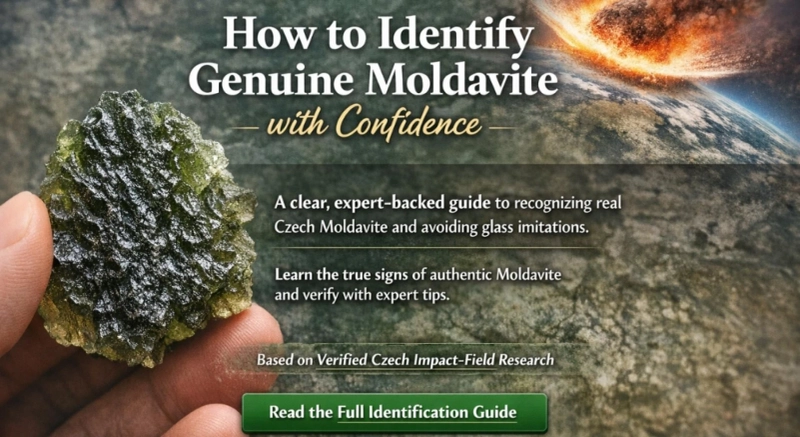
As global interest in Moldavite continues to rise, so does the number of imitations entering the market. Many buyers are drawn to its deep green color and rare origin, but few truly understand how to separate genuine Moldavite from artificial glass. This has made the question of how to identify genuine Moldavite more important than ever.
This guest article approaches the topic from an educational and geological perspective, helping readers understand Moldavite through its origin, natural characteristics, and long-term rarity rather than visual appeal alone.
Understanding What Makes Moldavite Unique
Genuine Moldavite is not a typical gemstone and should not be evaluated like one. It is a natural tektite formed approximately 15 million years ago when a large meteor struck the Earth near what is now the Ries Crater in southern Germany. The extreme heat from this impact melted surface rock and soil, which was ejected into the atmosphere and cooled rapidly before landing primarily in regions of the present-day Czech Republic.
This process explains why Moldavite is technically a natural glass rather than a crystal and why its physical characteristics are unlike any factory-made material. Understanding this formation process is essential when learning how to identify genuine Moldavite.
Geographic Origin as the First Filter
One of the most reliable ways to identify genuine Moldavite is by verifying its geographic origin. Authentic Moldavite has only been found in specific areas of the Czech Republic, particularly Southern Bohemia and Moravia. No confirmed natural Moldavite deposits exist outside these regions.
This geographic limitation is not negotiable. Any stone claimed to be Moldavite but sourced from another country does not align with established geological evidence. While appearance can be mimicked, origin cannot. Experienced collectors and serious buyers treat origin as the first and most important authenticity filter.
Surface Texture and Natural Erosion
Genuine Moldavite surfaces tell a story of time and environment. After landing, Moldavite remained buried in Czech soil for millions of years. During this time, natural chemical weathering and erosion sculpted its surface into irregular, etched forms.
Authentic Moldavite typically shows uneven textures, sharp ridges, pits, and grooves. These patterns are random and non-repeating, reflecting natural processes rather than human design. Artificial glass, by contrast, often appears smooth, glossy, or uniformly textured, even when artificially distressed.
Surface texture is one of the clearest visual indicators of authenticity when learning how to identify genuine Moldavite.
Color: Natural Variation Over Artificial Brightness
Color alone does not define authenticity, but it offers useful context. Genuine Moldavite displays earthy green tones ranging from olive and moss green to deep forest green. The color often varies across the stone and may appear different under changing light conditions.
Artificial Moldavite frequently appears overly bright, neon green, or excessively clear. Such uniform brightness is uncommon in natural Moldavite. Experienced evaluators view overly vivid color as a cautionary sign rather than a positive feature.
Internal Structures Reveal Formation History
Because Moldavite cooled rapidly while airborne, it often contains internal features that reflect this violent formation process. Elongated gas bubbles, flow lines, and internal streaking may be visible when the stone is examined under light.
These internal characteristics are extremely difficult to reproduce accurately in artificial glass. While some imitations attempt to include bubbles, they are usually round and evenly distributed, unlike the stretched, irregular features seen in genuine Moldavite.
Internal structure is best evaluated alongside surface texture and origin rather than as a single deciding factor.
Weight, Shape, and Natural Asymmetry
Genuine Moldavite often feels lighter than expected for its size due to its glass structure and internal voids. Its shape is usually irregular, asymmetrical, and sometimes sharp-edged. These forms are the result of molten material solidifying mid-air and later being weathered underground.
Factory-made glass tends to feel heavier and is often shaped into predictable or repeated forms. Uniformity in shape across multiple pieces is a strong indication of artificial production.
Scarcity, Pricing, and Market Behavior
Understanding how to identify genuine Moldavite also involves understanding market logic. Moldavite formed during a single event and cannot be replenished. As mining areas become depleted and protected, supply continues to shrink while demand grows.
As a result, genuine Moldavite is rarely inexpensive, especially in larger sizes. Offers involving large quantities, identical pieces, or unusually low prices should be approached with skepticism. Market behavior often reveals authenticity more clearly than visual inspection alone.
From Education to Trust: A Natural Funnel
At the awareness stage, readers learn what Moldavite is and why it is rare. This establishes interest and curiosity.
At the consideration stage, readers compare genuine Moldavite to imitations using origin, texture, and structure as evaluation tools.
At the decision stage, informed buyers gravitate toward sellers and sources that emphasize transparency, education, and verified sourcing. Trust is built through information, not persuasion.
This natural progression mirrors how knowledgeable collectors make confident decisions.
Frequently Asked Questions: How to Identify Genuine Moldavite
How can a buyer confidently identify genuine Moldavite without laboratory testing?
Buyers can confidently identify genuine Moldavite by combining several observable indicators rather than relying on a single test. The most important factor is confirmed Czech origin, as Moldavite forms only in that region. Surface texture should appear naturally etched and irregular rather than smooth or glossy. Color should be earthy and varied, not neon or uniform. Internal features such as elongated bubbles or flow lines further support authenticity. Finally, realistic pricing aligned with scarcity helps validate genuine material. Together, these indicators provide strong confidence without laboratory equipment.
Why do many fake Moldavites appear convincing to inexperienced buyers?
Fake Moldavites often appear convincing because modern glass production can closely imitate color and transparency. Many imitations are designed to be visually attractive rather than geologically accurate, using bright green hues and polished surfaces. Without understanding natural erosion patterns, internal structures, and geographic limitations, inexperienced buyers may equate appearance with authenticity. Education shifts focus from visual appeal to factual evaluation, which significantly reduces the risk of being misled.
Can genuine Moldavite ever look smooth or polished?
Genuine Moldavite can be polished after extraction, but polishing does not remove its natural origin or internal features. Even polished pieces usually retain irregular shapes, internal flow lines, or gas bubbles. Completely smooth stones with no internal structure are unlikely to be genuine. Buyers should distinguish between surface polishing and natural formation when evaluating authenticity.
Why is origin more reliable than appearance when identifying Moldavite?
Appearance can be replicated, but origin cannot. Moldavite’s formation is tied to a specific meteor impact and geographic distribution. A stone may visually resemble Moldavite, but without confirmed Czech origin, it lacks geological legitimacy. Origin anchors authenticity in scientific evidence, while appearance alone is subjective and easily manipulated.
How does understanding authenticity protect long-term value?
Understanding how to identify genuine Moldavite protects buyers from financial loss and preserves long-term value. Genuine Moldavite continues to become rarer as supply decreases. Buyers who prioritize authenticity, origin, and education are more likely to own stones that retain or increase in value over time. Knowledge transforms Moldavite from a decorative object into a verified collectible.
Conclusion
Learning how to identify genuine Moldavite is not about memorizing tricks but about understanding natural history. Genuine Moldavite carries clear evidence of its cosmic formation, geographic origin, and long-term rarity. Buyers who approach the subject with patience and education gain confidence, avoid imitations, and develop lasting trust in the material itself.
Authenticity begins with understanding—and understanding begins with facts, not claims.