



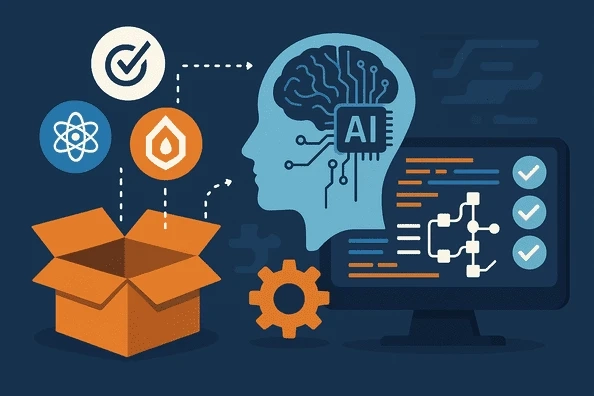
The landscape of software testing is evolving rapidly. With increasingly complex applications, traditional testing approaches can no longer keep pace with development speed. Open source testing tools have long been a backbone for cost-effective, flexible testing. Now, when combined with AI, these tools can provide smarter, faster, and more reliable automation, transforming QA workflows from reactive to proactive.
This article explores how AI and open source testing tools can be integrated to maximize test efficiency, reduce maintenance, and improve software quality.
Why AI in Test Automation Matters?
AI in test automation brings intelligence to areas that traditionally required manual effort:
- Flaky test detection: Identifying tests that fail intermittently due to environment or data inconsistencies.
- Test prioritization: Determining which tests are most critical based on code changes and risk patterns.
- Automated test generation: Creating test cases from real application usage or API traffic.
By combining AI with open source testing tools, teams can leverage flexibility and customization while gaining the predictive power that AI provides.
Step 1: Choose the Right Open Source Testing Tools
The foundation of smarter automation lies in selecting the right open source testing tools for your needs. Popular options include:
- Keploy: For AI-driven automated test generation based on real API traffic.
- Selenium / Playwright / Cypress: For browser-based UI automation.
- Postman / RestAssured / Karate: For API testing.
- JaCoCo / Coveralls: For code coverage reporting and test analysis.
Integrating AI on top of these tools allows you to enhance test generation, detect flaky tests automatically, and optimize execution without losing the benefits of open source flexibility.
Step 2: Leverage AI for Automated Test Case Generation
One of the most impactful ways AI improves test automation is by generating realistic, maintainable test cases automatically. Platforms like Keploy can observe actual API traffic and generate corresponding tests, which ensures that your automation covers real-world scenarios. This approach reduces manual effort and ensures that tests remain aligned with how applications are truly used, minimizing gaps in coverage and increasing reliability.
Step 3: Optimize Test Execution With AI
Large test suites can become time-consuming, slowing down CI/CD pipelines. AI can help optimize execution by:
- Identifying high-priority tests affected by recent code changes
- Grouping tests based on dependencies and execution time
- Detecting redundant tests that do not add value
By using AI-driven analytics in conjunction with open source test runners, teams can significantly reduce execution time while maintaining high confidence in release quality.
Step 4: Detect and Manage Flaky Tests
Flaky tests are a major maintenance headache in large automation suites. AI-powered analysis can automatically flag tests that fail inconsistently, identify root causes, and suggest fixes. For example:
- Environment-related failures (e.g., network latency, database resets)
- Timing issues in UI automation scripts
- Unstable test data
Addressing flaky tests proactively prevents wasted effort and keeps CI/CD pipelines stable. Keploy’s AI-driven test adaptation also contributes to reducing flakiness by aligning test behavior with actual system usage.
Step 5: Integrate AI Insights Into CI/CD Pipelines
For AI-enhanced automation to be truly effective, its insights need to be integrated into CI/CD pipelines. This allows teams to:
- Automatically run high-priority tests for each commit or pull request
- Receive analytics-driven feedback on test quality and coverage gaps
- Adjust test suites dynamically based on AI recommendations
This integration ensures that automation remains relevant, actionable, and efficient throughout the development lifecycle.
Step 6: Continuously Monitor and Refine Automation
AI does not replace human oversight—it enhances it. Teams should continuously monitor AI-driven testing insights, refine test cases, and adjust strategies as the application evolves. By analyzing trends in test failures, coverage gaps, and execution performance, QA teams can make informed decisions that improve both speed and reliability.
Conclusion
Combining open source testing tools with AI transforms test automation from a manual, time-consuming process into a smarter, data-driven workflow. By leveraging AI for automated test generation, flaky test detection, execution optimization, and CI/CD integration, teams can reduce maintenance overhead, accelerate release cycles, and improve overall software quality.
Platforms like Keploy demonstrate how AI can be seamlessly integrated with open source tools, generating realistic tests from actual API traffic and adapting them as applications evolve. This approach allows developers and QA teams to focus on high-value work while ensuring that automation remains reliable, efficient, and aligned with real-world usage.