



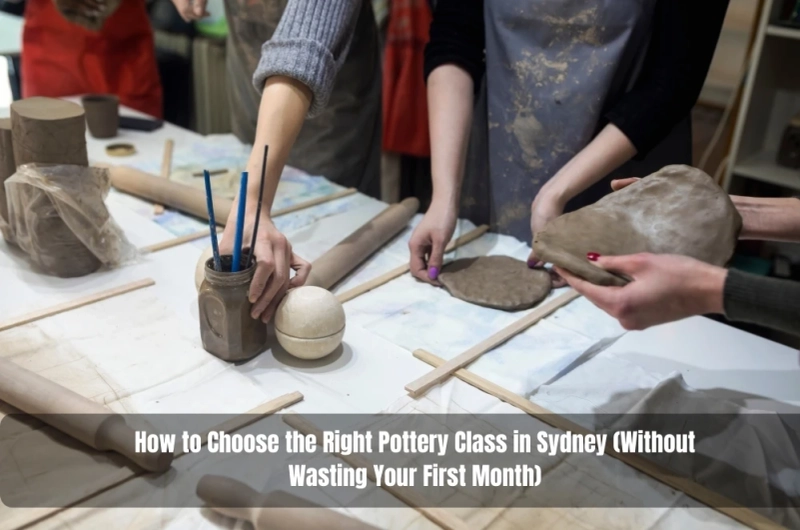
People don’t usually drop pottery because they “failed”.
They drop it because the first class didn’t match what they wanted to make, how they learn, or how much mess-and-repeat they can handle at the start.
In Sydney, it’s easy to book something that looks fun, then realise the format doesn’t actually teach you the basics you thought you were paying for.
A good first month isn’t about perfect pieces—it’s about building a rhythm you’ll still enjoy on week four.
Why most people stall in week two
Week one is novelty: clay on your hands, the wheel hum, and the rush of making something that vaguely resembles a bowl.
Week two is where the clay starts telling the truth.
Rims crack, bases warp, and glazing talk suddenly sounds like a different language.
That doesn’t mean you’re hopeless at pottery; it usually means you walked into a class that didn’t explain the messy parts up front.
If the instructor has a plan for common failures—and says so early—you’ll stick around long enough to get good.
The four class formats and who each suits
1) One-off taster workshops
These work when you’re genuinely undecided and just want to see if you like the process.
What you lose is repetition, and repetition is the whole game in the first month.
2) Short multi-week beginner courses
This suits most first-timers who want real progress without needing to self-direct.
A decent course stacks skills in order, so each week feels like a small upgrade, not a random new activity.
3) Technique-focused intensives
Good if you already know your goal (“I want wheel basics” or “I want to improve trimming”), and you can handle fast pacing.
If you’re brand new, an intensive can feel like trying to learn a new sport during the finals.
4) Open studio / membership-style access
Great once you can safely work without constant supervision and you know how the studio runs.
As a first step, it’s often too unstructured unless you’re confident in learning independently.
Wheel throwing vs handbuilding: pick your starting point
Wheel throwing looks magical online, but the first few sessions can feel like wrestling a damp balloon.
That is normal.
Handbuilding is slower, but it gives you more control early on, especially for functional pieces like small bowls, pinch pots, or simple mugs.
If you want a calm, tactile hobby, handbuilding can be a kinder first month.
If you want a technical craft with measurable progression, the wheel can be brilliant—just expect repeats, not instant results.
What “good value” really means in a pottery class
You’re not just paying for teaching—you’re paying for the unglamorous infrastructure.
Kilns, shelves, glazes, studio ventilation, and someone’s system for keeping everybody’s work labelled and not stuck together.
Good value usually means clear inclusions: clay allowance, firing policy, glazing access, and what happens when something cracks, slumps, or (rarely) gets sacrificed to the kiln gods.
Ask how many pieces you can realistically finish, not how many you can “start”.
Also, ask about class size, because feedback is the hidden product you’re really buying.
Common mistakes first-timers make
Treating a taster like a training plan
One session can be fun, but it won’t build muscle memory unless you follow it with more practice.
Choosing on aesthetics alone
A beautiful studio doesn’t automatically mean the teaching is beginner-proof.
Not asking about firing timelines
You might not see finished work for weeks, and that gap can kill momentum if you weren’t expecting it.
Overcommitting to wheel throwing because it’s the “real” pottery
Plenty of people would enjoy pottery more, starting with handbuilding, then moving to the wheel later.
Using more water to fix wet clay
This catches people out: more water often makes things worse, not better.
Buying a toolkit before you understand your habits
A sponge, a needle tool, and one rib will get you through most beginner needs; the rest can wait.
Decision factors when comparing studios and courses
Progression: Is the course designed as a sequence, or is each week a standalone theme?
Beginners do better when the steps are predictable: form → refine → manage drying → join → finish → glaze.
Feedback: How often does the instructor actually watch you work and correct technique?
A 20-second correction early can save you 20 minutes of fighting the clay.
Class size and studio support: If the room is busy, is there support during bottleneck moments (centring, trimming, joining)?
If there isn’t, you’ll spend a lot of time waiting or guessing.
Inclusions and boundaries: How much clay is included, how many firings, and what’s the policy if pieces fail?
Clear boundaries remove a surprising amount of stress.
Skill focus: Does the class teach what you want—functional ware, sculptural work, wheel foundations, glazing basics—or just a taste?
“Fun” and “foundational” are both valid, but they’re not the same purchase.
When you’re comparing options, it helps to see a clear breakdown of formats and what’s included—here’s a simple reference point via the Diana Ceramic course guide so you can sanity-check what a workshop versus a multi-week course typically looks like.
Operator Experience Moment
In studios, you often see new students blame themselves when a piece collapses, but it’s usually timing and pressure—not talent.
The turning point is almost always when someone slows down, compresses properly, and stops trying to rescue wet work with more water.
A well-run class makes that moment common and repeatable, instead of something you stumble into by luck.
A simple first-action plan for the next 7–14 days
Days 1–2: Decide what “success” means for you
Pick one: “learn the basics”, “make one functional piece”, “try the wheel”, or “find a relaxing weekly ritual”.
Days 3–4: Choose a format that matches that goal
If you want progress, book a multi-week beginner course.
If you’re unsure, do a taster—but treat it as a trial, not the full learning path.
Days 5–7: Remove the friction that causes drop-off
Book a time you can keep even when work gets messy.
Set expectations at home: clay dust is real, and nails won’t stay pristine.
Days 8–10: Learn the three habits that save most beginner work
Control drying (slow is safer), make good joins (score and slip properly), and aim for even wall thickness.
These are boring on paper and life-changing in practice.
Days 11–14: Do one repeat session on purpose
Repeat one form (small bowl, cylinder, or pinch pot) rather than “trying everything”.
Repetition is how you stop starting over every week.
Local Sydney SMB mini-walkthrough
Pick a class time you’ll keep when the week gets noisy—Sydney traffic has a way of undoing good intentions.
Check parking or public transport before you book, especially for evening sessions.
Ask how pickup works for finished pieces if you miss the first window.
Choose a course length that fits your real calendar (school terms, project deadlines, end-of-quarter chaos).
Bring a note of what you made and how you glazed it—by the time it’s fired, you’ll be guessing.
Practical Opinions
Multi-week courses are usually the quickest way to feel genuine improvement.
Handbuilding is an underrated starting point for functional pieces.
Smaller classes tend to fix bad habits sooner.
Key Takeaways
- Choose the format that matches your real goal: trial, progression, or skill targeting.
- Compare courses by progression, feedback, inclusions, and class size—not aesthetics alone.
- Expect early failures and pick a studio that treats them as part of the process.
- Use the next 7–14 days to set up consistency and repetition, not variety.
Common questions we hear from Australian businesses
Q1) Should we book a one-off workshop or a multi-week course for a team activity?
Usually, a one-off workshop suits teams best because everyone shares the same experience in one session, even if skill levels vary. A practical next step is to confirm group size limits and whether the session is wheel-based or handbuilding, because that changes the pace and the “waiting time” in the room. In Sydney, weeknight sessions can run late once you factor in travel and pack-up, so choose a time that won’t turn into a scramble.
Q2) How do we know whether wheel throwing is suitable for absolute beginners?
It depends on how the class is structured and how much hands-on correction is built in. A practical next step is to ask how much time is allocated to centring and forming, and whether the instructor demonstrates common fixes (like collapsing walls and uneven bases). In most cases around Sydney, beginners do better on the wheel when class sizes are kept manageable, because the instructor can actually get to each person before frustration sets in.
Q3) What inclusions should we confirm so we don’t get surprised later?
In most cases, you’ll want clarity on clay allowance, firing counts, glazing access, and what happens if pieces crack or don’t survive a firing. A practical next step is to request a written outline of inclusions and any extra costs, particularly around additional firings or larger pieces. In Australia, kiln and materials costs vary studio to studio, so two classes with the same ticket price can offer very different “finished result” value.
Q4) How long does it take to get finished pieces back after a workshop?
Usually, it’s a few weeks because pieces must dry fully, then be bisque fired, glazed, and fired again, and studios batch these steps for efficiency. A practical next step is to ask about the typical pickup window and how long they hold items if someone can’t collect straight away. In Sydney, pickup logistics can be the real pain point for busy teams—especially if people are travelling or working variable rosters.