



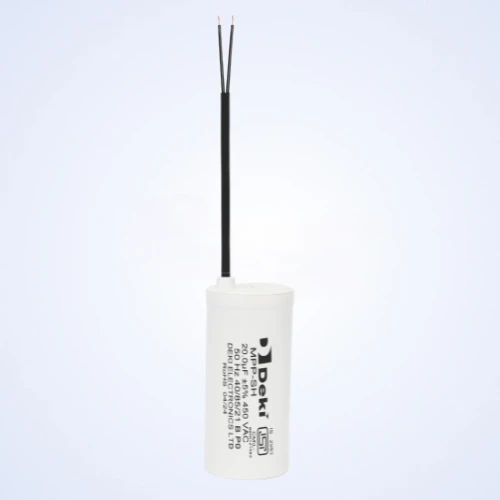
Motor run capacitors play a critical role in the efficient and reliable operation of single-phase motors used in ceiling fans, air conditioners, pumps, and various industrial systems. Selecting the correct motor run capacitor is essential to ensure smooth motor performance, reduced energy losses, and long operational life.
This article explains how motor run capacitors work, where they are used, and what factors engineers and OEMs should consider when selecting the right capacitor for their application.
What Is a Motor Run Capacitor?
A motor run capacitor is designed for continuous operation in AC motor circuits. It helps improve motor efficiency by maintaining the correct phase shift between windings, resulting in smoother rotation and better torque characteristics. Unlike start capacitors, motor run capacitors remain in the circuit throughout normal operation.
Motor run capacitors are commonly manufactured using metallized polypropylene film technology due to its low dielectric loss, high insulation resistance, and excellent electrical stability.
Common Applications of Motor Run Capacitors
Motor run capacitors are widely used across domestic, commercial, and industrial applications, including:
- Ceiling fans and exhaust fans
- Air conditioners and HVAC systems
- Submersible pumps and water pumping systems
- Compressors and refrigeration equipment
- Inverters, UPS systems, and industrial motors
Each application requires a capacitor with suitable voltage rating, capacitance value, and thermal performance.
Key Factors to Consider When Selecting a Motor Run Capacitor
Selecting the correct motor run capacitor involves evaluating several important parameters:
1. Capacitance Value (µF)
The capacitance value must match the motor’s design requirements. An incorrect value can lead to reduced efficiency, overheating, or premature motor failure.
2. Voltage Rating
The capacitor’s rated voltage should be higher than the operating voltage of the system to ensure safe and reliable operation under voltage fluctuations.
3. Operating Temperature
Motor run capacitors should be capable of operating reliably in elevated ambient temperatures, especially in enclosed fan housings or industrial panels.
4. Dielectric Material
Polypropylene film capacitors are preferred due to their stability, low losses, and long service life compared to other dielectric materials.
5. Continuous Duty Performance
Since motor run capacitors operate continuously, they must be designed for long-term electrical and thermal stress.
Common Causes of Motor Capacitor Failure
Understanding common failure causes helps in selecting higher-quality capacitors and improving system reliability:
- Over-voltage conditions
- Excessive heat and poor ventilation
- Incorrect capacitance selection
- Electrical stress due to unstable power supply
- Use of low-quality dielectric materials
Choosing capacitors from an experienced manufacturer significantly reduces the risk of premature failures.
Importance of Manufacturer Quality and Reliability
For OEMs and industrial buyers, selecting a reliable capacitor manufacturer is as important as choosing the right specifications. A manufacturer with strong application knowledge, controlled production processes, and consistent quality standards ensures long-term product performance and reduced maintenance costs.
Deki Electronics, a leading manufacturer of motor run and film capacitors in India, supplies capacitors engineered for continuous-duty applications across fans, motors, power electronics, and industrial systems.
Conclusion
Motor run capacitors are a vital component in electrical and motor-driven systems. Proper selection based on electrical ratings, operating conditions, and application requirements ensures optimal performance and long service life. Partnering with a trusted manufacturer further enhances system reliability and operational efficiency.
For engineers, OEMs, and procurement teams, understanding these fundamentals is key to building dependable electrical systems.