



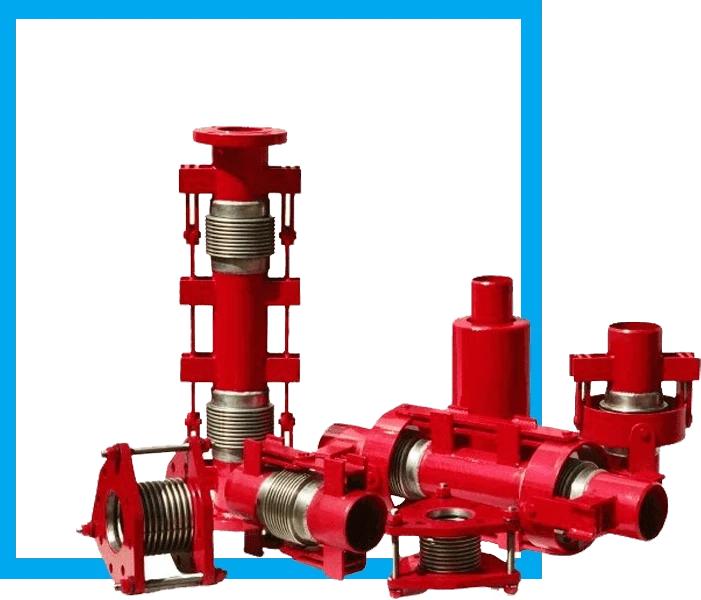
Expansion joints frequently go unnoticed despite their importance. For every industry, they are essential pipe system components.
These adaptable joints enable pipe system movement. They can also reduce noise and vibration. Installing the proper joints is crucial since expansion joint failure can cause process delays as well as safety or environmental issues.
Expansion joints come in a wide range of materials, including stainless steel and various rubber forms. They also come in a variety of designs and combinations. Understanding how to choose the best expansion joints for a particular application helps reduce failures and increase the longevity of the important equipments including the entire piping system. Continue reading to learn how to choose the ideal bellow expansion joints for your particular piping system.
What are Pipe Expansion Joints?
Pipeline expansion joints are places where sections of pipe are connected. They move, expand, and contract in order to compensate for movements caused by changes in pressure, temperature, machine vibrations, and alignment problems.
Expansion joints are also known as compensators, expansion bellows, or flexible joints. They are often employed in transfer sections next to heating systems, motors, generators, condenser units, pumps, and heat exchangers, among other places.
Depending on the application, several materials can be used to make expansion joints. Pipeline expansion joints come in a variety of materials, with metal bellows being one of the most popular and practical. Rubber, material, and plastic (like PTFE) are also used in certain applications.
Make sure that a professional with knowledge in the field is consulted before implementation to ensure that the appropriate sort of pipeline expansion joint has been chosen for your purpose.
Types of Expansion Joints
- metal expansion joint
- Engine exhaust expansion joints
- Rectangular Bellows Expansion Joints
- Dismantling Expansion Joints
- Hinged Expansion Joints
- elbow pressure balanced expansion joint
- in-line pressure balanced expansion joints
- pump suction and discharge Expansion joint
- pipe expansion joint
- Axial Expansion Joints
How to Choose the Right Expansion Joint for Your Piping Applications
Now, you have already learned what metal expansion joints are. Let\'s now learn how to choose the right expansion joints and bellows for your piping needs:
Develop your criteria
Understanding the particular type of expansion joints required for the application necessitates gathering all the necessary information. We have given a set of standards applying the abbreviation "STAMPED" to identify the most effective expansion joint type.
- Size includes inner pipe diameter, pipe thickness, and total flange spacing.
- Temperature, what are the changing rates in terms of temperature? What is the range of the surrounding temperature if the pipe is outside?
- Application: what sort of equipment is connected to the joints, and what sector do they serve? Movement: which process medium—liquid, solid, or gas—is used? Neutral, basic, or acidic?
- Movement: What kind of pipe movement could be anticipated at various locations, axial lateral or angular movements.
- Pressure: What are the system\'s test, operational, and surge pressures in terms of pressure and vacuum?
- End fitting: What kind of end fittings are there, and how are they set up? What kind of drilling pattern is required?
- Delivery: How soon do the expansion joints need to be delivered?
Follow Piping Standards Regarding Misalignment
For expansion joints to last as long as possible, proper pipe alignment is crucial. There are restrictions on the flexibility that metal expansion joints can offer a system. A pipe system\'s larger offsets diminish an expansion joint\'s useful life.
Changes take place, equipment undergoes modifications, and pipes fall out of alignment as piping systems get older. It\'s crucial to abide by the Fluid Sealing Association\'s advice of no more than one-eighth inch of misalignment when replacing expansion joints in a current piping system. The lifespan of the bellow expansion joints should be increased by including offsets in them if the pipe misalignments cannot be fixed.
Identify the areas that require personal protection.
Expansion joints are intended to be the pipe system\'s weakest point. They can stop pump and pipe failures that would be highly expensive to fix, would cause delays, and would violate environmental laws.
Personnel safety should be the main priority. A metal shroud can be used to shield individuals from potentially dangerous elements that could escape expansion joints. Hazardous material will flow parallel to the pipe rather than outward from the junction if the joint were to collapse.
Review expansion joint criteria prior to changing the process.
It is advisable to speak with a technical specialist to help in evaluating whether expansion joints need to be replaced prior to making process modifications in an existing system. Examine changes in temperature, pressure, flow, or medium carefully to see if the current joints still match the STAMPED requirements.
Assuming the expansion joints already installed are sufficient might lead to expensive downtime. For instance, when a company changed the piping in their process, failures of the rubber seated valve and the expansion joint gasket occurred because different glycols have different effects on different elastomers.
Conclusion
Expansion Joints are one of the most essential parts of your piping system. They not only compensate for thermal expansion, misalignments, and pressure but also prevent your piping systems from failure.
If you are considering installing piping expansion joints in your application, then it is highly recommended to use bellows and metal expansion joints manufactured by Flexpert Bellows.
They are one of the leading Pipe expansion joints manufacturers in this sector exporting to more than 44 countries worldwide. Their thermal Piping Expansion Joints find applications in almost all core sector Industries, including Steel, Cement, Sugar, Power Generation, Petrochemical, Paper, Shipping, Rubber, Chemical, Metal Refining, Aerospace, Heat recovery, and Nuclear Power Industries.