



When a person passes away without leaving behind a valid Will, their estate does not automatically transfer to the legal heirs. In such cases, the heirs must seek legal permission from the court to manage, administer, and distribute the deceased person’s estate. This permission is granted in the form of Letters of Administration.
In India, the law governing succession and administration of estates is primarily outlined under the Indian Succession Act, 1925. For individuals who die intestate (without a Will), their heirs need to apply for Letters of Administration before they can rightfully deal with the assets left behind. This ensures transparency, legal compliance, and protection of the rights of all heirs involved.
What are Letters of Administration?
Letters of Administration are legal documents issued by a competent court that empower one or more persons to act as administrators of the estate of a deceased person. The administrator is legally responsible for collecting the estate, settling outstanding debts, and distributing the remaining assets to rightful heirs.
In simple terms, it is an official recognition that allows heirs to lawfully manage the property and financial assets of someone who has passed away without a Will.
Who Can Apply for Letters of Administration?
Not every individual can approach the court for this document. The law grants the right to apply for Letters of Administration only to specific categories of people:
- Legal heirs of the deceased – spouse, children, parents, or siblings.
- Close relatives – in cases where immediate heirs are not available.
- Beneficiaries or claimants – who can establish their right to a portion of the estate.
If multiple heirs exist, one person can apply while others may provide their consent or No Objection Certificate (NOC). In cases of disputes, the court may appoint more than one administrator to ensure fair distribution.
Documents Required to Apply
The process requires a structured set of documents to establish identity, relationship, and details of the estate. The commonly required documents include:
- Death Certificate of the deceased
- Proof of relationship with the deceased (birth certificate, marriage certificate, etc.)
- Identity and address proof of the applicant
- Details of the assets and liabilities of the deceased
- No Objection Certificate (NOC) from other legal heirs, if applicable
- Property documents or financial statements related to the estate
Preparing these documents in advance ensures a smoother application process and reduces delays during court proceedings.
Procedure to Apply for Letters of Administration
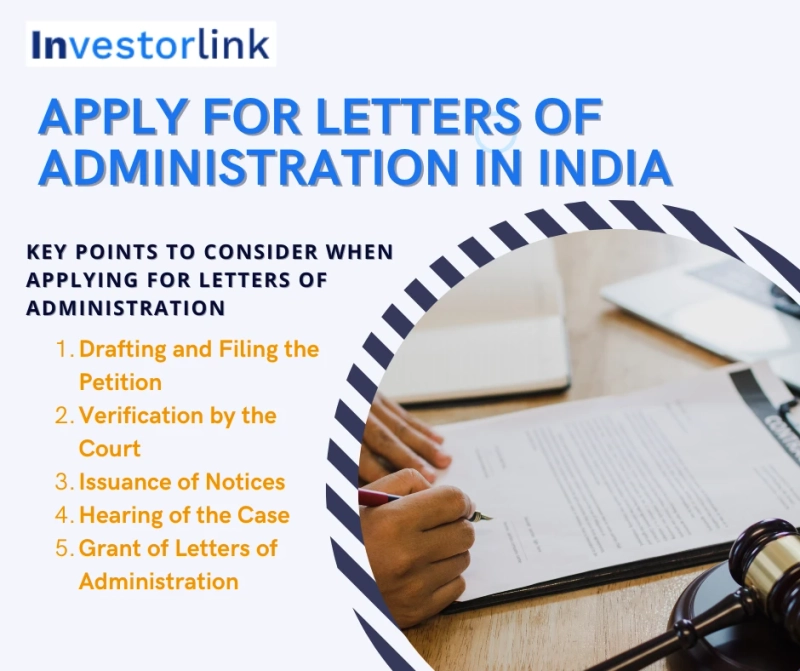
The step-by-step procedure for applying for Letters of Administration in India generally involves the following stages:
- Drafting and Filing the Petition
- The applicant must file a petition in the competent district court where the deceased resided or where the property is located.
- The petition should include details of the deceased, a list of heirs, a description of the estate, and grounds for the application.
- Verification by the Court
- The court reviews the petition, ensuring all legal requirements are met.
- Supporting documents, such as the death certificate and asset details, are examined.
- Issuance of Notices
- The court issues notices to other legal heirs, allowing them to either support or contest the application.
- Public notices may also be issued to ensure transparency.
- Hearing of the Case
- The court conducts hearings to verify the authenticity of claims.
- If objections are raised, they are heard and resolved.
- Grant of Letters of Administration
- Once satisfied, the court issues the Letters of Administration to the applicant, granting them authority to manage the estate.
Timeframe and Costs Involved
The time taken to apply for Letters of Administration can vary depending on the complexity of the case, objections raised, and the workload of the court. On average, the process may take 6 months to 1 year.
Costs involved typically include:
- Court fees (which vary depending on the value of the estate)
- Stamp duty on documents
- Legal professional fees for drafting and filing the petition
Duties and Responsibilities of an Administrator
Once appointed, the administrator has several legal responsibilities:
- Collecting and securing the assets of the deceased
- Settling outstanding debts and liabilities
- Paying applicable taxes
- Preparing an inventory of the estate
- Distributing the remaining assets among the rightful heirs as per succession laws
Failure to perform these duties diligently can result in legal consequences, including removal of the administrator by the court.
Difference Between Letters of Administration and Succession Certificate
Many individuals confuse these two legal instruments. While both serve important roles in estate settlement, there are clear differences:
- Letters of Administration – Applies when there is no Will. It grants authority to manage the entire estate, including immovable property.
- Succession Certificate – Primarily relates to movable assets such as debts, securities, and investments. It does not usually extend to immovable property.
Understanding this distinction helps families choose the correct legal route depending on the nature of the estate.
Importance of Letters of Administration
Obtaining Letters of Administration is not just a legal formality but a safeguard for heirs. Its importance lies in:
- Preventing fraudulent claims over the estate
- Ensuring fair and legal distribution of assets
- Protecting the interests of all heirs and creditors
- Providing heirs with legal authority to transfer property titles, encash investments, or close accounts
Without this document, heirs may face difficulties in transferring ownership, selling property, or claiming financial assets.
Final Thoughts
When a person dies intestate, the family members and heirs must secure legal authority before handling the estate. The correct approach is to apply for Letters of Administration through the competent court. Although the procedure can be lengthy and involves compliance with multiple formalities, it ensures the lawful settlement of the estate and protects the rights of all heirs.
At Investorlink, our expertise lies in assisting individuals and families with the preparation, documentation, and filing process for obtaining Letters of Administration. With professional guidance, the complex procedure becomes simplified, enabling heirs to reclaim and manage the estate with confidence.