



Sydney service is rarely the problem. Prep is.
When curry is “nearly right” but never the same twice, it’s usually not the recipe—it’s the decisions hiding behind the recipe.
Thai curry paste sits in a funny spot: it’s an ingredient, a shortcut, and a system choice all at once.
Done well, it keeps flavour steady across shifts and takes pressure off your most skilled person.
Done badly, it turns one menu item into a weekly debate.
Why curry paste becomes an operations decision
If a dish relies on fresh pounding every time, the quality ceiling can be high—but the floor drops fast when the roster changes. Most Sydney kitchens don’t have the luxury of building a service around “the one person who knows the curry.”
Paste moves the work from artisanal to repeatable: you’re not inventing flavour from scratch, you’re managing variables.
The two variables that bite hardest are measurement and process. If paste is scooped “by feel,” food cost and heat bounce around. If the paste isn’t cooked out properly, the aroma falls flat, and the curry tastes sharp.
Also, curry paste touches other systems: ordering cadence, storage space, allergen comms, and how confidently a junior cook can cover a station when it’s heaving.
A curry paste choice should make the dish easier to execute on a Friday, not harder.
What “bulk” actually means in practice
Bulk doesn’t just mean “bigger container.” It means you’re betting on throughput.
Sometimes bulk is about fewer deliveries and less admin. Sometimes it’s about locking a spec so you don’t get silent substitutions. Sometimes it’s simply that your green curry sells and you’re sick of running out mid-week.
Bulk only works when the pack size fits your routine: how you portion, how you store once opened, and how quickly you burn through it.
One-sentence reality check: the cheapest unit price is irrelevant if half the pack oxidises in the coolroom door.
Decision factors that actually matter during service
1) Flavour intent (and who you’re feeding)
Not every venue needs “blow-your-head-off” heat. Plenty of curry gets sold to office lunch traffic, families, and people who want comfort more than punishment.
Pick the flavour direction first: aromatic-forward, chilli-forward, sweeter, more savoury, heavier lemongrass, heavier galangal—whatever matches the menu and the room.
Then decide what the kitchen will not do. If nobody has time to toast spices and pound herbs on a Tuesday, don’t pretend you will.
2) Heat control, you can repeat
Heat is tricky because it’s felt, not measured. If the paste is extremely hot, you end up using tiny amounts—and tiny amounts create big variation.
A more “moderate” paste can be easier to standardise because the portion size is bigger and more forgiving.
Decide where heat comes from: paste dose, fresh chilli, or a controlled “heat add-on” (like chilli oil or prik nam pla) so the base stays stable.
3) Ingredients, allergens, and label clarity
This is where kitchens get caught out, especially when someone swaps a product because “it’s the same thing.”
Pastes often contain shrimp and/or fish. Some include soy. Sugar and salt levels can vary a lot, too, which changes how much “finishing” seasoning your recipe needs.
If “green curry paste” is the whole spec on the order list, you don’t have a spec.
4) Pack format, storage, and portioning workflow
How you handle paste matters as much as which paste you buy.
If you decant into a service container, you need a tight rule: clean utensil, date label, product name, and a clear “use by once opened” window.
If cooks scoop straight from the original pack, smaller packs can reduce contamination risk and keep the flavour fresher.
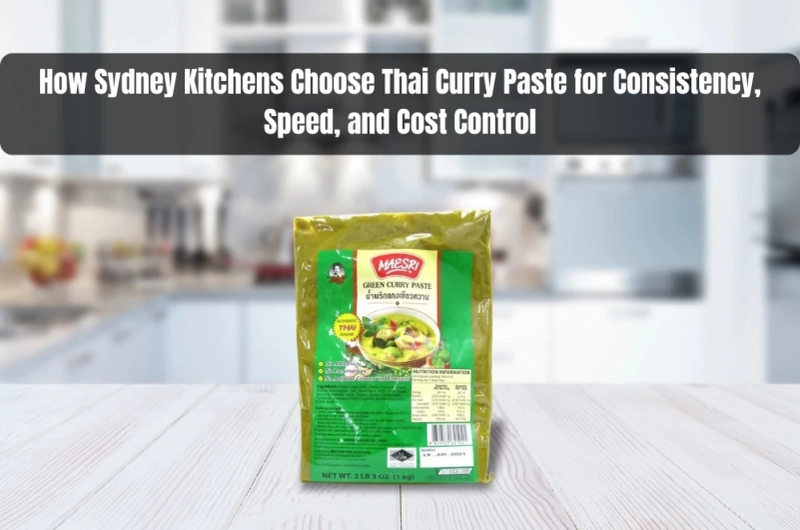
If you want a quick reference when comparing heat levels and pack formats, the BKK Australia Maesri range overview is a handy starting point.
5) Performance in the pan (the make-or-break bit)
Thai curry usually tastes “right” because the paste is fried off in oil before any liquid goes in. That’s the moment aroma blooms.
If the paste burns easily, rushed cooking will produce bitterness. If it takes ages to come alive, the staff will get impatient and skip the step.
Test it the way you actually cook: same pan, same burner, same oil, same coconut milk, same timing.
One sentence here saves a lot of “why is it different tonight?”
Common mistakes that quietly wreck consistency
Mistake 1: Treating paste like a ready-made sauce.
Paste is a base; it still needs proper cook-out.
Mistake 2: No written ratio for paste-to-liquid.
“Two spoons” is not a measurement, and your spoons are not identical.
Mistake 3: Changing coconut milk (or stock) without noticing.
Fat level shifts thickness, sweetness perception, and heat perception.
Mistake 4: “Fixing” every batch at the end.
If you need sugar/fish sauce rescue moves every time, your base process is unstable.
Mistake 5: Buying a pack size that doesn’t match sales.
An open container that hangs around invites oxidation and cross-contamination.
Mistake 6: Substituting brands mid-week without recalibration.
Different salt/sugar/chilli levels mean the same recipe produces a different dish.
This is how a curry becomes “that thing that’s good sometimes.”
The first-actions plan: the next 7–14 days
Days 1–2: Pick two candidates and write your assumptions down.
What do you think each paste will deliver, and why?
Days 3–4: Do a controlled cook-off and record the numbers.
Weigh the paste in grams, time the fry-off, and note how it smells at each point.
Day 5: Run the “two-cook test.”
Have two different people make it from the written method and taste side-by-side.
Days 6–7: Lock a base method and define the only allowed adjustments.
Example: “Finish with up to X ml fish sauce per batch” or “up to Y g sugar,” not an open-ended freestyle.
Days 8–10: Set storage rules that survive a busy week.
Where it lives, how it’s sealed, how it’s labelled, and who owns rotation.
Days 11–14: Train in the real flow of service.
Watch the first 90 seconds: heat, oil, fry-off, and paste measurement.
One-sentence discipline: if you don’t weigh paste, you don’t control cost.
Local SMB mini-walkthrough: a Sydney week where curry goes sideways
Monday: delivery turns up; paste gets shoved wherever there’s room.
Tuesday: someone decants into a tub with no label because “we’ll remember.”
Wednesday: another cook uses a different spoon and doesn’t fry it off long enough.
Thursday: the coconut milk brand changes because the usual one is out of stock.
Friday: rush hits; curry gets thinned, then “fixed” with sugar and fish sauce.
Saturday: you run low, sub in a different paste, and nobody updates the recipe card.
That’s a system problem, not a talent problem.
Operator Experience Moment
The biggest improvements I’ve seen come from boring detail: grams, timers, and labels. When a kitchen agrees on a fry-off time and a paste weight per batch, the arguments stop because the curry stops drifting. Most “quality issues” weren’t about finding a magic paste—they were about removing guesswork at the exact moment the kitchen speeds up.
Choosing a supplier or buying approach
This is less about who has the cheapest carton and more about who helps you keep your spec stable.
Look for range stability (fewer forced substitutions), pack options that match your weekly turnover, clear product naming so you can write a real spec, and an ordering rhythm that prevents panic buys.
If you’re running multiple sites (or even thinking about it), choose the approach that makes it easiest to replicate the dish without constant retraining.
One-sentence mindset: stability beats cleverness when you’re busy.
Practical Opinions
Pick the paste that your newest cook can execute without drama.
Write the ratio in grams, not “spoons,” and protect it like a menu price.
If you keep “rescuing” the curry, fix the fry-off step first.
Key Takeaways
- Curry paste is a consistency system, not just a flavour shortcut.
- Bulk buying only works when the pack size matches turnover and storage discipline.
- Standardise paste weight and fry-off time before tweaking sugar or fish sauce.
- Prevent silent substitutions by writing a clear product spec and process.
Common questions we get from Aussie business owners
How do we keep curry consistent across different cooks?
Usually, the win is locking three non-negotiables: paste weight (grams), fry-off time, and the exact liquid ratio used. Next step: run a two-cook test on a quiet prep day and taste them side-by-side. In Sydney venues with rotating casuals, that written method is what keeps the flavour steady when the roster changes.
Is it always smarter to buy the biggest pack for “bulk” savings?
It depends on your turnover and how your team handles opened product. Next step: calculate how many servings one pack produces using your measured recipe, then compare that to weekly sales so you know how long an opened unit will sit. In most cases, for smaller NSW operators, a slightly smaller pack that gets finished cleanly can outperform a large pack that degrades or gets contaminated.
What’s the clearest sign the problem is the process, not the paste?
In most cases, it’s when one shift’s curry tastes fine and the next shift’s tastes flat or sharp, using the “same” recipe. Next step: watch the fry-off step in real time—heat, oil amount, and how long the paste is cooked before liquid hits the pan. In busy Sydney services, that first minute is where corners get cut, and flavour disappears.
How should we handle allergens and labelling with curry pastes?
Usually, it starts with treating paste like a specified ingredient, not a generic pantry item that anyone can swap. Next step: add the paste to your allergen register and enforce a decant label rule (product name, open date, key allergens) so front-of-house can answer confidently. In Australia, allergen questions come up most when it’s packed and loud—clear labels reduce guesswork when you least have time for it.