



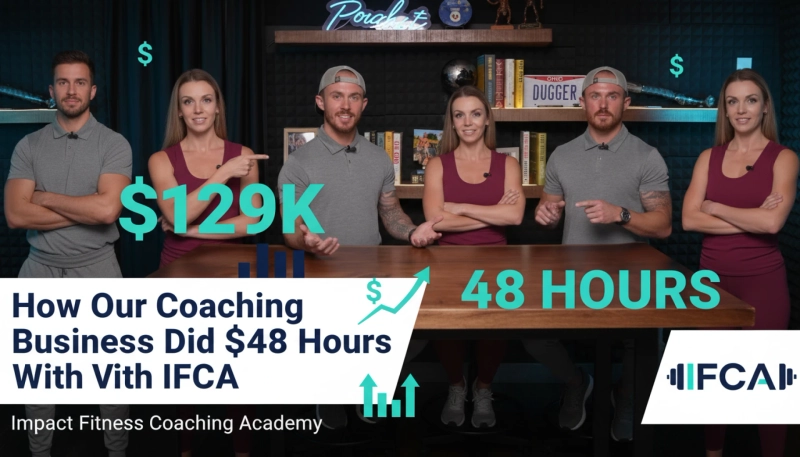
Every business milestone tells a story — but some stories redefine what’s possible. Ours did. When our coaching business partnered with IFCA (Impact Fitness Coaching Academy), we generated $129,000 in just 48 hours. What started as an ambitious launch quickly turned into a master class on clarity, systems, and strategic execution.
Understanding the IFCA Framework
IFCA isn’t just a coaching program — it’s a full-scale business transformation system. Their model focuses on aligning mindset, message, and marketing so coaches can grow beyond word-of-mouth and start scaling with intention.
Before we joined, our business had traction but zero structure. We had clients, but no repeatable process. Sales were inconsistent, content was reactive, and our audience messaging was scattered. The IFCA approach helped us fix all of that by breaking down success into three key pillars:
1. Clarity of Offer and Niche Positioning
They helped us drill down into who we serve, what we offer, and — most importantly — why someone should choose us over competitors.
2. Client Acquisition Systems
IFCA introduced us to a proven sales funnel that automated lead flow and booking processes while keeping messaging consistent.
3. Coaching Delivery and Fulfillment
We learned how to scale delivery systems using group coaching and client management tools, ensuring value stayed high even as our client base grew.
Step 1: Identifying the Perfect Offer
Before the $129K launch, our biggest mistake was offering too much. We had several small products, custom services, and one-on-one packages that confused our audience.
With guidance from IFCA mentors, we shifted to one core offer — a high-ticket coaching program positioned as a true transformation, not just a transaction. Instead of selling hours, we sold results: helping coaches build profitable client acquisition systems.
This single shift in positioning — from service provider to solution expert — transformed how people perceived our value.
Step 2: Crafting the Pre-Launch Content Strategy
With the core offer nailed down, we moved to building anticipation. The IFCA marketing team emphasized pre-launch momentum. For 14 days leading up to launch, we created a content runway built around:
· Authority-building posts: Real results from clients and transparent revenue milestones.
· Storytelling videos: Behind-the-scenes looks into client wins and personal motivation.
· Educational content: Actionable mini-lessons that built trust before we ever pitched.
The purpose of this runway wasn’t just visibility — it was to prime our audience emotionally. Every piece of content addressed specific pain points and offered micro-transformations that made the final offer feel like the next natural step.
Step 3: Building a Conversion-Driven Funnel
One of the most powerful lessons from IFCA was understanding that your funnel is your salesperson. If your funnel doesn’t convert, no amount of leads will fix it.
We built a simple yet high-performing three-step funnel:
1. Lead Magnet: A free “6-Figure Coaching Framework” guide that positioned our brand as an authority and collected email addresses.
2. Nurture Sequence: Automated emails that told our brand story, handled objections, and offered real-case studies.
3. Application Page: A high-conversion booking page where leads could apply to join our program.
Instead of chasing leads, the funnel started qualifying them for us. By the time someone booked a call, they already trusted our process.
Step 4: The 48-Hour Launch Execution
The $129K came from two days of focused action, but it was months of intentional preparation.
Here’s how the actual launch unfolded:
· Day 1: We opened enrollment with an exclusive 48-hour bonus — early access to our live group coaching series. This created healthy urgency without pressure-selling.
· Day 2: We engaged personally with every lead from the funnel, answering DMs, hosting live Q&As, and showcasing proof of transformation.
Our entire strategy revolved around authentic connection. No sleazy gimmicks, no fake scarcity. Just genuine value backed by clear systems.
By the end of day two, we closed 37 clients. The average program price was around $3,500 — adding up to a clean $129,000 in collected revenue.
Step 5: Delivering Transformational Results
Sales are great, but sustainable success depends on retention and referrals. IFCA’s fulfillment systems taught us how to overdeliver without burnout.
We structured a 12-week hybrid program using:
· Weekly live coaching calls for accountability.
· On-demand training modules for foundational skills.
· Private community support for daily wins and peer learning.
This model helped clients hit milestones faster while freeing up our time for growth-focused tasks like partnerships and content creation.
The ripple effect of client results also generated our next batch of organic leads — without a dollar spent on ads.
Step 6: Systematizing for Sustainable Growth
The $129K wasn’t the end — it became the benchmark. Once we saw what was possible, we built systems to ensure it could be repeated.
Here’s what we implemented after the launch:
· Automated lead tracking dashboards through CRM tools.
· Standard operating procedures (SOPs) for onboarding and fulfillment.
· Performance metrics that tracked every stage of the client journey — from lead to renewal.
This level of data organization gave us clarity to scale responsibly rather than reactively.
Key Takeaways From Our 48-Hour Launch
Looking back, five things made this launch a success:
1. Clarity beats complexity. The simpler our offer got, the faster we scaled.
2. Systems replace stress. Automation freed us from chasing leads manually.
3. Storytelling sells. People buy transformation, not transactions.
4. Urgency drives momentum. Limited-time enrollment kept engagement high.
5. Fulfillment builds loyalty. Retained clients became our best marketers.
With IFCA’s framework, we learned that strategy creates stability — and predictability creates profit.
Closing Thoughts: Why IFCA Works
Many coaching programs teach tactics; few teach transformation. IFCA did both.
It wasn’t just the marketing templates or scripts — it was the mindset shift. We stopped operating like freelancers and started thinking like entrepreneurs. Every decision now runs through a framework of intention, systems, and scale.
If your goal is to build a six-figure coaching business that doesn’t depend on hustle, IFCA’s framework is proof that clarity and systems change everything.