



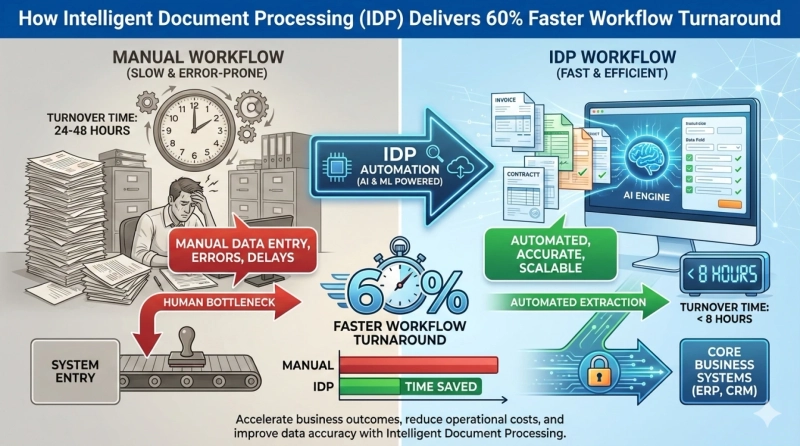
Organizations depend on documents like contracts, invoices, claims, compliance records, and shipping paperwork. However, manual data entry, email handoffs, human error, and repeated validation cycles often make document handling slow and resource-intensive, extending workflows for days or weeks.
Intelligent Document Processing (IDP) is now essential for digital transformation. By combining optical character recognition (OCR), machine learning, and automation, IDP converts documents into structured, verified data that moves quickly across systems.
In practice, IDP consistently reduces cycle times.
This overview explains how IDP achieves these results and how integrating with technologies such as a barcode scanner SDK can further accelerate workflows.
What Is Intelligent Document Processing?
IDP goes beyond traditional OCR. While OCR converts images of text into machine-readable characters, IDP uses artificial intelligence to interpret and process documents. A modern IDP platform can:
- Automatically classify documents (invoice, contract, bill of lading, claim form)
- Extract key data fields from both structured and unstructured layouts.
- Validate information using business rules and confidence levels.
- Route documents to the appropriate systems or teams.
- Continuously learn from corrections to improve accuracy.
The growing adoption of IDP demonstrates its business value. According to a report, the global IDP market is projected to grow from about $1.5 billion in 2022 to over $17 billion by 2032, driven by enterprise automation and cost-reduction initiatives.
Where the “60% Faster” Comes From
IDP does not accelerate processes through a single feature. Instead, it transforms entire workflows by removing the primary sources of delay.
1. Automated Data Capture and Classification
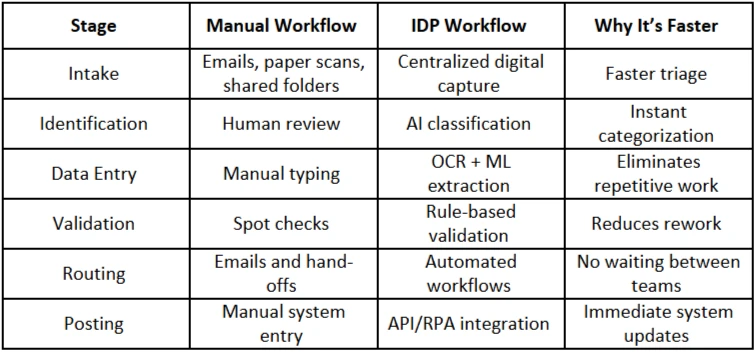
In manual workflows, staff must identify document types and re-key relevant data. IDP automates both steps. AI models classify documents instantly and extract data fields accurately, eliminating manual entry.
This stage is even faster when combined with barcode or QR code capture. A barcode scanner SDK integrated into desktop or mobile apps can instantly identify a document, shipment, or case number at the point of scanning. Barcodes enable deterministic routing into the correct IDP workflow, rather than relying solely on AI classification.
2. Validation That Eliminates Rework
Rework is a common but often overlooked cause of slow turnaround. Incorrect or missing data leads to follow-up emails, resubmissions, and additional approvals.
IDP applies predefined rules, such as checking totals against line items, validating tax formats, or confirming the presence of a purchase order. Low-confidence fields are flagged for review, while high-confidence documents proceed automatically. This reduces the number of records requiring multiple reviews.
3. Straight-Through Processing (STP)
A key benefit of IDP is straight-through processing, which handles documents from receipt to posting without human intervention.
According to a report, leading IDP deployments achieve over 90% straight-through processing for structured documents such as invoices and standardized forms. As more documents are processed automatically, staff are needed only for exceptions, significantly reducing overall cycle time.
4. Fewer Hand-Offs Between Teams
Many document workflows are delayed not by the work itself, but by waiting for review, approval, or re-entry of data into other systems.
McKinsey highlights that automation in back-office operations can reduce processing time by 50% or more by eliminating manual hand-offs, duplicate data entry, and inconsistent review processes. IDP enables this type of streamlined, end-to-end automation.
Manual Processing vs. IDP-Enabled Workflows
How IDP Delivers 60% Faster Turnaround Across Industries
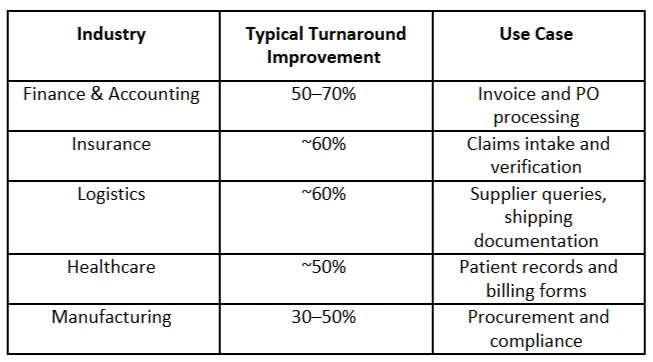
A logistics example from ABBYY shows that IDP reduced response times to supplier requests by 60% by automating transportation and trade document handling. These gains result from faster intake, automated validation, and real-time routing into operational systems.
Why Barcodes and IDP Are a Powerful Combination
Most organizations still process a mix of paper, PDFs, and mobile-captured documents. Barcodes and QR codes offer a fast, reliable way to identify and route documents at capture.
Common IDP + Barcode Scanning Scenarios
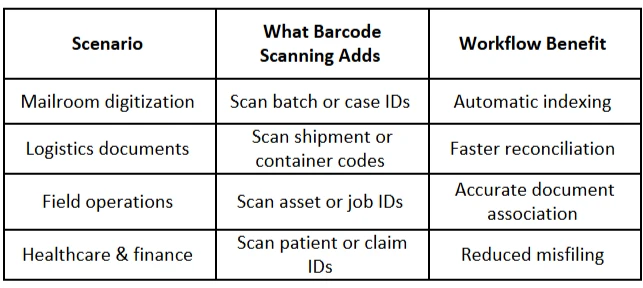
Integrating a barcode scanner SDK with an IDP platform combines deterministic identification with AI-driven data extraction. This ensures documents are classified, routed, and processed correctly from the start.
What Implementation Typically Looks Like
Most organizations deploy IDP in phases:
Phase 1: Structured documents (0-2 months)
Invoices, forms, and standardized reports are automated first, providing rapid ROI.
Phase 2: Semi-structured documents (3-6 months)
Purchase orders, shipping documents, and contracts are added using customized models and validation rules.
Phase 3: Unstructured content (6-12 months)
Emails, correspondence, and scanned records are incorporated into the end-to-end automation process.
Integrating IDP with ERP, CRM, and document management systems removes the final manual steps and enables accurate straight-through processing.
Beyond Speed: The Broader Business Impact
While a 60% faster turnaround is compelling, IDP also delivers:
- Lower error rates through automated validation
- Cost savings through reduced manual labor and rework
- Improved compliance with audit trails and consistent processing
- Scalability to handle peak volumes without increasing headcount
McKinsey notes that automation in back-office operations accelerates processing, improves accuracy and resilience, and enables organizations to scale efficiently without sacrificing control.
Conclusion
Intelligent Document Processing consistently delivers 50–70% reductions in document cycle time, with many organizations achieving about 60% faster workflows in real operational environments. By automating data capture, validation, and routing, IDP removes the slowest and most error-prone steps in document-driven processes.
When combined with complementary technologies like a barcode scanner SDK for instant identification at capture, IDP becomes even more powerful and enables fully automated, end-to-end workflows.
For organizations still relying on manual document handling, the cost is not just inefficiency but lost competitiveness. The real question is not whether to adopt IDP, but how quickly it can be deployed to deliver measurable business impact.