



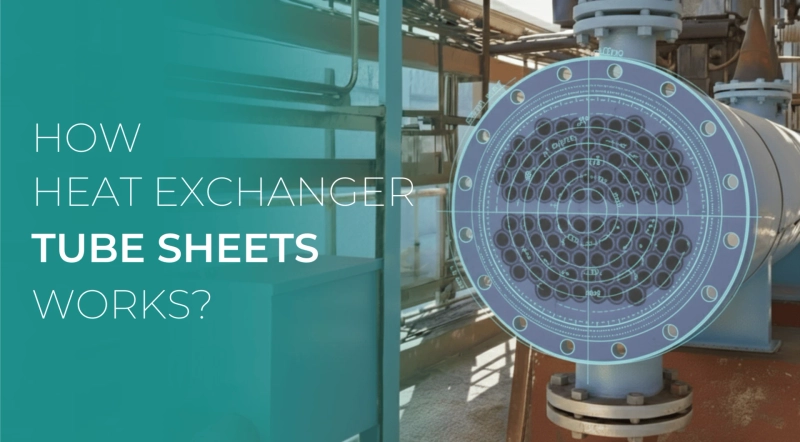
Heat Exchanger Tube Sheets
A heat exchanger is a thermal system designed to transfer heat between two fluids without mixing them. The most widely used type in industrial applications is the shell-and-tube exchanger, where one fluid flows through a bundle of tubes and the other flows across the outside of those tubes within a shell. This arrangement delivers reliable performance in power generation, petrochemicals, refineries, HVAC and marine cooling, making it one of the most common types of heat exchangers worldwide.
In a shell-and-tube heat exchanger the tube sheet is a thick, perforated plate that secures tubes in precise alignment and separates shell-side and tube-side fluids. It provides structural stability, prevents fluid leakage and ensures that heat transfer occurs safely under demanding operating conditions.
Tube sheets are engineered to match their service environment, with factors such as material strength, corrosion resistance and machining accuracy influencing design. Common materials include stainless steel, cupro nickel, cladded boiler-quality steel and super alloys, each selected based on their ability to withstand temperature, pressure and corrosive media.
Even a minor deviation in hole tolerance, tube pitch, or surface finish can compromise the exchanger’s performance. That is why precision machining, compliance with ASME and TEMA standards and strict quality inspection are non-negotiable in tube sheet manufacturing.
.
How Tube Sheets Work Inside Heat Exchangers
In a shell-and-tube exchanger, the tube sheet forms the foundation of the entire assembly. It is a heavy, perforated plate into which hundreds or even thousands of tubes are inserted. Once positioned, the tube ends are expanded, welded, or rolled to create a leak-tight joint. This ensures that fluids on the tube side and shell side remain completely separated. Read more about - How Tube Sheets Work Inside Heat Exchangers