



The lifespan of an excavator or loader varies even for the same model. The machines are designed for the most challenging terrain, and they can be seen either breaking through hardened clay or moving tons of aggregate to a steep spot.
The internal parts of the machines experience far more stress than standard equipment can handle. The steel teeth are taking the visible part of the work, but the real fighting goes on in the gearboxes and final drives. That is where gear oil serves as the primary defence.
What's a shock load?
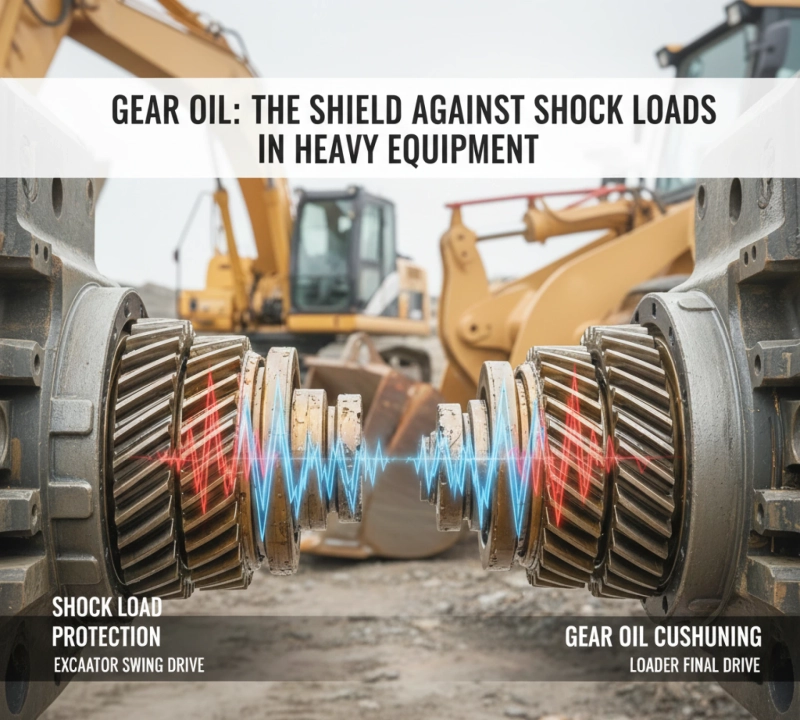
You might be used to the idea of steady mechanical pressure, but earthmoving machinery operates in harsh environments. A shock load is a sudden, massive spike in torque and pressure that occurs in a fraction of a second. Imagine you are operating a loader and you drive the bucket into a dense pile of rock. The sudden deceleration sends a massive wave of kinetic energy backwards through the drivetrain.
This isn't just a heavy load; it's a mechanical hammer blow. Without the right protection, these spikes would cause immediate, catastrophic metal-on-metal failure. The lubricant in your gearbox acts as a critical structural component, turning what could be a brittle impact into a manageable event.
What happens during an impact event
When your excavator bucket hits a buried boulder, the mechanical reaction is instantaneous. That energy doesn't just vanish; it travels from the point of contact through the final drive, the differentials, and into the planetary gears. At the microscopic level, the gear teeth are forced together so tightly that they try to squeeze out any liquid between them.
If the oil fails to hold its ground, you face "pitting" or "spalling" (where chunks of metal actually flake off the gear surface). Eventually, the stress leads to tooth breakage. You aren't just looking at a repair job at that point; you are looking at an entire system replacement.
What is fluid shield
To understand how your oil survives these hits, you have to examine the transition from hydrodynamic to boundary lubrication. Under normal operating speeds, a "wedge" of oil keeps the gears physically apart. This is hydrodynamic lubrication. However, a shock load is so powerful that it "squeezes" this wedge until it almost disappears. This is where the oil must perform under "boundary" conditions.
High-quality gear oils exhibit non-Newtonian behaviour (they can momentarily change their resistance to flow) to maintain their viscosity even when subjected to the rapid shear of a shock event. This maintains a microscopic layer of protection when mechanical pressure is at its peak.
Using chemical defences for mechanical safety
The main safety element in your gearbox is the extreme pressure (EP) additive package. These are usually sulfur-phosphorus compounds that remain dormant until needed. When a shock load hits, the impact's heat triggers a chemical reaction. These compounds react with the metal surface to create a chemical layer. It's essentially a thin & tough shield that prevents the gear teeth from welding themselves together under pressure.
Furthermore, you need Viscosity Index (VI) improvers to ensure the oil maintains its "body." Whether you are starting a cold machine in the morning or pushing a hot loader in the afternoon sun, the oil must stay thick enough to cushion the gears. Surface active agents ensure the oil clings to the gear teeth even when the machine is switched off. This means you have protection from the very first impact of the day.
More than just a lubricant
Stopping wear is the main goal. However, your gear oil also performs several secondary functions that are just as vital during a shock load.
- Heat dissipation: Sudden pressure spikes cause immediate thermal spikes. Your oil acts as a coolant, carrying that heat away so the gear metal doesn't soften (a process called tempering).
- Debris suspension: Impacts can create tiny wear particles. The oil holds these in suspension and carries them to filters or magnets, preventing "three-body abrasion" where a stray bit of metal acts like sandpaper between the gears.
- Vibration dampening: The molecular structure of high-quality oil acts as a liquid cushion. It reduces the "chatter" and harmonic stress that can rattle a gearbox to pieces over time.
Smart maintenance for high-impact work
You cannot expect "tired" oil to protect your machine. Over time, the chemical additives wear out, and the oil loses its molecular "springiness." Once those EP additives are used up, your gears don’t have any protection. This is why you should prioritise regular oil analysis. By looking for trace metals in the oil, you can spot early signs of shock-related wear before a total breakdown occurs. You must also ensure that you match the GL (Gear Lubricant) rating to your specific equipment requirements. Using a lower-grade oil in a high-shock environment is a recipe for expensive downtime.
At the end of the day, your gears provide the strength, but the oil provides the resilience. Investing in high-performance gear oil is essential against the unpredictable rigours of the construction site. It ensures that, whenever you lift the maximum load, your machinery absorbs it without slowing down.
FAQs
What are EP additives & why do my excavator gears need them?
Extreme Pressure or EP additives are chemical compounds. They are often sulphur or phosphorus-based & react with metal surfaces under extreme heat or pressure. They form a protective layer that prevents gear teeth from welding together during sudden impacts or shock loads in an excavator.
How often should I change the gear oil in machines that experience high shock loads?
You must follow your manufacturer's manual. However, machines subjected to constant shock loads often require more frequent maintenance. High-stress work depletes chemical additives faster and breaks down the oil's molecular structure. You need to use oil analysis to monitor the condition of the lubricant, as "dark" or "smelly" oil indicates that the protective additives are already exhausted.
Can I use universal lubricant instead of dedicated gear oil?
You should avoid using universal fluids unless the manufacturer explicitly approves them for the gearbox or final drive. Using the wrong fluid may result in overheating or mechanical failure.