



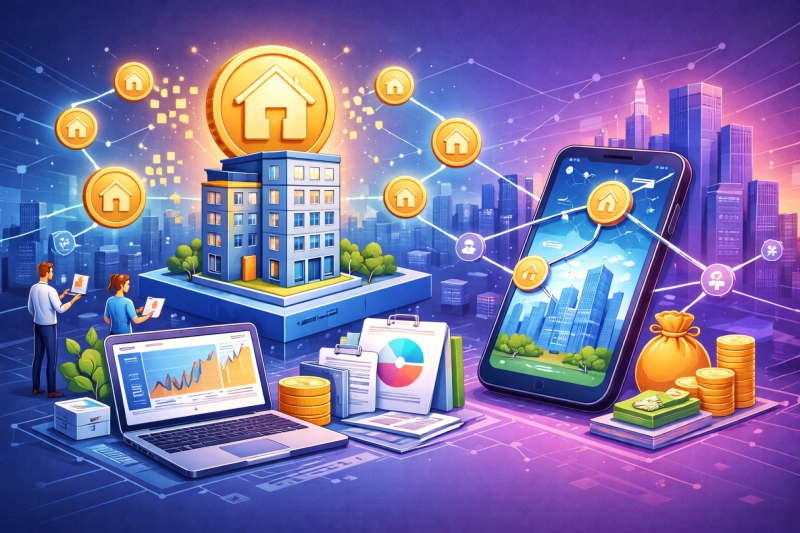
Real estate has long been regarded as one of the most reliable and valuable asset classes in the global economy. From residential housing and commercial buildings to industrial parks and mixed use developments, property represents a significant portion of global wealth. Yet despite its value and stability, real estate has always suffered from a fundamental limitation: illiquidity. Buying, selling, or transferring property is slow, capital intensive, and dependent on layers of intermediaries, documentation, and jurisdiction specific regulations. For decades, this lack of liquidity has restricted who can invest, how capital flows, and how efficiently value can be unlocked from property assets.
Real estate tokenization is changing this paradigm. By converting ownership rights in property into blockchain based digital tokens, tokenization transforms traditionally illiquid real estate into divisible, transferable, and tradable capital. This shift is not simply a technical upgrade. It represents a structural evolution in how real estate is owned, financed, and exchanged across markets. Understanding how real estate tokenization achieves this transformation requires examining the nature of illiquidity, the mechanics of tokenization, and the economic impact of turning physical assets into programmable financial instruments.
Why Real Estate Has Always Been Illiquid
Illiquidity in real estate is not accidental. It is deeply embedded in how property markets function. Traditional real estate transactions involve high entry costs, long settlement periods, regulatory approvals, legal due diligence, and reliance on centralized intermediaries such as brokers, banks, registrars, and custodians. Each transaction is unique, asset specific, and governed by local laws that often lack standardization.
Ownership itself is indivisible in most cases. A property is typically sold as a whole unit, meaning investors must commit large sums of capital to participate. Even when partial ownership structures exist through real estate investment trusts or joint ventures, access is often limited to institutional players or accredited investors. Exiting an investment can take months or even years, depending on market conditions, buyer demand, and financing availability.
This structural friction ties up capital. Property owners may hold valuable assets but lack the ability to quickly unlock their value for reinvestment or liquidity needs. Investors face limited flexibility, reduced portfolio diversification, and exposure to market timing risks. In a global economy that increasingly values speed, accessibility, and efficiency, traditional real estate models struggle to keep pace.
What Real Estate Tokenization Actually Means
Real estate tokenization involves representing ownership rights or economic interests in a property as digital tokens recorded on a blockchain. Each token corresponds to a defined fraction of the asset or its cash flows. These tokens can be bought, sold, or transferred without transferring the physical property itself.
At its core, tokenization separates economic ownership from physical ownership mechanics. The property remains in the real world, managed and operated as usual. What changes is how ownership interests are structured and exchanged. Instead of paper based deeds or complex shareholding arrangements, ownership is encoded into smart contracts that define rights, obligations, and transfer rules.
Tokenization can represent different layers of real estate value. Tokens may reflect equity ownership, revenue sharing rights, debt exposure, or hybrid structures. This flexibility allows real estate assets to be structured more like financial instruments while remaining anchored to tangible property value.
Fractional Ownership as the Foundation of Liquidity
One of the most powerful ways real estate tokenization turns illiquid assets into tradable capital is through fractionalization. Tokenization allows a single property to be divided into thousands or even millions of digital units. Each unit represents a proportional share of the asset’s value or income.
This fractional ownership model dramatically lowers the barrier to entry. Investors no longer need large sums of capital to access premium real estate. Smaller investments can be made across multiple properties, regions, and asset types, enabling greater diversification and risk management.
Fractionalization also creates a broader investor base. When more participants can own and trade portions of a property, market activity increases. Increased participation naturally leads to improved liquidity, as tokens can change hands more frequently than entire properties ever could.
For property owners, fractionalization unlocks dormant capital. Instead of selling an entire asset to raise funds, owners can tokenize a portion of their property while retaining control or operational authority. This creates new financing options without sacrificing long term ownership goals.
Token Markets Enable Continuous Trading
Traditional real estate markets operate on discrete transactions. Properties are listed, negotiated, and sold through lengthy processes that occur sporadically. Tokenized real estate introduces the concept of continuous market access.
Once real estate tokens are issued, they can be traded on compliant digital marketplaces that operate much like financial exchanges. Buyers and sellers can transact more efficiently, with pricing driven by supply and demand rather than prolonged negotiations. This creates a dynamic market environment where real estate value becomes more transparent and responsive.
Continuous trading does not mean speculative volatility. Instead, it reflects the ability to access liquidity when needed. Investors are no longer locked into long holding periods by default. They gain the flexibility to rebalance portfolios, exit positions, or increase exposure based on market conditions or personal financial needs.
This shift fundamentally redefines real estate from a static asset into an active component of modern capital markets.
Smart Contracts Reduce Transaction Friction
Another critical factor in turning illiquid assets into tradable capital is the automation enabled by smart contracts. In traditional real estate, transaction costs are high due to manual processes, legal verification, escrow arrangements, and settlement delays. These costs discourage frequent trading and limit market participation.
Smart contracts encode transaction rules directly into blockchain based logic. Ownership transfers, compliance checks, dividend distributions, and voting rights can be executed automatically when predefined conditions are met. This reduces reliance on intermediaries and minimizes administrative overhead.
Lower transaction costs encourage more frequent participation. When buying or selling ownership interests becomes faster and more predictable, real estate tokens begin to behave more like liquid financial assets while retaining their connection to physical property.
Automation also enhances trust. Transparent, immutable records reduce disputes and improve investor confidence, further strengthening market liquidity.
Global Accessibility Expands Capital Flows
Real estate markets have traditionally been local or regional. Cross border investment is often constrained by regulatory complexity, currency barriers, and limited market access. Tokenization introduces a new level of global reach.
Digital tokens can be accessed by investors across jurisdictions, subject to regulatory compliance. This expands the pool of potential capital far beyond local markets. A property in one country can attract investors from multiple regions without requiring physical presence or complex legal arrangements for each participant.
Global accessibility increases demand and improves price discovery. When more buyers can compete for ownership interests, assets become easier to trade. Liquidity improves not because properties change, but because the market around them becomes broader and more connected.
This global dimension is especially valuable for emerging markets, where real estate assets may be undervalued due to limited local capital access. Tokenization enables these assets to tap into international investment demand, unlocking new growth opportunities.
Turning Rental Income Into Tradable Yield
Real estate tokenization does not only affect ownership transfers. It also transforms how income generated by property is distributed and valued. Rental income, lease payments, and other cash flows can be programmatically allocated to token holders based on predefined rules.
This creates a transparent and predictable yield structure. Investors can evaluate tokenized real estate not just as a long term appreciation play, but as an income generating financial asset. Regular distributions enhance attractiveness and increase trading activity, as investors can price tokens based on expected returns.
When yield becomes tokenized and predictable, real estate begins to resemble fixed income or dividend paying securities. This familiarity attracts a broader class of investors and integrates property assets more deeply into capital markets.
The ability to trade yield bearing tokens further enhances liquidity. Investors seeking income can acquire tokens, while those prioritizing capital gains can exit without waiting for a full property sale.
Liquidity Without Losing Asset Integrity
A common concern around tokenization is whether increased liquidity undermines the stability of real estate. In practice, tokenization enhances liquidity without compromising the underlying asset.
The physical property remains unchanged. It is still governed by real world laws, managed by professionals, and subject to market fundamentals such as location, demand, and economic conditions. Tokenization simply modernizes how ownership interests are represented and exchanged.
By separating operational control from economic participation, tokenization allows properties to function efficiently while enabling investors to trade interests freely. This balance preserves the long term value proposition of real estate while unlocking short term flexibility.
This structural separation is what allows real estate to enter the realm of tradable capital without becoming detached from real world value.
New Financing Models for Property Owners
Tokenization opens new avenues for property financing that were previously difficult or inefficient. Instead of relying solely on bank loans or full asset sales, property owners can raise capital by issuing tokens backed by a portion of their asset’s value.
This approach can reduce dependence on debt and improve balance sheet flexibility. Owners can access liquidity while maintaining operational control and long term upside. Investors gain exposure to high quality real estate without traditional ownership complexity.
These alternative financing models increase market activity and create secondary trading opportunities. Tokens issued for fundraising can later be traded, further enhancing liquidity and capital circulation within the real estate ecosystem.
Transparency Builds Market Confidence
Liquidity thrives on trust. Traditional real estate markets often suffer from information asymmetry, where buyers lack visibility into asset performance, ownership history, or financial metrics. Tokenization introduces a higher standard of transparency.
Blockchain based records provide verifiable ownership data, transaction history, and performance metrics. Investors can assess assets with greater confidence, reducing perceived risk. Lower risk perceptions encourage participation and trading activity.
Transparency also improves regulatory oversight and compliance. Clear records simplify audits and reporting, making tokenized real estate more attractive to institutional investors who require rigorous governance standards.
As confidence grows, so does liquidity. Transparent markets naturally attract more participants and sustain higher trading volumes.
Real Estate as a Composable Financial Asset
Perhaps the most transformative aspect of tokenization is how it turns real estate into a composable asset within the digital financial ecosystem. Tokenized real estate can be integrated into broader financial strategies, used as collateral, combined into portfolios, or structured into new investment products.
This composability increases utility and demand. Assets that can serve multiple financial purposes are more valuable and more frequently traded. Real estate tokens can move seamlessly between investment strategies, enhancing their role as active capital rather than static holdings.
By becoming programmable and interoperable, real estate assets shed their traditional limitations and enter a more fluid economic environment.
The Long Term Impact on Capital Markets
Real estate tokenization is not a short term trend. It represents a fundamental shift in how physical assets interact with financial systems. As tokenized property becomes more widely adopted, capital markets themselves begin to evolve.
Illiquid assets no longer remain isolated from modern financial infrastructure. They become part of a continuous value exchange where ownership, income, and risk can be dynamically managed. This integration improves capital efficiency at a systemic level.
For investors, this means greater access, flexibility, and control. For property owners, it means new ways to unlock value without sacrificing long term strategy. For the broader economy, it means capital flows more freely to productive assets.
Conclusion
Real estate tokenization turns illiquid assets into tradable capital by reengineering how ownership is defined, divided, and exchanged. Through fractionalization, smart contracts, global accessibility, and transparent markets, tokenization unlocks liquidity that was previously trapped by structural inefficiencies.
The physical nature of real estate remains intact, but its financial representation becomes dynamic, accessible, and efficient. Properties are no longer confined to slow, capital intensive transaction cycles. Instead, they participate in continuous, digital capital markets where value can be accessed and reallocated with unprecedented flexibility.
As tokenization matures, the line between real estate and financial assets will continue to blur. What emerges is a more inclusive, liquid, and responsive property market where real world assets finally move at the speed of modern capital.