



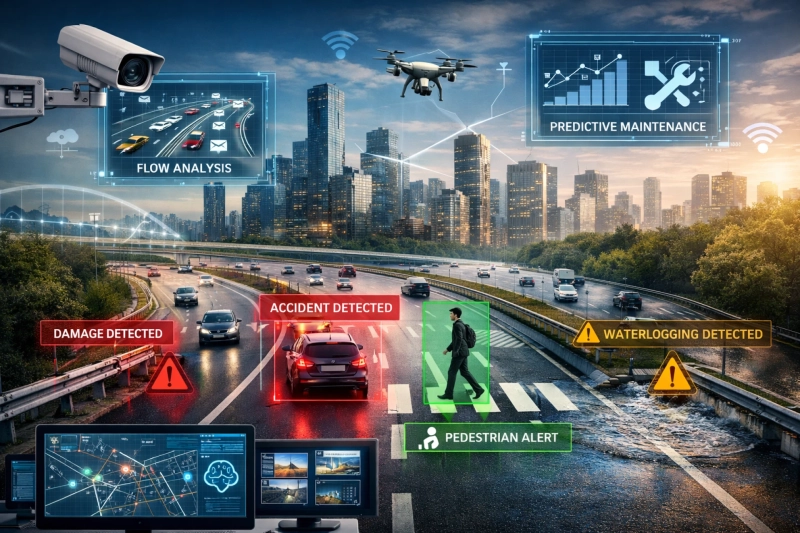
In modern society, transportation plays a critical role in economic growth, urban connectivity, and overall quality of life. As cities expand and traffic volumes rise, ensuring road safety and maintaining highway infrastructure have become major challenges for urban planners. Traditional traffic monitoring and asset inspection methods are often reactive, labor-intensive, and costly, making them unsuitable for today’s fast-growing smart cities.
This is where computer vision technology is redefining transportation systems. By combining AI, machine learning, and real-time video analytics, computer vision enables cities to move from reactive road maintenance to predictive, automated, and intelligent highway management. From improving pedestrian safety to detecting infrastructure defects, computer vision is becoming a foundational pillar of smart urban mobility.
This article explores the applications, benefits, challenges, and future of computer vision in road safety and highway asset management.
What Is Computer Vision in Transportation?
Computer vision is a branch of artificial intelligence that allows machines to interpret and analyze visual data from images and videos. In transportation, computer vision systems process live camera feeds from roads, highways, intersections, and vehicles to identify patterns, detect anomalies, and make real-time decisions.
When integrated with AI video analytics software, computer vision enables authorities to monitor traffic flow, identify safety risks, and manage infrastructure more efficiently—without relying heavily on manual inspections.
Key Applications of Computer Vision in Road Safety & Transportation
1. Maintaining Road & Highway Safety
Highway safety is one of the most crucial elements of urban infrastructure. Computer vision enhances traditional Intelligent Transportation Systems (ITS) and Advanced Driver Assistance Systems (ADAS) by providing deeper insights through visual data analysis.
Vision AI automatically detects hazards such as:
- Broken road signs
- Faded lane markings
- Accidents or stalled vehicles
- Unauthorized road usage
By identifying risks early, authorities can take preventive action, reducing collisions and improving roadside safety.
2. Video Analytics Supported by AI Sensing
AI-enabled cameras paired with AI video analytics software allow continuous monitoring without manual intervention. Unlike traditional sensors that require frequent maintenance, vision-based systems are cost-effective and scalable.
These systems can simultaneously:
- Record visual data
- Analyze traffic behavior
- Generate actionable insights
This dual capability makes computer vision ideal for modern highway asset monitoring.
3. Guardrail & Crash Barrier Monitoring
Crash barriers and guardrails are essential for reducing accident severity. However, exposure to weather, corrosion, and repeated impacts weakens their effectiveness over time.
Computer vision systems continuously inspect these assets by:
- Detecting structural damage
- Identifying missing or misaligned barriers
- Monitoring corrosion and wear
Automated detection ensures timely maintenance, improving both safety and asset lifespan.
4. Real-Time Alerts & Emergency Response
Real-time alert systems powered by computer vision significantly reduce response times during emergencies. Vision AI can instantly detect incidents such as accidents, wrong-way driving, or unusual crowd behavior and alert authorities immediately.
This proactive surveillance helps:
- Improve first-responder efficiency
- Reduce accident escalation
- Enhance public safety
5. Pedestrian Safety Enhancement
Pedestrian safety remains a major concern in urban traffic environments. Computer vision models integrated with smart traffic lights can detect pedestrian movement at crossings and intersections.
These systems can:
- Extend crossing time during heavy foot traffic
- Alert drivers when pedestrians are present
- Reduce pedestrian-vehicle collisions
This intelligent coordination greatly improves urban road safety.
6. Drainage & Waterlogging Detection
Waterlogging and poor drainage accelerate road degradation and increase accident risks. Computer vision AI models detect standing water, blocked drains, and flooding conditions in real time.
This enables authorities to:
- Address drainage issues proactively
- Prevent pavement damage
- Maintain visibility and driving safety
7. Traffic Flow Analysis & Congestion Management
Unlike induction coils and traditional sensors, computer vision offers higher accuracy with lower maintenance. Vision AI analyzes live video feeds to assess:
- Traffic density
- Peak congestion hours
- Lane usage patterns
These insights help city planners optimize signal timing and reduce traffic bottlenecks.
8. Predictive Maintenance & Infrastructure Planning
By analyzing historical and real-time visual data, computer vision predicts infrastructure degradation before failures occur. Predictive maintenance replaces reactive repairs with data-driven planning.
Benefits include:
- Reduced maintenance costs
- Extended asset life
- Fewer traffic disruptions
Why Choose Nextbrain’s Computer Vision–Powered Highway Asset Monitoring?
Nextbrain’s highway asset monitoring solution leverages advanced computer vision and deep learning algorithms to analyze live video feeds in real time. Powered by AI Video Analytics for Highway Asset Monitoring, the system enables automated detection of defects, anomalies, and safety hazards without any manual intervention, making large-scale infrastructure monitoring seamless and efficient.
Unlike traditional inspection methods, Nextbrain’s solution continuously processes visual data from AI-enabled cameras and drones to identify early signs of wear, damage, missing assets, and environmental risks. This proactive approach allows highway authorities to shift from reactive maintenance to predictive and preventive strategies, significantly reducing operational costs while improving road safety.
Designed for scalability, the platform integrates effortlessly with existing surveillance cameras, asset management systems, and smart city infrastructure, ensuring safer highways and optimized asset performance across urban and national road networks.
The Future of Computer Vision in Highway Asset Management
The future of transportation lies in AI-driven, autonomous infrastructure systems. Computer vision will continue to evolve alongside smart sensors, IoT, and predictive analytics to deliver fully integrated traffic ecosystems.
Future advancements will focus on:
- Autonomous incident detection
- Self-healing infrastructure insights
- Real-time citywide traffic intelligence
- Sustainable and resilient road networks
Computer vision is no longer an option—it is a necessity for next-generation smart cities.
Conclusion
Computer vision is transforming the way cities manage and maintain highways. From real-time traffic monitoring and pedestrian safety to predictive maintenance and infrastructure efficiency, AI-powered systems are enabling smarter, safer, and more resilient road networks. By automating the inspection of highway assets, reducing human error, and providing actionable insights, computer vision allows authorities to take proactive measures, prevent accidents, and optimize urban road infrastructure for the long term.
Ready to elevate your urban highway management with cutting-edge technology? Contact Nextbrain today to learn more about our AI Video Analytics for Highway Asset Monitoring and take the first step toward building smarter, safer, and more efficient roadways.
Frequently Asked Questions (FAQs)
1. What is computer vision in highway asset management?
Computer vision uses AI algorithms to analyze images and videos from cameras and vehicles to automatically detect, monitor, and evaluate highway assets.
2. Which highway assets can be monitored using computer vision?
It can monitor road signs, guardrails, crash barriers, pavements, lane markings, traffic lights, lighting poles, and drainage systems.
3. How does computer vision improve road safety?
By identifying damaged or missing assets in real time, computer vision enables early repairs, preventing accidents and enhancing driver and pedestrian safety.
4. Does computer vision support predictive maintenance?
Yes. AI-powered computer vision detects early signs of wear and degradation, enabling proactive maintenance and reducing repair costs.
5. Is computer vision scalable for large highway networks?
Absolutely. Vision AI systems are highly scalable and can process large volumes of visual data across city roads and national highways while maintaining real-time performance.