



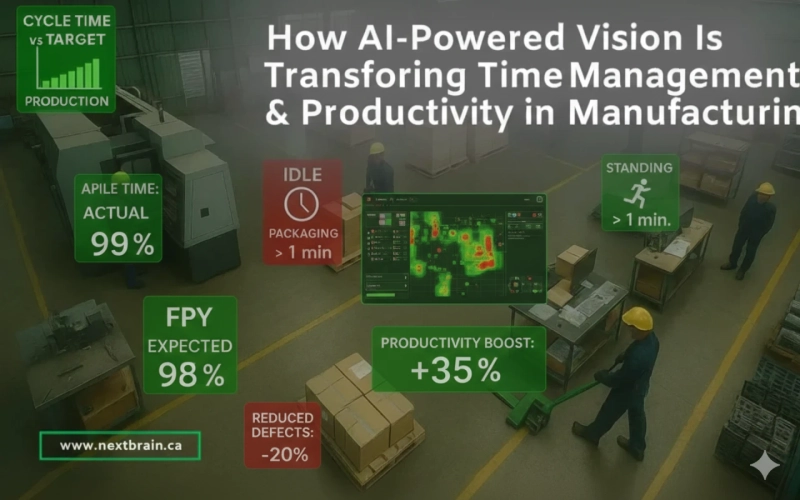
Within a modern manufacturing infrastructure, AI has reshaped operational processes by empowering factories to optimize time, enhance productivity, and eliminate inefficiencies. Even minor delays at individual workstations can snowball into missed deadlines, lower equipment utilization, and increased costs. As the global manufacturing sector moves toward Industry 4.0 and beyond, AI-powered vision systems have emerged as a critical technology accelerating efficiency and accuracy.
Today, manufacturing businesses rely on computer vision and real-time video analytics to differentiate between productive and idle time, track workflows, and gain data-backed insights into operations. By harnessing real-time visual intelligence, factories are achieving unprecedented levels of efficiency, precision, and agility—ultimately creating a strong competitive advantage.
This article explores how AI-driven computer vision is revolutionizing time management and productivity in manufacturing industries.
Understanding AI-Powered Vision in Manufacturing
AI-powered computer vision leverages machine learning algorithms and high-resolution imaging systems to interpret complex visual inputs from factory floors. Unlike traditional sensors, computer vision systems can autonomously detect defects, track processes, monitor worker activities, and assess equipment conditions.
These intelligent systems analyze visual data to drive data-backed decision-making, optimize resource utilization, and maintain consistent quality across production stages.
In modern manufacturing, companies often experience approximately 20% productivity loss due to ineffective tracking and visibility gaps. With the adoption of Computer vision for manufacturing productivity, organizations can gain real-time insights into bottlenecks, reduce downtime, and ensure smoother operational flow.
Key Productivity Statistics of AI in Manufacturing
Several studies and real-world implementations highlight the powerful impact of AI-driven vision technology on productivity:
Consistent results
Manufacturers witness a significant drop in cycle-time deviation, resulting in improved on-time delivery and consistent workflow output.
Cycle-time optimization
AI-driven detailed tracking boosts throughput by nearly 20% and enhances efficiency by 15%.
Real-time productivity tracking
Manufacturers using continuous task monitoring have achieved up to 25% savings in labor costs.
Improved workplace visibility
Over 55% of employers using productivity tracking tools report nearly 80% improvement in output post-AI implementation.
These improvements prove how AI-driven vision solutions are transforming the way manufacturing processes are monitored, analyzed, and optimized.
How AI Vision Enhances Time Management in Manufacturing
Time management in manufacturing relies heavily on accurate, real-time visibility. AI-powered vision systems bring this visibility by constantly tracking operations, detecting anomalies, and sending immediate alerts for corrective action.
Below are the major ways AI enhances time management:
1. Real-Time Monitoring
AI systems continuously analyze video feeds to track machine performance, workstation activities, assembly-line operations, and overall workflow movement. This real-time monitoring helps identify inefficiencies instantly.
Benefits include:
- Immediate recognition of production delays
- Early detection of equipment issues
- Reduction in unnecessary idle time
- Faster decision-making through dynamic insights
By converting visual data into actionable intelligence, manufacturers improve output speed, reduce downtime, and ensure continuous workflow efficiency.
2. Instant Alerts
AI-driven systems automatically send instant alerts when they detect delayed activities, anomalies, safety issues, or equipment malfunction.
This instant response allows:
- Supervisors to fix issues immediately
- Reduced escalation of small problems into major disruptions
- Time savings and smooth operational continuity
3. Predictive Maintenance
Predictive maintenance has become one of the most transformative applications of AI in manufacturing. AI vision models examine visual patterns such as:
- Wear and tear
- Leaks
- Misalignments
- Abnormal vibrations
- Temperature variations
These early alerts prevent unexpected breakdowns and reduce maintenance costs. Predictive maintenance improves equipment lifespan and minimizes downtime, directly contributing to consistent productivity.
4. Data-Driven Decision-Making
AI-based dashboards and historical pattern analysis help manufacturers move from intuition-driven decisions to precise, analytics-driven strategies.
AI systems provide insights such as:
- Performance behavior of machines
- Worker productivity patterns
- Predictive operational challenges
- Resource allocation optimization
This transition to data-backed decision-making ensures long-term efficiency across factory units.
5. Automated Quality Checks
AI vision systems detect defects, inconsistencies, and deviations from quality standards in real time. With automated quality inspection:
- Human error is minimized
- Inspection speed increases
- Accuracy improves significantly
- Defective products are spotted early
This automation not only improves product quality but also reduces the time spent on rework activities.
Boosting Productivity with Intelligent Automation
AI-driven computer vision goes beyond monitoring—it enhances automation across manufacturing lines. By integrating deep learning with automated workflows, factories can streamline repetitive tasks, detect anomalies, and maintain quality with minimal human involvement.
Some of the top ways visual intelligence contributes to productivity include:
1. Predictive Maintenance
AI-powered cameras help detect abnormal wear, leaks, rust, vibration inconsistencies, and other warning signs early. This prevents breakdowns and ensures continuous operations.
2. Automated Quality Inspection
AI scans products at high speed, detecting surface defects, structural inconsistencies, and size deviations. It ensures consistent quality without slowing down production.
3. Workflow Optimization
Computer vision tracks movement patterns, material flow, and workstation interactions. This helps identify bottlenecks and optimize resource allocation.
4. Inventory & Asset Management
Using camera feeds and object detection, computer vision maintains real-time inventory counts, tracks asset usage, and reduces manual errors. Automated inventory monitoring prevents stockouts and supports seamless production flow.
5. Enhanced Workplace Safety
AI-powered cameras detect:
- Unsafe worker behavior
- PPE non-compliance
- Restricted-area violations
- Equipment malfunction
- Slip-and-fall risks
This visual intelligence significantly reduces workplace accidents and improves safety compliance across manufacturing facilities.
6. Better Human–Machine Collaboration
AI helps operators by automating repetitive tasks, enabling them to focus on skilled roles. It strengthens collaboration between humans and machines through streamlined workflows, clear insights, and smart recommendations.
How Nextbrain Helps Manufacturers Transform with AI Vision
Nextbrain, as a trusted AI development company, delivers advanced vision-based solutions that empower manufacturers to achieve automation, predictive insights, and consistent efficiency. With deep technical expertise in AI, machine learning, and computer vision, Nextbrain helps industries unlock the full potential of smart manufacturing.
Why Nextbrain stands out:
- Customized AI models tailored to every manufacturing challenge
- Proven expertise in computer vision and predictive analytics
- Measurable, future-ready outcomes optimized for performance and scalability
- End-to-end support from data strategy to deployment
- Collaborative approach ensuring seamless integration and knowledge transfer
Nextbrain’s vision AI platform transforms raw video feeds into actionable intelligence—helping manufacturers improve productivity, minimize downtime, and future-proof their operational ecosystem.
Final Thoughts
Standing on the foundations of real-time visual intelligence and automation, AI-powered computer vision enables manufacturers to streamline operations, enhance productivity, and manage time with precision. It offers long-term benefits, including higher efficiency, reduced downtime, better resource utilization, and improved product quality.
With advanced solutions from expert partners like Nextbrain, adopting AI-powered vision systems is no longer just an innovation—it represents the next era of digital manufacturing.
FAQs
1. What is computer vision AI in manufacturing?
Computer vision AI in manufacturing uses cameras and machine learning algorithms to analyze real-time visual data from production lines. It helps detect defects, monitor processes, track equipment conditions, and provide actionable insights that improve quality and operational efficiency.
2. How does AI improve time management in manufacturing?
AI improves time management by offering continuous monitoring, automated alerts, predictive maintenance, and workflow optimization. With AI Video Analytics Software, factories can instantly detect delays, analyze performance, and streamline processes, ensuring faster decision-making and reduced downtime.
3. Can AI-driven predictive maintenance reduce production downtime?
Yes. Predictive maintenance powered by AI identifies early signs of equipment wear, misalignment, and malfunction. By addressing issues before they escalate, manufacturers achieve significantly lower unplanned downtime, improved asset lifespan, and more efficient production cycles.
4. How does Nextbrain support AI vision integration for manufacturers?
Nextbrain offers end-to-end AI vision solutions, including custom model development, data analysis, deployment, and continuous support. Their solutions are scalable, accurate, and optimized for real-time industrial environments, helping manufacturers improve productivity and operational visibility.
5. What are the main benefits of implementing AI-powered vision systems?
Key benefits include improved quality control, reduced workplace accidents, optimized workflows, predictive maintenance, lower operational costs, and better productivity. AI systems automate inspections, enhance safety compliance, and offer deep insights into manufacturing operations.