



Imagine a world where your customer service team works tirelessly around the clock, always ready to assist, resolve issues, and engage customers with personalized solutions — no matter the hour or volume. Sounds like a dream? With AI-driven customer communication, it’s fast becoming a reality.
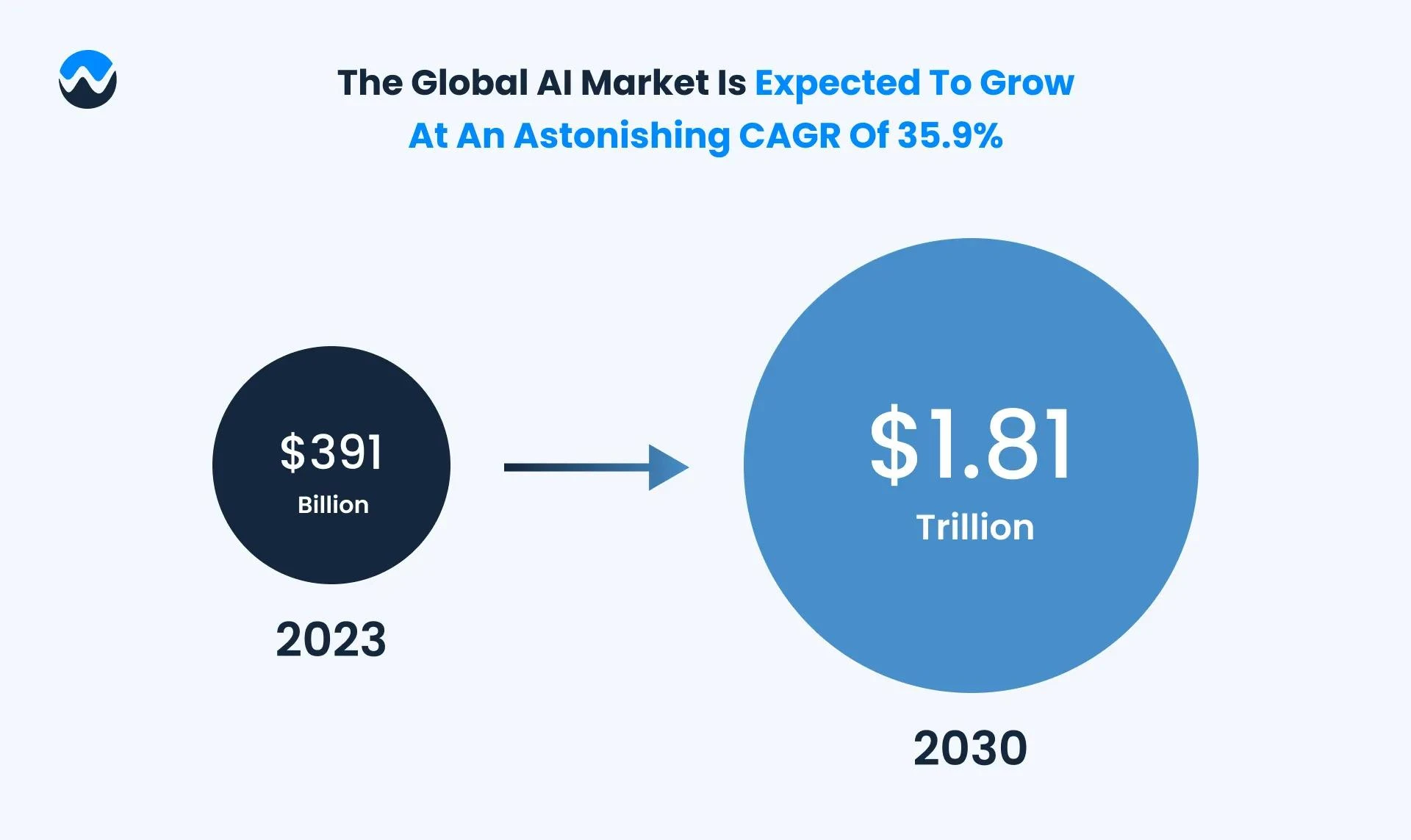
The global AI market, valued at $391 billion in 2023, is expected to skyrocket to $1.81 trillion by 2030, growing at an astonishing CAGR of 35.9%. This exponential growth is transforming industries across the globe, with AI becoming a fundamental part of business strategies. By 2025, nearly 97 million people are projected to be working in the AI space, driving innovations like AI chatbots for business, AI-powered customer service tools, and AI customer experience platforms that reshape the way companies engage with their clients.
As 83% of companies identify AI as a top priority in their business plans, it’s clear that AI’s role in customer service optimization and AI customer support automation is more critical than ever. The question is, are you ready to leverage AI customer service tools to enhance your own customer interactions and unlock growth?
With AI, businesses are not only improving customer support but also personalizing the digital customer journey, enhancing customer satisfaction, and boosting loyalty — all of which drive significant business growth. Let’s explore how AI is revolutionizing customer communication and why this technology is essential for your company’s future.

The Pre-AI Era: Challenges in Traditional Customer Communication
Before the rise of AI customer communication and AI customer service, businesses grappled with a myriad of inherent challenges in their traditional, human-centric customer support models. While human interaction offers invaluable empathy and nuance, its limitations often created significant friction in the customer experience. These pre-AI hurdles directly impacted customer satisfaction, operational efficiency, and ultimately, a company’s potential for business growth.
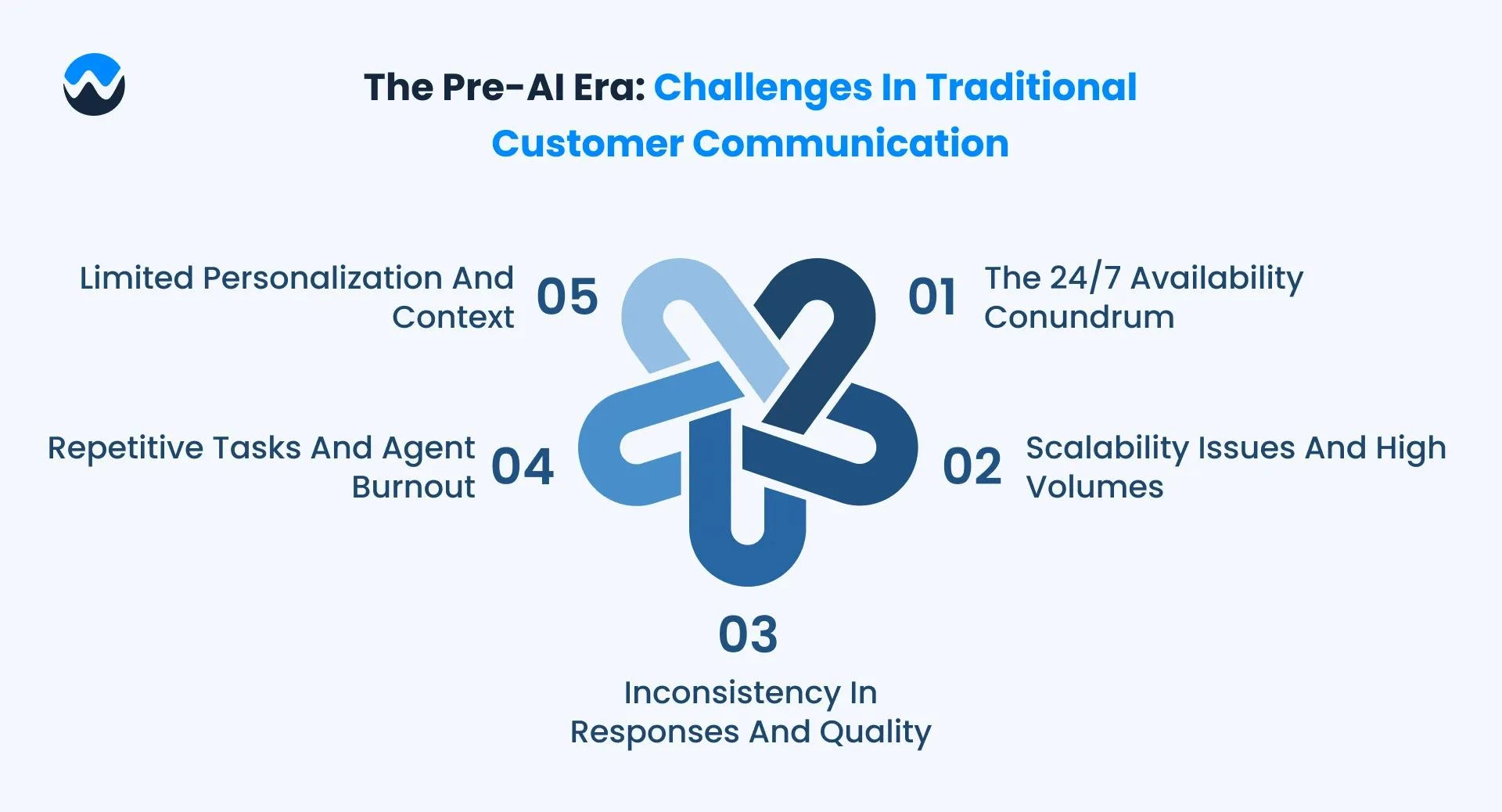
Here’s a deeper dive into the key limitations that paved the way for the AI revolution in customer communication:
1. The 24/7 Availability Conundrum
In an increasingly globalized and always-on world, traditional customer service struggled to meet the demand for round-the-clock support. Businesses were often limited by:
- Fixed Operating Hours: Most customer support centers operated within standard business hours, leaving customers in different time zones or those with urgent queries outside of these hours without immediate assistance. This led to frustrated customers, delayed resolutions, and potentially lost sales.
- Staffing Constraints: Maintaining a 24/7 human-powered support team is incredibly expensive and logistically challenging, especially for small and medium-sized businesses (SMBs). It requires significant investment in salaries, benefits, and infrastructure, often making it unsustainable.
2. Scalability Issues and High Volumes
As businesses grew, so did the volume of customer inquiries. Traditional models found it difficult to scale effectively without compromising service quality or incurring prohibitive costs:
- Long Wait Times: During peak periods, customers often faced exasperatingly long hold times on phone calls or delayed responses to emails and chat messages. This directly eroded customer satisfaction and increased abandonment rates.
- Inability to Handle Surges: Unexpected events, product discovery, or system outages could lead to massive spikes in inquiry volume. Human teams, with their finite capacity, were quickly overwhelmed, leading to backlogs and a further decline in service quality.
- Resource Intensiveness: Scaling up meant hiring and training more agents, which is a slow, costly, and continuous process. This often made expansion daunting and inefficient for businesses aiming for rapid growth.
3. Inconsistency in Responses and Quality
Relying solely on human agents inevitably led to variations in the quality and consistency of information provided:
- Human Error: Agents, being human, are susceptible to mistakes, misinterpretations, or simply not having access to the most up-to-date information. This could lead to incorrect solutions, repeated efforts, and customer frustration.
- Varying Expertise Levels: Not all agents possess the same level of product knowledge or problem-solving skills. Customers might receive different answers to the same question depending on which agent they spoke to, causing confusion and distrust.
- Lack of Standardization: Without robust and easily accessible knowledge bases (which AI now excels at managing), ensuring uniform responses across a large team was a constant battle.
4. Repetitive Tasks and Agent Burnout
A significant portion of traditional customer service involved handling highly repetitive, low-complexity queries:
- Monotonous Workload: Answering the same basic questions repeatedly (e.g., “What’s my order status?” or “How do I reset my password?”) was tedious for agents, leading to boredom and reduced engagement.
- Agent Burnout and Turnover: The monotonous nature of these tasks, coupled with high call volumes and sometimes dealing with frustrated customers, contributed to high stress levels and significant agent burnout. This resulted in high employee turnover, further exacerbating staffing and training costs.
- Hindered Focus on Complex Issues: When agents were bogged down by simple queries, they had less time and energy to dedicate to more complex, nuanced, or high-value customer interactions that truly required human problem-solving skills and empathy.
5. Limited Personalization and Context
Prior to the era of AI-driven customer engagement, achieving a truly personalized customer experience at scale was a significant challenge:
- Fragmented Customer Data: Customer information was often siloed across different departments or systems (e.g., sales, marketing, support), making it difficult for agents to get a complete 360-degree view of a customer’s history and preferences.
- Lack of Proactive Engagement: Without the ability to quickly analyze vast amounts of data, businesses struggled to anticipate customer needs or identify potential issues before they escalated. Most interactions were reactive, rather than proactive.
- Generic Interactions: Even with access to some data, the sheer volume of interactions made it impractical for human agents to tailor every conversation with deep personalization, leading to generic responses that failed to make customers feel truly valued.
These fundamental limitations of the pre-AI era highlighted a clear need for a more efficient, scalable, and intelligent approach to customer communication — a gap that AI customer experience platforms and AI-powered customer service tools would soon begin to fill.