If you run a business, you already know how hard it is to predict your future revenue and expenses accurately. Traditional accounting tools give you numbers from the past, but what you really need are insights into what’s coming next. That’s where AI accounting software changes the game.
It doesn’t just record what happened; it helps you make sense of what’s likely to happen next. Financial forecasting used to take hours of spreadsheet work and guesswork. With AI, it’s faster, more accurate, and built around real-time data instead of assumptions.
Let’s break down how this works, why it matters, and which tools can help you do it right.
What is AI Accounting Software?
AI accounting software uses artificial intelligence to automate tasks like bookkeeping, categorizing expenses, generating reports, and predicting future trends. It learns from your financial data and keeps improving its predictions over time.
Unlike regular accounting tools, it doesn’t just follow rules. It analyzes your data patterns and helps you understand how different decisions might impact your cash flow, sales, or expenses next quarter.
Many companies are now using AI tools like Otto AI Accounting Software, QuickBooks Online, and Xero to manage their books smarter. These platforms use machine learning to detect patterns, highlight risks, and forecast more accurately.
Why Financial Forecasting Matters
Forecasting is the foundation of smart financial planning. It helps you:
- Plan cash flow and budgets more effectively
- Identify upcoming revenue gaps or expense spikes
- Make hiring or investment decisions based on data
- Set realistic sales and growth targets
Without strong forecasting, you’re flying blind. You might think your business is healthy, but a single slow month could hurt your cash flow if you didn’t see it coming. AI-driven forecasting reduces that risk by giving you a clearer view of what’s next.
Bonus: Choosing the Right AI Accounting Software for Your Business
How AI Accounting Software Improves Financial Forecasting
Let’s look at how AI accounting tools actually make forecasting better.
1. Real-time Data Analysis
Traditional accounting relies on manual data entry, which means your numbers are always a little behind. AI accounting software connects directly to your bank accounts, invoices, and receipts to pull in data instantly.
That gives you a live snapshot of your financial position. Instead of waiting for your accountant to update spreadsheets, you can make decisions using real-time insights.
2. Pattern Recognition and Predictive Analytics
AI can find patterns humans might miss. For example, if your sales tend to rise 20% every December or your expenses spike after each product launch, AI accounting tools detect that automatically.
This pattern recognition helps generate accurate forecasts without you doing complex calculations. You can plan ahead for busy seasons, inventory needs, and payroll changes with confidence.
3. Scenario Planning
Some AI accounting software can simulate “what-if” scenarios. You can test how different decisions might affect your financial health.
For example:
- What if your sales drop by 10%?
- What if you raise prices by 5%?
- What if supplier costs increase?
Tools like Otto AI Accounting Software or Zoho Books use these predictive models to help small business owners evaluate outcomes before making big moves.
4. Error Reduction
Even the best accountants can make mistakes when copying or updating data. AI reduces human error by automating repetitive tasks like data entry and reconciliation.
With fewer mistakes, your forecasts are more reliable. That accuracy helps you make better financial calls without second-guessing your reports.
5. Smarter Budget Allocation
AI accounting helps you spot where your money is working and where it’s wasted. By analyzing spending patterns, it can suggest areas to cut costs or reinvest profits.
That’s crucial for small businesses that can’t afford to waste resources. The software identifies unnecessary expenses before they become a problem, helping you stay lean and profitable.
What Makes AI Accounting Software Different from Traditional Tools?
AI accounting isn’t just about automating bookkeeping. It’s about giving you a financial brain that learns as your business grows.
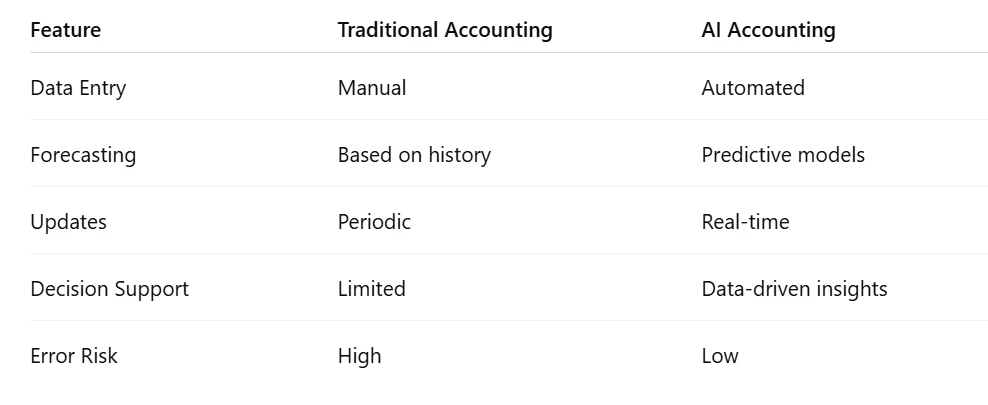
Traditional accounting software only shows you what happened. AI tools show you what’s likely to happen and why.
Here’s a quick comparison:
What Are the Best AI Accounting Software Options?
There are plenty of great AI-driven accounting platforms on the market. Here are three that stand out for their forecasting abilities:
- Otto AI Accounting Software – Best for businesses that want simple automation and accurate forecasts. It integrates with banks and CRMs, offering data-driven insights with minimal setup.
- QuickBooks Online Advanced – Known for robust features and AI-assisted cash flow forecasting, ideal for growing small businesses.
- Zoho Books – Affordable and feature-rich with solid AI forecasting tools and expense tracking automation.
Each of these tools can help you get real-time visibility into your numbers and predict future performance more confidently.
PAA: How does AI improve accounting accuracy?
AI improves accuracy by automating data entry, catching errors, and analyzing large data sets in seconds. It identifies unusual transactions, ensures data consistency, and updates records in real time, which makes financial statements more reliable.
PAA: Is AI accounting software good for small businesses?
Yes, accounting software for small business powered by AI is a game changer. It automates time-consuming tasks, helps predict cash flow, and keeps track of expenses, so small business owners can focus on growth instead of spreadsheets.
PAA: Can AI help forecast cash flow?
Absolutely. AI accounting tools analyze your income and expenses to predict cash flow patterns. They consider recurring payments, invoices, and seasonal trends to give you a realistic view of your upcoming cash position.
PAA: What data does AI use for financial forecasting?
AI uses your accounting data such as sales, expenses, payroll, invoices, and external financial trends. It combines this data to identify correlations and predict future revenue, costs, and profit margins with greater accuracy than manual methods.
PAA: How secure is AI accounting software?
Most modern AI accounting systems use encryption, role-based access, and secure cloud storage. Platforms like Otto AI Accounting Software and QuickBooks comply with international data security standards, ensuring your financial information stays safe.
Bonus: AI Accounting Software Features That Save You Time and Money
The Future of AI Accounting and Forecasting
AI accounting isn’t replacing accountants. It’s making their jobs smarter. Instead of spending hours crunching numbers, finance professionals can focus on strategy and decision-making.
As AI continues to advance, financial forecasting will become even more precise. Predictive analytics will evolve into prescriptive insights, meaning the software won’t just tell you what might happen, but what you should do next.
Businesses that adapt early will have a huge advantage. They’ll operate with clarity instead of guesswork.