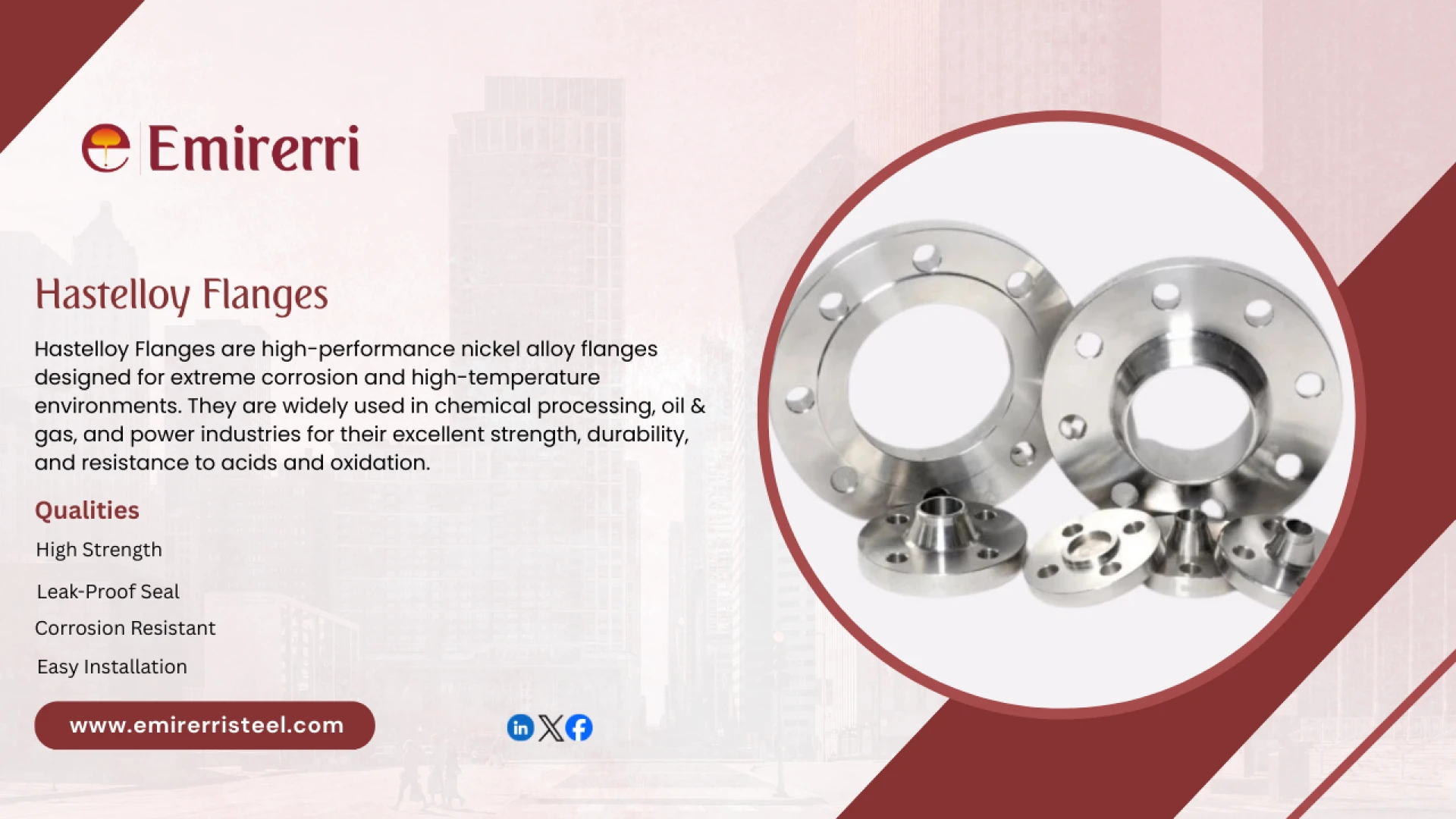
Hastelloy flanges are widely recognized for their exceptional performance in highly corrosive and high-temperature environments. Manufactured from nickel-based alloys, these flanges are specifically designed for industries where standard stainless steel or carbon steel flanges fail to deliver long-term reliability. Due to their superior resistance to corrosion, oxidation, and stress cracking, Hastelloy flanges are extensively used in chemical processing, oil and gas, power generation, and marine industries.
What Are Hastelloy Flanges?
Hastelloy flanges are pipe flanges produced from Hastelloy alloys, a family of nickel-chromium-molybdenum materials known for outstanding corrosion resistance. These flanges provide secure, leak-proof connections in piping systems operating under aggressive conditions such as high pressure, high temperature, and exposure to acids or chlorides.
Hastelloy flanges are commonly manufactured in compliance with international standards such as ASTM B564 N10276, SB564 N10276, and B564 N10276, ensuring consistent quality, mechanical strength, and chemical composition.
Key Hastelloy Grades Used in Flanges
Hastelloy C276 Flanges
C276 flanges are among the most widely used Hastelloy flanges due to their exceptional resistance to pitting, crevice corrosion, and stress corrosion cracking. Hastelloy C276 is a nickel-molybdenum-chromium alloy that performs exceptionally well in both oxidizing and reducing environments.
C276 flanges are commonly used in chemical reactors, heat exchangers, pollution control equipment, and offshore applications. These flanges are typically manufactured according to ASTM B564 N10276 and SB564 N10276 specifications, ensuring excellent mechanical properties and corrosion resistance.
Hastelloy B2 Flanges
Hastelloy B2 flanges are known for their outstanding resistance to hydrochloric acid and other non-oxidizing acids. This nickel-molybdenum alloy is particularly suitable for handling reducing chemical environments where other alloys may fail.
Hastelloy B2 flanges are widely used in chemical processing plants, petrochemical facilities, and pharmaceutical industries where strong acid resistance is critical. However, they are not recommended for oxidizing environments, making proper material selection essential.
Hastelloy C22 Flanges
Hastelloy C22 flanges offer enhanced corrosion resistance compared to C276, especially against pitting, crevice corrosion, and chloride-induced stress corrosion cracking. This alloy provides excellent resistance to both oxidizing and reducing media, making it one of the most versatile Hastelloy grades.
Hastelloy C22 flanges are frequently used in flue gas desulfurization systems, chemical reactors, wastewater treatment plants, and marine applications where mixed corrosive environments are present.
Standards and Specifications
Hastelloy flanges are manufactured in accordance with recognized standards to ensure reliability and performance. Common specifications include:
- ASTM B564 N10276 – Covers forged Hastelloy C276 flanges and fittings
- B564 N10276 – Specifies material requirements for nickel alloy forgings
- SB564 N10276 – ASME equivalent of ASTM B564 for pressure vessel applications
Compliance with these standards ensures that the flanges meet strict requirements for chemical composition, mechanical strength, dimensional accuracy, and testing.
Types of Hastelloy Flanges
Hastelloy flanges are available in various types to suit different piping system requirements, including:
- Weld Neck Flanges
- Slip-On Flanges
- Blind Flanges
- Socket Weld Flanges
- Threaded Flanges
- Lap Joint Flanges
Each flange type offers specific advantages depending on pressure rating, installation method, and operational conditions.
Mechanical and Corrosion Properties
Hastelloy flanges exhibit excellent mechanical properties even at elevated temperatures. They offer high tensile strength, good yield strength, and excellent ductility, ensuring durability under cyclic loads and pressure variations.
The high molybdenum and chromium content in alloys like C276 and C22 provides superior resistance to localized corrosion, while the nickel base ensures stability in extreme chemical environments. This makes Hastelloy flanges ideal for long-term service with minimal maintenance.
Applications of Hastelloy Flanges
Due to their exceptional performance, Hastelloy flanges are widely used in:
- Chemical processing equipment
- Oil and gas pipelines
- Heat exchangers and condensers
- Power generation plants
- Marine and offshore structures
- Pollution control and waste treatment systems
Their ability to maintain integrity in aggressive environments significantly reduces downtime and operational risks.
Advantages of Hastelloy Flanges
Some key benefits of using Hastelloy flanges include:
- Outstanding resistance to corrosion and oxidation
- High strength at elevated temperatures
- Long service life in harsh environments
- Compatibility with international standards
- Reduced maintenance and replacement costs
These advantages make Hastelloy flanges a preferred choice for critical industrial applications.
Conclusion
Hastelloy flanges play a vital role in industries that demand superior corrosion resistance and mechanical reliability. Whether it is C276 flanges manufactured under ASTM B564 N10276, SB564 N10276, or other grades like Hastelloy B2 flanges and Hastelloy C22 flanges, these components ensure safe and efficient operation in the most demanding conditions. By selecting the appropriate Hastelloy grade and standard, industries can achieve enhanced performance, safety, and long-term cost efficiency.