



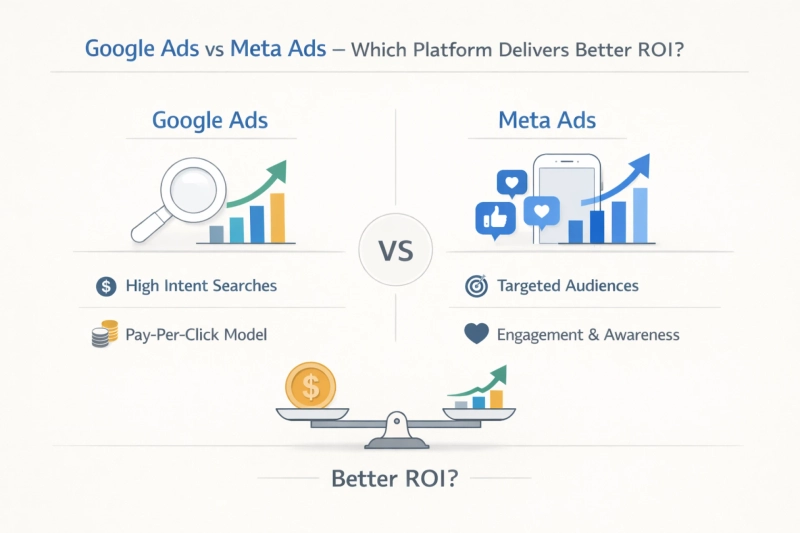
When businesses invest in paid advertising, one of the most common questions they ask is whether Google Ads or Meta Ads (Facebook & Instagram Ads) deliver better return on investment. Both platforms dominate the digital advertising space, yet they function very differently and serve different marketing goals.
Understanding how each platform works, where they perform best, and how they impact ROI is crucial for brands looking to generate consistent leads, sales, and long-term growth. As a digital marketing agency in Indore, we help businesses choose platforms based on performance data—not assumptions.
In this detailed blog, we will compare Google Ads vs Meta Ads, analyze their ROI potential, and help you decide which advertising platform is better for your business.
What Are Google Ads?
Google Ads is an intent-based advertising platform that allows businesses to show ads on Google Search, YouTube, Gmail, and partner websites. The most popular format is Google Search Ads, where text-based ads appear when users actively search for keywords related to products or services.
For example, when someone searches for “best digital marketing services near me” or “hotel booking agency”, the ads appearing at the top of the search results are Google Search Ads.
The biggest strength of Google Ads is user intent. People using Google are actively searching for solutions, making them more likely to convert. This makes Google Ads highly effective for lead generation and direct sales.
What Are Meta Ads?
Meta Ads include advertisements shown on Facebook, Instagram, Messenger, and the Meta Audience Network. These ads are visually driven and appear in feeds, stories, reels, and videos.
Unlike Google Ads, Meta Ads are interest-based, not search-based. Users are targeted based on demographics, interests, behavior, and previous interactions.
Meta Ads are excellent for:
- Brand awareness
- Audience discovery
- Engagement
- Remarketing
They help businesses introduce their brand to users who may not be actively searching but could still be potential customers.
Understanding ROI in Digital Advertising
ROI (Return on Investment) measures how profitable your ad campaigns are compared to how much you spend. In digital marketing, ROI is not limited to direct sales—it can also include leads, app installs, calls, engagement, and long-term customer value.
When comparing Google Ads and Meta Ads, it’s important to understand that both platforms contribute to ROI at different stages of the marketing funnel.
ROI Potential of Google Ads
Google Ads generally delivers higher direct ROI, especially for businesses focused on conversions.
Why Google Ads Performs Well for ROI
- Targets users with high purchase intent
- Higher conversion rates due to active searches
- Faster results and measurable outcomes
- Strong control over keywords, bids, and budgets
Because users are already looking for solutions, Google Ads often generate high-quality leads. However, competitive industries may face higher cost per click, which requires proper keyword selection and optimization.
This is why many brands prefer working with a google ad agency indore to manage bids, keywords, and landing page performance efficiently.
ROI Potential of Meta Ads
Meta Ads usually have lower cost per click, but conversions may take longer because users are not actively searching.
Where Meta Ads Deliver Strong ROI
- Brand awareness campaigns
- Audience engagement
- Video and creative storytelling
- Remarketing campaigns
Remarketing on Meta Ads often delivers excellent ROI by targeting users who have already visited your website or interacted with your content. Over time, Meta Ads play a major role in reducing overall cost per acquisition.
Which Platform Gives Better ROI?
In most cases, Google Ads delivers better direct ROI, especially for businesses that depend on immediate leads or sales.
However, Meta Ads should not be seen as less effective. Instead, Meta Ads support ROI indirectly by building awareness, nurturing audiences, and strengthening remarketing performance.
From our experience as a best google ad agency in indore, the most profitable campaigns rarely rely on a single platform.
When Google Ads Is the Better Choice
Google Ads works best when:
- People actively search for your service or product
- You want immediate leads or inquiries
- You operate in industries like real estate, healthcare, education, hotels, or professional services
Local businesses especially benefit from Google Ads due to high-intent searches like “near me” or “best service provider”.
When Meta Ads Make More Sense
Meta Ads are ideal when:
- You want to build brand awareness
- You are launching a new business or product
- You want strong remarketing performance
- Visual storytelling is important
Meta Ads also work well for nurturing cold audiences before converting them through search or remarketing campaigns.
Best ROI Strategy: Using Google Ads and Meta Ads Together
The most effective digital marketing strategies combine both platforms.
Google Ads capture high-intent users, while Meta Ads nurture and remarket those users across social platforms. This full-funnel approach improves overall ROI and reduces dependency on one channel.
That’s why many brands working with a digital marketing agency indore adopt a multi-platform advertising strategy for sustainable growth.
Budget Allocation for Maximum ROI
For most small and medium-sized businesses:
- Allocate 60–70% budget to Google Ads for conversions
- Allocate 30–40% budget to Meta Ads for awareness and remarketing
Budgets should always be optimized based on performance data.
Common Mistakes That Reduce ROI
- Running Meta Ads without remarketing
- Choosing high-cost Google keywords without intent
- Ignoring conversion tracking
- Poor landing page experience
- Not aligning ad creatives with the funnel stage
Avoiding these mistakes alone can significantly improve ROI.
Role of Landing Pages in ROI
No matter the platform, ROI depends heavily on landing page quality. Fast loading speed, mobile optimization, clear messaging, and strong CTAs are essential for converting traffic into leads or sales.
Final Conclusion
Google Ads and Meta Ads serve different purposes, but both are essential for a high-performing advertising strategy.
Google Ads usually deliver higher direct ROI due to strong search intent, while Meta Ads improve long-term ROI through awareness, engagement, and remarketing.
Businesses that partner with the best google ad agency in indore understand that real success comes from using Google Ads and Meta Ads together—not choosing one over the other.
With the right strategy, tracking, and optimization, both platforms can drive consistent growth and measurable ROI.