



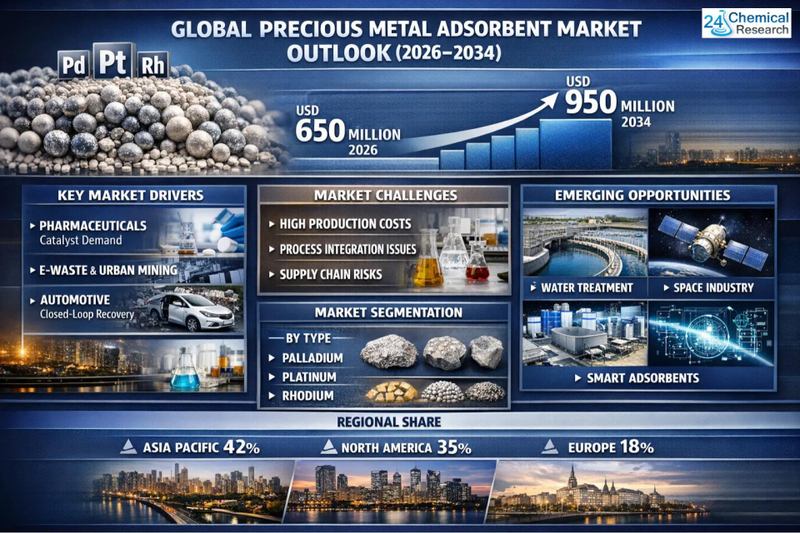
Global Precious Metal Adsorbent market was valued at US$ million in 2023 and is projected to reach US$ million by 2030, exhibiting a steady CAGR during the forecast period.
Precious metal adsorbents represent a critical component in modern industrial processes, offering unparalleled efficiency in capturing and recovering valuable metals like palladium, platinum, and rhodium. These materials have transitioned from niche laboratory applications to becoming indispensable in sectors ranging from pharmaceutical manufacturing to electronics recycling. Their unique molecular structures enable selective metal capture even from complex waste streams, making them fundamental to sustainable resource recovery in today's circular economy.
Get Full Report Here: https://www.24chemicalresearch.com/reports/265588/global-precious-metal-adsorbent-market-2024-2030-789
Market Dynamics:
The precious metal adsorbent market operates at the intersection of environmental responsibility and economic necessity, with its evolution driven by both regulatory pressures and technological advancements across multiple industries.
Powerful Market Drivers Propelling Expansion
- Pharmaceutical Industry's Catalyst Revolution: The pharmaceutical sector's insatiable demand for palladium and platinum-based catalysts in drug synthesis represents the primary growth vector. Modern APIs (Active Pharmaceutical Ingredients) increasingly incorporate these metals, with adsorbents playing a crucial role in meeting strict purity standards. Recent FDA guidance on metal impurities has made high-performance adsorbents not just beneficial but mandatory for drug manufacturers seeking market approval.
- Urban Mining and E-Waste Recycling: The electronics waste crisis has transformed into a commercial opportunity through urban mining. Precious metal adsorbents enable recovery rates of 90-95% from waste streams, creating a secondary supply chain that mitigates price volatility in virgin metal markets. With global e-waste volumes expected to exceed 74 million metric tons annually by 2030, adsorbent technologies are becoming the backbone of responsible resource management.
- Automotive Sector's Clean Technology Push: The transition to electric vehicles hasn't diminished the importance of platinum group metals - rather, it's shifted their applications to fuel cells and advanced battery systems. Automakers' sustainability commitments now include closed-loop metal recovery systems, where adsorbents play a pivotal role in maintaining supply chain sustainability.
Download FREE Sample Report: https://www.24chemicalresearch.com/download-sample/265588/global-precious-metal-adsorbent-market-2024-2030-789
Significant Market Restraints Challenging Adoption
While the market shows strong potential, several barriers must be addressed to reach full commercialization potential.
- High Specialty Chemical Costs: The advanced ligand chemistry required for selective metal adsorption carries significant R&D costs. Production of these specialized materials often involves complex synthesis pathways requiring controlled environments and scarce precursor materials. These factors combine to keep production costs 25-35% higher than conventional adsorbents, posing adoption challenges in price-sensitive markets.
- Process Integration Complexities: Retrofitting existing metal recovery systems to accommodate advanced adsorbents frequently requires substantial capital expenditure. Many industrial facilities face compatibility issues with new adsorbent chemistries, necessitating complete process overhauls that can idle production lines for weeks. This creates resistance among operators reluctant to disrupt established workflows.
Critical Market Challenges Requiring Innovation
The industry faces technical hurdles in scaling laboratory success to industrial implementations. Maintaining adsorption efficiency at flow rates exceeding 500 liters per minute remains problematic, with many adsorbents experiencing 20-30% performance degradation under continuous flow conditions. Additionally, regenerating spent adsorbents for repeated use while maintaining >90% recovery efficiency still presents engineering challenges, particularly for complex multi-metal solutions.
Supply chain vulnerabilities also pose ongoing concerns. The specialized resins and ligand compounds used in premium adsorbents often have single-source suppliers, creating potential bottlenecks. Recent trade tensions have demonstrated how geopolitical factors can suddenly restrict access to critical raw materials, forcing manufacturers to maintain costly inventory buffers.
Vast Market Opportunities on the Horizon
- Water Treatment Applications: Municipal water systems are emerging as unexpected growth areas for precious metal adsorbents. Trace concentrations of platinum from automotive catalytic converters now appear in urban water supplies, creating both environmental concerns and recovery opportunities. New adsorbent chemistries capable of operating in ppm concentration ranges open a $500 million potential market in wastewater remediation.
- Space Industry Applications: The commercialization of space travel creates unique metal recovery challenges where every gram counts. Lightweight, high-efficiency adsorbent systems for recovering precious metals from spacecraft wastewater and life support systems represent an exciting frontier. Early prototypes have demonstrated 92% recovery rates in microgravity, paving the way for orbital recycling systems.
- Digital Integration Advancements: The intersection of adsorbent technology with IoT represents a game-changing opportunity. Smart adsorbent systems incorporating real-time metal concentration sensors and predictive regeneration algorithms could reduce operational costs by 40% while boosting recovery yields. Several pilot projects already demonstrate the potential for blockchain integration to certify metal provenance from recovery through reuse.
In-Depth Segment Analysis: Where is the Growth Concentrated?
By Type:
The market segments into Palladium Adsorbent, Platinum Adsorbent, Rhodium Adsorbent, and others. Palladium Adsorbents currently dominate, fueled by their critical role in pharmaceutical catalysis and dental applications. However, rhodium adsorbents are experiencing the fastest growth, responding to increasing demand from the automotive and chemical catalyst sectors where rhodium prices have shown extreme volatility.
By Application:
Segmentation includes Medicine, Metal Recycling, Electronic Chemicals, and others. Metal Recycling constitutes the largest segment, as recyclers seek to maximize yields from increasingly lean feedstocks. The Medicine segment follows closely, driven by tightening regulatory standards for metal contamination in pharmaceuticals.
By End-User Industry:
End users span Pharmaceuticals, Automotive, Electronics, and Chemical Manufacturing. The Pharmaceutical industry leads in adoption rates, where stringent quality requirements justify premium adsorbent solutions. Electronics manufacturers represent the fastest-growing segment as they implement comprehensive resource recovery programs.
Download FREE Sample Report: https://www.24chemicalresearch.com/download-sample/265588/global-precious-metal-adsorbent-market-2024-2030-789
Competitive Landscape:
The global Precious Metal Adsorbent market features a mix of chemical giants and specialized material science firms. The three dominant players—BASF (Germany), Y.S. Techno (Japan), and Shaanxi Rock New Materials (China)—hold approximately 50% combined market share. Their leadership stems from vertical integration strategies that combine adsorbent production with complementary catalyst and recycling services.
List of Key Precious Metal Adsorbent Companies Profiled:
- BASF (Germany)
- Y.S. Techno (Japan)
- Shaanxi Rock New Materials (China)
- Shanghai Jiu Ling Chemical (China)
- Si-Novation (Korea)
- Bangkai (China)
Competitive differentiation increasingly comes through application-specific formulations. Leading players now offer customized adsorbent solutions tailored to particular industrial waste streams or metal combinations, moving beyond one-size-fits-all products. Service models are also evolving, with several firms offering metal recovery as a managed service rather than just selling adsorbent materials.
Regional Analysis: A Global Footprint with Distinct Leaders
- Asia-Pacific: Commands 42% of global demand, driven by China's massive electronics manufacturing and Japan's advanced pharmaceutical sector. The region's rapid industrialization and growing emphasis on circular economy principles fuel adoption. China's recycling initiatives and Japan's precision chemical needs create complementary demand drivers.
- North America: Represents 35% of the market, with strength in pharmaceutical and high-tech applications. The U.S. lead stems from stringent EPA regulations on metal discharges and pharmaceutical industry quality standards. Canada's mining sector provides additional demand for metal recovery solutions.
- Europe: Accounts for 18% market share, distinguished by advanced recycling infrastructure and automotive sector adoption. Germany's chemical industry and Scandinavia's sustainability focus drive regional innovation. The EU's circular economy action plan continues to stimulate adsorbent technology development.
Get Full Report Here: https://www.24chemicalresearch.com/reports/265588/global-precious-metal-adsorbent-market-2024-2030-789
Download FREE Sample Report: https://www.24chemicalresearch.com/download-sample/265588/global-precious-metal-adsorbent-market-2024-2030-789
About 24chemicalresearch
Founded in 2015, 24chemicalresearch has rapidly established itself as a leader in chemical market intelligence, serving clients including over 30 Fortune 500 companies. We provide data-driven insights through rigorous research methodologies, addressing key industry factors such as government policy, emerging technologies, and competitive landscapes.
- Plant-level capacity tracking
- Real-time price monitoring
- Techno-economic feasibility studies
International: +1(332) 2424 294 | Asia: +91 9169162030
Website: https://www.24chemicalresearch.com/