



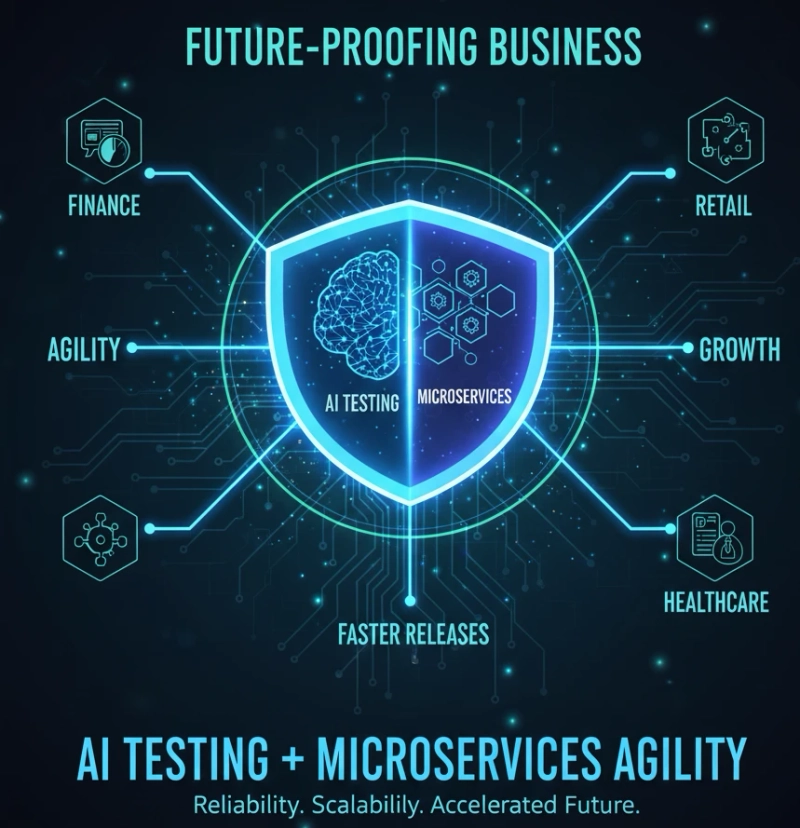
Businesses working toward achieving digital transformation seek fast yet precise techniques. That implies adopting tools where shorter time-to-insight (TTI) does not increase biases. Scaling, adapting, and updating without breaking user experiences are also among the non-negotiable conditions. AI testing and microservices ensure that companies can fulfill those responsibilities while accelerating operations and deliveries. This post will highlight the role of AI testing and microservices integration for future-proofing businesses through unprecedented agility.
Why AI Testing is Gaining Momentum Across the World
AI-powered product testing demands continuous optimization and significant investment, but corporations still pursue it. Why? Because, unlike traditional software and standalone machine learning models, AI systems exhibit better outcomes and decrease human effort. They can correct themselves when the output fails to meet user expectations. Therefore, leveraging artificial intelligence solutions for product ideation, prototyping, and testing has attracted product development leaders.
Automated AI testing platforms such as MLflow and Tricentis enable product engineers to catch performance issues upstream. These platforms continuously evaluate models based on core metrics. If AI integrations encounter accuracy degradation or increased bias, they can alert stakeholders. Advanced systems can also demonstrate agentic features where they will rectify simpler problems on-site without being explicitly instructed by supervisory professionals. Through alerts and logs, stakeholders can keep track of how AI tests are progressing.
Microservices and Their Agility Benefits
Microservices architectures excel at breaking multi-purpose products and processes into small, independent service modules. Therefore, businesses can future-proof their tech stack by embracing independently developed and deployed task-specific tools. This approach indicates that microservices development services remarkably increase the flexibility of technology selection and the speed at which new product features can go live.
Noteworthy tools that facilitate such modularization include the following utilities:
- Istio for service mesh
- Jenkins for automation
- AWS Lambda for serverless functions
AI Testing in Microservices Pipelines for Agility Improvement
AI testing naturally integrates with microservices-based CI/CD workflows. Here, CI stands for continuous integration, while CD is all about continuous delivery. Consequently, each service that uses machine learning can benefit from AI-assisted containers and dedicated validation methods involving AI tests. In the long run, that workflow leads to better stability despite distinct modules getting new features.
Related agility improvements originate from decreased risk of downtime due to compatibility or interdependency issues. Gone are the days when developers and testers had to update countless databases to release one new feature. The same is valid for cybersecurity measures and bug removal.
Automated pipelines run model checks in GitLab CI and GitHub Actions before any deployment reaches production. As an example, an e-commerce fraud detection microservice can test its model via AI testing based on synthetic or historical data.
So, when that fraud detector goes live, the chance of incompatibility, governance inconsistency, and user experience failures is minuscule. That increases client trust.
Industry Use Cases
Today, brands across finance, retail, and healthcare depend on AI testing tools to avoid the risks created by unpredictable machine learning model behaviors. Especially for industries handling extremely sensitive information, even an occasional deterioration in test integrity and quality assurance can hurt many people.
Prevention of such a disaster necessitates timely validation, and AI technology now offers 24/7 support in this area.
Conclusion
When each and every service has to undergo automated model validation, overall product reliability increases significantly. In turn, agility in decision-making increases because stakeholders have fewer reasons to worry about one feature update breaking the entire system. AI tests are also prone to the known transparency drawbacks, but explainable AI projects represent a growing movement toward fixing that.
In short, human input is necessary for AI testing systems when they are still in their infancy. However, for future-proofing purposes, businesses must start experimenting with them with expert oversight as soon as possible.