



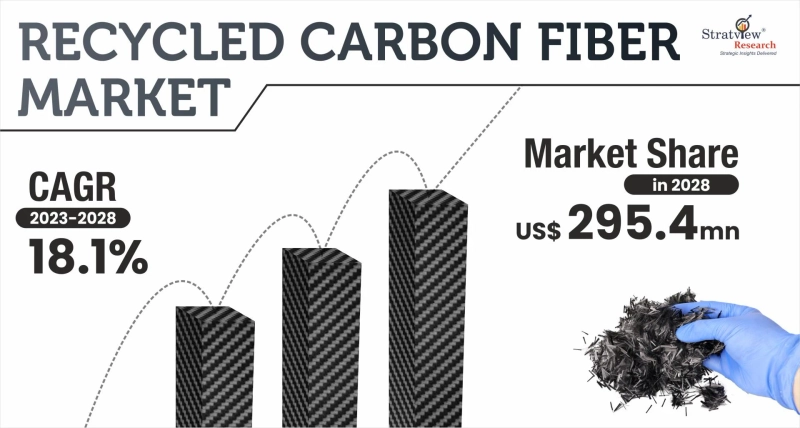
The global recycled carbon fiber market was estimated at USD 104 million in 2022 and is projected to grow at a remarkable CAGR of 18.1% from 2023 to 2028, reaching USD 295.4 million in 2028, according to Stratview Research. This robust expansion underscores an increasing demand for sustainable, high-performance alternatives to virgin carbon fiber.
Download the Free Sample Report Here:
https://www.stratviewresearch.com/Request-Sample/953/recycled-carbon-fiber-market.html#form
 Market Drivers
Several compelling factors are fueling this growth trajectory:
- Environmental sustainability: Recycling carbon fiber helps reduce waste and lower carbon emissions. Estimates suggest replacing 1 kg of virgin carbon fiber through recycling saves roughly 3 kg of CO₂, and substituting 1.5 kg of steel with 1 kg of recycled carbon fiber saves about 15 kg of CO₂.
- Resource and cost efficiency: With virgin carbon fiber production being resource- and cost-intensive, recycling offers an economical way to reuse high-strength fiber materials.
- Regulatory pressure and circular economy policies: Stricter waste management and emissions regulations worldwide are boosting adoption of recycled materials, particularly in industries like automotive and aerospace.
- Industrial collaborations: Notable initiatives, such as Formosa Plastics partnering with CATACK-H and Teijin forming alliances for low-impact CFRP products, highlight growing commitment to recycling solutions.
Segment Analysis
Stratview Research breaks down the market into several insightful segments:
- By Form Type:
- Chopped recycled carbon fiber is dominant, due to low cost, ease of processing (e.g., injection molding), and broad usability in composites.
- By Source Type:
- Aerospace scrap leads, driven by high volumes of CFRP in modern aircraft (e.g., 50–53% carbon fiber makeup in Boeing 787 and Airbus A350) and increasing aircraft retirements.
- By Waste Form Type:
- Prepreg waste is most frequently recycled, owing to its uniform resin-fiber structure and minimal contamination, simplifying recovery.
- By End-Use Industry:
- Automotive & Transportation are the biggest consumers—used in interiors, bumpers, engine covers, and other components—thanks to growing demand for lightweight, cost-effective materials.
- By Region:
- Europe is predicted to remain both the largest and fastest-growing market, supported by a strong circular economy ethos, robust automotive and aerospace industries, and active recycling players like Procotex, Gen 2 Carbon, and Fairmat.
Emerging Trends
- Growing industry collaboration: Partnerships between manufacturers and recyclers are scaling infrastructure and adoption.
- Increased automotive uptake: Growing demand for lighter, more efficient vehicles is driving recycled carbon fiber use in automotive segments.
- Circular economy leadership in Europe: Policymaker support and industrial commitment position Europe as a sustainability frontrunner.
Conclusion
Projected to grow from USD 104 million in 2022 to USD 295.4 million in 2028, at an impressive 18.1% CAGR, the recycled carbon fiber market is gaining serious traction. Driven by sustainability demands, regulatory pressure, and cost advantages, recycled carbon fiber is being increasingly embraced—especially in automotive and aerospace. Europe leads the charge, supported by strong institutional frameworks and industrial ecosystems. Looking ahead, collaboration and technology innovation will continue to enhance recycled carbon fiber’s value proposition.