



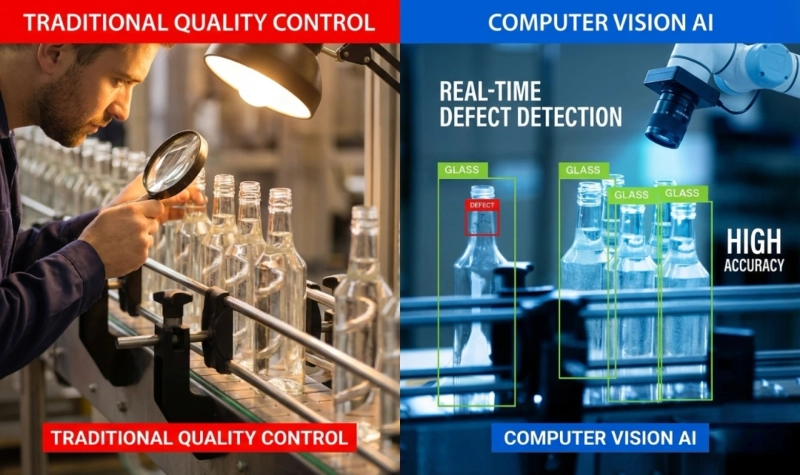
Manufacturing industries today are under immense pressure to deliver flawless products at scale while keeping costs low and production speed high. Even minor defects—scratches, misalignments, surface deformities, or assembly errors—can lead to product recalls, revenue loss, and reputational damage. Traditional quality inspection methods, heavily dependent on manual checks and rule-based automation, often fail to keep up with modern manufacturing demands.
This is where AI-powered computer vision is redefining quality assurance. By analyzing visual data in real time, intelligent vision systems can detect defects with unmatched accuracy and consistency. In fact, computer vision in detecting manufacturing defects has become a critical enabler for smart factories aiming to achieve zero-defect manufacturing and Industry 4.0 readiness.
In this blog, we explore how computer vision AI is revolutionizing defect detection, improving production efficiency, and helping manufacturers move from reactive quality control to proactive, data-driven decision-making.
Understanding Manufacturing Defects and Their Impact
Manufacturing defects can occur at any stage of production—raw material handling, machining, assembly, or packaging. Common defect types include:
- Surface defects such as cracks, dents, scratches, or discoloration
- Dimensional inaccuracies and misalignments
- Missing or incorrect components
- Welding and soldering defects
- Packaging and labeling errors
When defects go unnoticed, they lead to increased scrap rates, rework costs, production delays, and customer dissatisfaction. Manual inspection is not only time-consuming but also prone to fatigue and inconsistency, especially in high-volume manufacturing environments.
What Is Computer Vision AI in Manufacturing?
Computer vision AI uses advanced algorithms, deep learning models, and high-resolution cameras to “see” and interpret visual information—similar to how humans inspect products, but at machine speed and precision.
By training AI models on thousands of images of defective and non-defective products, computer vision systems learn to identify even the smallest anomalies that the human eye may miss. These systems operate continuously, ensuring consistent quality inspection across production lines.
Key Benefits of Computer Vision AI for Defect Detection
1. Real-Time Defect Detection at Scale
Computer vision systems analyze products in real time as they move along the production line. This allows manufacturers to:
- Instantly detect defects
- Remove faulty items before they proceed further
- Prevent defective batches from reaching customers
Real-time inspection ensures that quality issues are addressed immediately rather than after production is complete.
2. Higher Accuracy and Consistency
Unlike manual inspection, AI-powered vision systems do not suffer from fatigue or subjective judgment. They deliver:
- Uniform inspection standards
- Micron-level defect detection
- Reliable results across shifts and locations
This consistency is essential for industries such as automotive, electronics, pharmaceuticals, and aerospace.
3. Reduced Waste and Operational Costs
Early detection of defects minimizes scrap and rework. By identifying the root causes of defects, manufacturers can:
- Optimize production processes
- Reduce material waste
- Lower labor and quality control costs
Over time, this leads to significant cost savings and improved profitability.
4. Predictive Quality and Process Optimization
Beyond defect detection, computer vision AI provides actionable insights by analyzing defect patterns. When combined with analytics, manufacturers can:
- Identify recurring defects
- Predict quality issues before they escalate
- Fine-tune machinery and workflows
This shifts quality control from reactive to predictive, enabling continuous improvement.
5. Seamless Integration with Smart Factory Systems
Computer vision solutions integrate seamlessly with existing manufacturing systems such as PLCs, MES, ERP, and IoT sensors. This enables:
- Automated alerts and reporting
- Data-driven decision-making
- End-to-end visibility across production lines
Such integration is a cornerstone of Industry 4.0 and smart manufacturing ecosystems.
Industry Use Cases of Computer Vision Defect Detection
- Automotive manufacturing: Detecting welding defects, paint inconsistencies, and component misalignment
- Electronics: Identifying PCB defects, missing components, and soldering issues
- Pharmaceuticals: Inspecting tablets, capsules, and packaging for contamination or labeling errors
- Food & beverage: Ensuring packaging integrity, correct labeling, and contamination-free products
Nextbrain: Driving Intelligent Quality Inspection with AI
At Nextbrain, we specialize in building advanced AI-powered computer vision solutions tailored for modern manufacturing environments. Our defect detection platforms leverage AI Video analytics software to analyze production lines in real time, ensuring defects are identified with high accuracy even at high speeds.
What Nextbrain Offers:
- Custom-trained computer vision models for specific manufacturing defect types
- Real-time inspection dashboards powered by AI Video analytics software
- Automated alerts and actionable insights for quality teams
- Seamless integration with existing factory infrastructure, PLCs, and IoT systems
- Scalable solutions for single plants or multi-location manufacturing operations
By combining deep learning, visual intelligence, and industrial-grade AI, Nextbrain helps manufacturers reduce waste, prevent costly recalls, and achieve zero-defect manufacturing. Our solutions empower businesses to move from traditional quality control to intelligent, data-driven inspection systems.
Future of Defect Detection in Manufacturing
As AI models become more sophisticated, computer vision systems will continue to evolve. Future advancements include:
- Self-learning models that adapt to new defect types
- 3D vision for complex surface inspections
- Edge AI for ultra-low-latency inspection
- Autonomous quality control systems
Manufacturers that adopt these technologies early will gain a competitive advantage in efficiency, quality, and customer trust.
Conclusion
Computer vision AI is no longer a futuristic concept—it is a proven technology reshaping modern manufacturing. From real-time defect detection and predictive quality insights to reduced costs and improved consistency, AI-powered vision systems are transforming how manufacturers ensure product quality.
By adopting intelligent inspection solutions, manufacturers can eliminate defects, optimize processes, and stay ahead in a highly competitive market.
Contact Nextbrain today to discover how our AI-powered computer vision solutions can help you build smarter, defect-free manufacturing operations.
Frequently Asked Questions (FAQs)
1. What is computer vision AI in manufacturing?
Computer vision AI uses cameras and deep learning algorithms to visually inspect products, detect defects, and ensure consistent quality in manufacturing processes.
2. How accurate is computer vision in detecting manufacturing defects?
AI-powered vision systems can achieve accuracy levels higher than manual inspection, detecting micro-level defects consistently and in real time.
3. Can computer vision replace human quality inspectors?
Computer vision complements human inspectors by handling repetitive, high-speed inspections, allowing humans to focus on complex decision-making and process improvement.
4. Is computer vision suitable for all manufacturing industries?
Yes, computer vision is widely used in automotive, electronics, pharmaceuticals, food & beverage, and heavy manufacturing industries.
5. How long does it take to implement a computer vision defect detection system?
Implementation timelines vary based on complexity, but most solutions can be deployed within weeks with proper data collection and model training.