



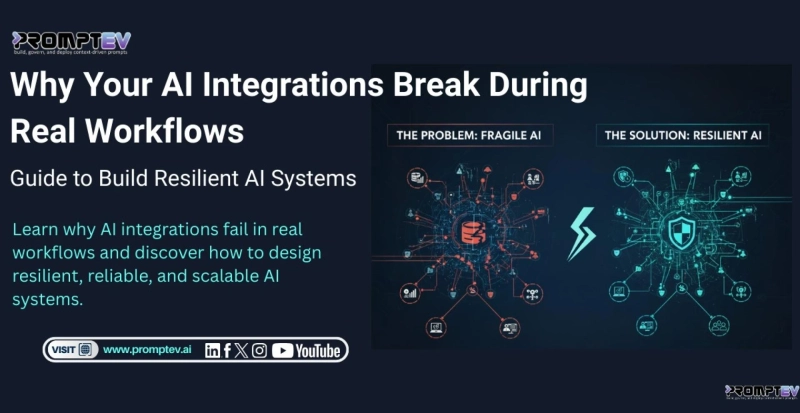
For many teams, AI adoption starts with a prompt. A well-written prompt produces impressive results in a demo. Stakeholders are excited. The system looks intelligent. Everything feels ready for launch. Then the AI enters real workflows—and things start to break.
Responses become inconsistent. Context gets lost. Edge cases pile up. Trust slowly erodes. The problem isn’t the model. The problem is trying to run prompt-level AI in production environments.
Why Prompt-Based AI Doesn’t Scale
Prompts are powerful, but they are not systems.
Most prompt-based AI implementations assume:
- Clean inputs
- Linear interactions
- One-shot responses
- Static context
Real workflows violate all of these assumptions.
In production:
- Users behave unpredictably
- Data changes between steps
- Multiple tools and systems are involved
- Decisions depend on historical context
Without structure, AI becomes fragile the moment it’s exposed to real work.
The Gap Between Experimentation and Production
AI experimentation is about possibility. Production AI is about reliability.
Many teams get stuck in between.
They have:
- Good prompts
- Strong models
- Initial success
But they lack:
- Workflow awareness
- Context continuity
- Fallback mechanisms
- Visibility into AI behavior
This gap is where most AI integrations quietly fail.
What “Production-Ready AI” Actually Means
Production-ready AI is not defined by intelligence alone. It’s defined by resilience.
Resilient AI systems are designed to:
- Maintain structured context across multiple steps
- Adapt when inputs or conditions change
- Detect degraded outputs before users do
- Support human intervention when needed
Instead of collapsing under pressure, they continue to function predictably.
The Shift: From Prompts to Systems
To survive real-world workflows, AI must be treated as part of a system—not a standalone feature.
This means moving beyond prompts and focusing on:
- Context engineering instead of prompt tweaking
- Workflow-aware execution instead of isolated responses
- Observability instead of blind automation
- Long-term consistency instead of short-term accuracy
AI systems that succeed in production are engineered, not improvised.
Designing AI for Real Workflows
Real workflows are rarely simple.
They include:
- Multiple decision points
- Conditional logic
- Human approvals
- Integration with existing tools and data
AI systems must be designed to operate within these constraints.
This requires:
- Clear role definition for AI within the workflow
- Structured inputs and outputs
- Guardrails for edge cases
- Continuous feedback and refinement
When AI understands the workflow, it stops being reactive and starts being reliable.
Why Reliability Builds Trust
Users don’t need AI to be perfect. They need it to be predictable.
When AI behaves consistently:
- Adoption increases
- Manual overrides decrease
- Teams rely on it for critical tasks
Reliability is what turns AI from an experiment into infrastructure.
How Promptev Helps Bridge the Gap
Promptev is built for teams moving from AI experimentation to production.
It helps teams:
- Design structured, context-aware AI workflows
- Maintain consistency across real-world use cases
- Gain visibility into AI behavior and outputs
- Build systems that scale without breaking
Instead of asking “Does this prompt work?”, teams using Promptev ask:
“Will this AI still work under real operational pressure?”
The Future of AI Is Operational
The next phase of AI adoption won’t be defined by better prompts or larger models.
It will be defined by:
- Stronger systems
- Better context management
- Reliable execution at scale
Teams that make this shift early will build AI that lasts.
Those that don’t will keep fixing broken workflows.
Want to Go Deeper?
If you’re serious about building AI that survives real-world workflows, read the full guide on designing resilient AI systems:
https://promptev.ai/ai-integrations-break-build-resilient-ai-systems/