



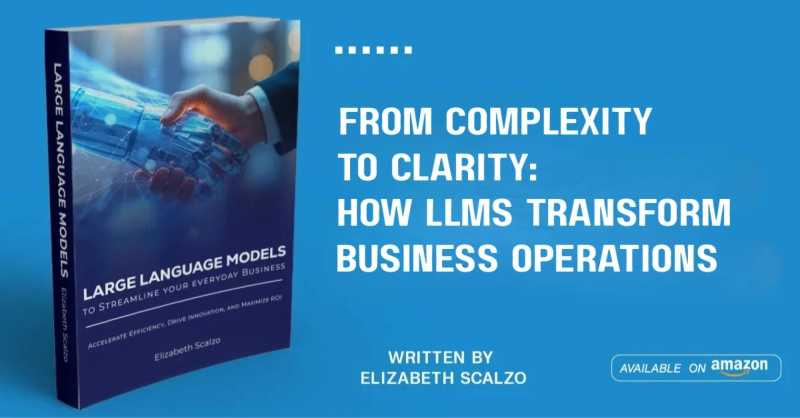
Artificial intelligence can feel overwhelming for many business leaders. Complex terminology, rapidly evolving technology, and concerns about implementation often create hesitation. In Large Language Models to Streamline Your Everyday Business, Elizabeth Scalzo demystifies AI, providing clear, actionable guidance for integrating Large Language Models (LLMs) into business operations. Her approach empowers leaders to move from uncertainty to strategic confidence.
Scalzo begins by highlighting the practical benefits of AI integration. LLMs can automate routine tasks, freeing up valuable time for employees to focus on higher-impact activities. From responding to customer inquiries to generating reports, these models streamline processes that would otherwise consume significant resources. The book provides step-by-step strategies that make implementation realistic and measurable, ensuring that automation translates into tangible efficiency gains.
Decision-making is another area where LLMs provide a competitive edge. Scalzo demonstrates how AI can process vast amounts of data to identify patterns, forecast trends, and inform strategic choices. This data-driven approach reduces risk and enhances organizational agility, allowing businesses to respond quickly to changing market conditions. Leaders learn not only to use AI but also to interpret its outputs responsibly and effectively.
Organizational resilience is a recurring theme. Scalzo emphasizes that AI integration is not merely about efficiency it’s about preparing companies to thrive in a rapidly shifting business environment. By embedding LLMs into core processes, organizations become more adaptable, capable of innovation, and better equipped to handle disruptions. The book stresses that technology alone is not enough; leadership, culture, and strategy are equally critical.
Ethics, security, and data privacy receive careful attention. Scalzo provides guidance on implementing AI responsibly, ensuring that organizational practices align with both legal standards and ethical norms. This emphasis builds trust internally and externally, positioning businesses for sustainable AI adoption that respects stakeholders and mitigates risk.
Measuring success and ROI is another key component. The book helps leaders evaluate AI initiatives using meaningful metrics, ensuring that every investment produces real value. Scalzo’s methodology transforms AI from an abstract concept into a strategic asset with measurable outcomes.
The author also emphasizes leadership during digital transformation. Integrating AI can be challenging, and Scalzo equips leaders with the skills to guide teams through change. By fostering understanding, building confidence, and creating a culture of innovation, leaders can ensure that AI adoption is both smooth and effective.
Finally, Scalzo’s approachable style makes the book accessible. Complex concepts are broken down into actionable steps, illustrated with real-world examples that highlight both challenges and successes. Readers walk away not only with a roadmap for AI integration but also with the confidence to lead their organizations through a technological revolution.
In short, Large Language Models to Streamline Your Everyday Business is more than a technical guide; it is a leadership manual for the AI era. By combining practical strategies, ethical guidance, and performance measurement, Elizabeth Scalzo equips business leaders to harness LLMs, improve efficiency, and drive innovation with measurable results.