



Introduction
The term fetch ai prognose has become increasingly popular among investors who are looking for exposure to artificial intelligence within the crypto market. The FET token sits at the intersection of two powerful narratives: decentralized infrastructure and AI‑powered automation, and this combination naturally attracts both traders and long‑term believers in the technology. At the same time, price forecasts for Fetch.ai vary widely, from conservative models that assume slow, steady growth to aggressive projections that factor in a full‑blown AI supercycle over the next decade.
This article breaks down what Fetch.ai is doing, why the fetch ai prognose looks so different from one source to another, and which factors are likely to influence FET’s performance between now and 2030. The goal is not to promise a specific number, but to help investors think in realistic scenarios and understand the risks that come with such a speculative segment.
What is Fetch.ai and FET?
Fetch.ai began as a platform focused on autonomous software agents that can perform tasks such as data trading, resource optimization, and service discovery on behalf of users and organizations. Over time, the project aligned more directly with the broader Artificial Superintelligence Alliance narrative, positioning FET as a core token for decentralized AI infrastructure and applications.
The FET token has several roles in the ecosystem: it is used to pay for network services, to reward agents and validators, and in some cases as a governance and staking asset that secures the underlying protocol. Because of this, any serious fetch ai prognose needs to look not only at price charts but also at real usage, developer interest, and partnerships that could drive demand for the token over time.
Overview of current market sentiment
Current market sentiment around FET is heavily influenced by the broader hype around AI, with many commentators framing Fetch.ai as one of several leading AI‑linked crypto projects. Analysts point to growing demand for AI + blockchain solutions, tokenomics that can tighten supply over time, and visible partnerships with established companies as positive signals for the medium and long term.
On the other hand, short‑term technical outlooks can be mixed, with some models classifying FET in a neutral or even “sell” zone temporarily, depending on momentum indicators and moving averages. For anyone using a fetch ai prognose as part of a trading plan, this means distinguishing between cyclical pullbacks and the long‑term structural story is essential.
Short‑term fetch ai prognose (next 12–24 months)
Most short‑term forecasts cluster around the idea of continued volatility with a generally upward bias if the crypto market remains constructive and AI narratives stay in focus. Different platforms present different ranges: some neutral models see relatively modest prices extending toward fractions of a dollar or low‑dollar levels by the mid‑ to late‑2020s, while more optimistic sources project FET moving into multi‑dollar territory as soon as the next strong bull phase.
For example, several forecasting sites outline scenarios where FET could reach or exceed its previous all‑time high and potentially move toward a few dollars per token if AI‑focused tokens lead the next altcoin cycle. At the same time, more conservative institutional‑style outlooks highlight that a flat or risk‑off macro environment could compress prices, leaving the token closer to its historical averages rather than its most aggressive targets.
Medium‑term outlook to 2025
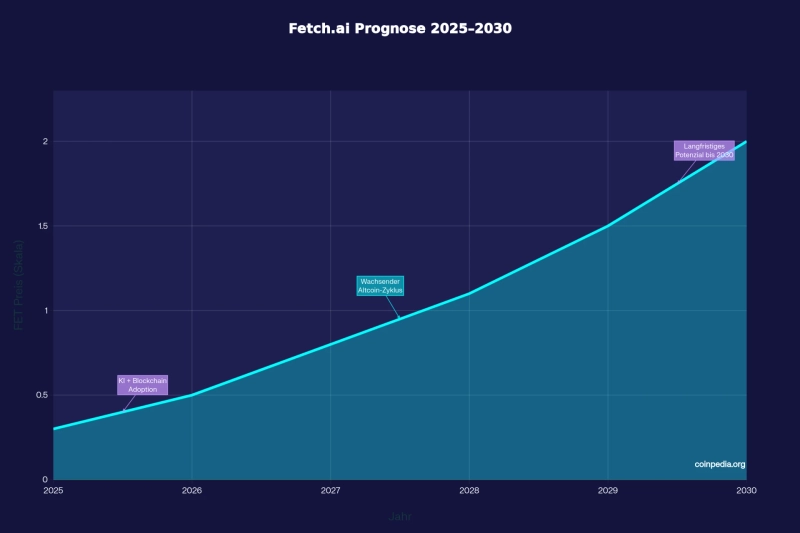
When it comes to a fetch ai prognose for 2025, most models agree on one thing: directionally they lean bullish, but the exact numbers vary dramatically. Some analytics‑driven forecasts suggest moderate gains and emphasize that even a steady annual growth rate would put FET meaningfully above current levels by 2025 or 2026. In contrast, more speculative projections see 2025 as a potential peak year for a broader crypto bull cycle, with FET benefiting from AI mania and possibly reaching high single‑digit or even double‑digit dollar values under their assumptions.
The biggest drivers in this period are likely to be:
- The strength and timing of the next major crypto bull market.
- Adoption of Fetch.ai’s infrastructure by real applications and enterprise partners.
- The competitive position of FET versus other AI‑themed tokens and data networks.
If those elements line up favorably, a constructive fetch ai prognose for 2025 is plausible, but it is important to remember that none of these outcomes are guaranteed.
Long‑term fetch ai prognose to 2030 and beyond
Long‑term predictions out to 2030, 2040 or even 2050 reflect the highest level of uncertainty but also the widest upside potential. Several long‑horizon models envision FET significantly above current prices by 2030, sometimes in the mid‑single‑digit to high‑single‑digit dollar range, while very aggressive outlooks imagine double‑digit prices or more under assumptions of massive AI and blockchain integration into everyday infrastructure.
These bold forecasts typically assume that:
- Decentralized AI networks become an essential layer for smart cities, autonomous transport, and industrial automation.
- Fetch.ai or the wider Artificial Superintelligence Alliance maintain a leading position among competing AI‑crypto projects.
- Tokenomics, including any burn or emission mechanisms, keep circulating supply in check relative to growing demand.
However, other outlets present much more cautious long‑term ranges, keeping 2030 prices closer to or only moderately above previous highs and emphasizing the high probability that some ambitious assumptions will not fully materialize. For a realistic fetch ai prognose, it makes sense to treat extreme bullish cases as aspirational and stress‑test portfolios against less favorable outcomes.
Key factors that shape the fetch ai prognose
Across different research sites and models, several recurring themes appear when analysts explain their forecasts for FET.
- Technology and roadmap delivery: Progress on core infrastructure, autonomous agent frameworks, interoperability, and performance upgrades can directly influence how attractive the network is to developers.
- Real‑world adoption and partnerships: Collaborations with enterprises, smart‑city projects, or DeFi platforms can translate narrative into real demand for FET‑denominated services.
- Macro and regulatory climate: Interest rates, global risk appetite, and crypto regulation heavily impact how much capital flows into high‑beta sectors such as AI tokens.
- Competition: New and existing AI‑focused crypto projects are pushing their own solutions and incentives, which could fragment liquidity and attention if Fetch.ai does not keep innovating.
Understanding these variables helps put any numerical fetch ai prognose into context: numbers change quickly, but drivers like adoption, token design, and competitive edge are more structural and easier to track over time.
Opportunities for investors
From an opportunity perspective, the main appeal behind a positive fetch ai prognose lies in the possibility that Fetch.ai becomes one of the core infrastructures for decentralized AI services. If AI continues to move into mainstream enterprise use cases and on‑chain coordination remains attractive, then a token linked to such an ecosystem could benefit from recurring demand and increased visibility.
Investors also see potential upside in the reflexive nature of narratives: as AI tokens trend on major exchanges and social platforms, speculative flows can temporarily push prices far above what fundamentals alone might justify. For traders who manage risk actively, this volatility can create opportunities, although it also increases the chance of sharp corrections.
Risks and limitations of any fetch ai prognose
It is equally important to balance these opportunities with clear risks. Forecasts for 2025–2030 and beyond rely on assumptions that may not hold, including continuous AI adoption, favorable regulation, and competitive strength of the project over many years. In a worst‑case scenario, a combination of regulatory pressure, failed execution, or loss of market interest could leave FET significantly below its most conservative projections.
Another key limitation is that long‑term crypto models often extrapolate from relatively short historical data series and volatile price histories. For that reason, no fetch ai prognose should be treated as financial advice or as a guarantee; instead, investors should use these scenarios as one input among many, alongside their own risk tolerance, time horizon, and portfolio strategy.