


Not all cables are designed to survive heat, chemicals, vibration, and tight installation spaces. That is where high-performance insulation materials come into play. While other options are renowned for their exceptional resilience to heat and harsh environments, the FEP cable stands out among them for its flexibility and clean finish. Selecting the best one is not merely a technical choice as it has an impact on reliability, safety, and maintenance costs.
Industries such as automotive, EV manufacturing, aerospace, medical equipment, and telecom rely on cables that don’t fail under pressure. That is why the conversation around material selection has shifted from “what conducts better” to “what protects better.” In that space, the debate between materials like FEP cable and others has become increasingly relevant. Both materials belong to the family of fluoropolymers, but they perform differently when exposed to temperature, chemicals, and mechanical stress.
Understanding these differences helps engineers, manufacturers, and designers make better decisions at the drawing board, not after installation. When conditions involve constant temperature fluctuations, chemical exposure, or space limitations, picking the wrong insulation can lead to inefficiencies or even breakdowns.
Now that the stage is set, the next step is to understand why industries are even comparing these materials in the first place. That’s where the real-world importance of PTFE cable and its alternatives begins to unfold.
Why This Comparison Matters
Temperature spikes in engines, chemical exposure in factories, tight wiring inside EV battery packs — cables today go through harsher conditions than ever before. That is why choosing the right insulation material is no longer a small decision. The comparison between materials like the PTFE cable and its alternatives matters because it directly affects how long a system will last, how safe it will be, and how much it will cost to maintain in the future.
Because PTFE cables can withstand high temperatures and chemical reactions without deteriorating, they are a reliable option in high-voltage, automotive, and aerospace settings. However, other businesses require flexibility, ease of installation, and cost effectiveness rather than maximal resistance. At that point, the comparison starts to make sense. The question is not about which material is superior. It is about which material is right for the environment it will serve.
Poor material choices can cause insulation cracks, short circuits, or even system shutdowns. In manufacturing setups where downtime means financial loss, using a cable that fails early is not an option. That is why engineers today are becoming more careful with insulation selection rather than focusing only on conductor quality.
With that importance in mind, it helps first to understand what these materials actually are before diving deeper. The following section explains what Polytetrafluoroethylene is and why it remains a preferred choice in critical applications.
Understanding Polytetrafluoroethylene (PTFE)
It is crucial to comprehend what polytetrafluoroethylene is before making any comparisons. Fluoropolymer is frequently employed as insulation in cables that are subjected to high levels of stress. What makes it stand out is its ability to handle very high temperatures without melting or deforming. In many cases, it performs steadily even when temperatures rise beyond 250°C. That is why it finds its place in engine compartments, aerospace wiring, EV battery systems, and control panels exposed to constant heat.
Polytetrafluoroethylene is also resistant to oils, acids, fuel, moisture, and most industrial chemicals. It does not react easily and does not allow electricity to leak through, which makes it a dependable choice in sensitive electrical environments. Along with that, its low-friction surface reduces the chances of wear when cables rub against each other during movement or vibration.
However, this strength comes with a trade-off. Polytetrafluoroethylene is challenging to process and cannot be melt-extruded like regular plastics. It requires special equipment, making it more expensive and slightly more complicated to install in tight areas.
Knowing this, it becomes easier to see why some industries choose a different insulation despite PTFE’s strong properties. This leads us to another material widely used for its balance of flexibility and durability. In the next section, we explore Fluorinated Ethylene Propylene and how it compares in real applications.
Understanding Fluorinated Ethylene Propylene (FEP)
While PTFE is praised for its resistance to extreme heat and chemicals, Fluorinated Ethylene Propylene offers a more flexible and easier-to-process alternative. Like other fluoropolymers, it provides solid protection against moisture, acids, oils, and harsh industrial environments, but it brings one key advantage — it can be melt-extruded. This allows smoother manufacturing and more consistent insulation thickness across long cable lengths.
The structure of Fluorinated Ethylene Propylene helps it maintain reliable performance at temperatures up to around 200°C. Because of its range, it can be used for wiring inside dashboards, EV charging systems, medical devices, communication networks, and small cable assemblies that frequently move or bend. Inspection of inner conductors during installation or maintenance is further facilitated by its translucent appearance.
But, it lacks PTFE's high-temperature resilience despite being practical and affordable. This is the point at which application-specific decisions become critical. Engineers may still select a different material if the system is projected to experience engine-level heat or ongoing chemical exposure.
So, while Fluorinated Ethylene Propylene holds its place in modern cabling, the debate is not about which is better overall, but which is better for a particular job. Now that the materials are understood individually, it is time to place them side by side and compare them based on real-world application needs.
Head-to-Head Comparison in Real Conditions
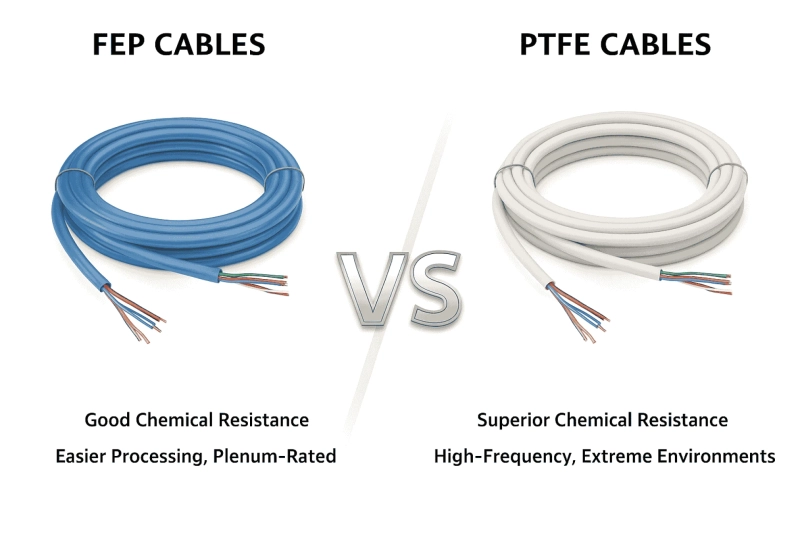
When both materials are used in practical settings, the differences become clearer. A FEP cable is more flexible, works well in moderate to high temperatures, and is simpler to install in small layouts. Additionally, it is beneficial in dashboards, EV connectors, and control panels where wire routing requires bends, tight corners, or frequent movement.
On the other hand, a PTFE cable remains the stronger choice when conditions involve extreme temperatures, chemical exposure, or continuous stress. It maintains stability even when temperatures cross 250°C, while a FEP cable is generally reliable up to about 200°C. This difference becomes vital in engines, aerospace applications, and high-voltage battery terminals.
Cost is another factor. A fep cable is often more budget-friendly because it can be melt-extruded, reducing processing complexity. PTFE cables, however, require special manufacturing methods that increase cost but offer added durability.
To put it simply, neither one is universally better. It depends on the level of heat, the type of environment, the movement involved, and the long-term reliability expected from the cable.
After determining each material's advantages, the next stage is to comprehend how choosing the best one impacts practical uses. It leads us to the areas where each material works best in various use cases and industries.
Where Does Each Material Works Best?
Some environments demand cables that stay flexible, lightweight, and easy to install, even when space is limited. These are usually areas like dashboards, EV charging ports, compact wiring harnesses, medical equipment, control panels, and sensor assemblies. Materials that allow easy routing and clean insulation application tend to perform better. They reduce installation errors and save time during maintenance or repairs.
But when the surrounding environment involves intense heat, fuel vapours, oils, acids, vibration, or continuous electrical load, the requirement changes completely. Applications such as engine compartments, aerospace wiring, and high-voltage connections need cables that can hold their shape and strength even when exposed to harsh working conditions for long durations.
At this point, material selection shifts from being theoretical to being practical. Which material is more appropriate for the task at hand is more important than which is more sophisticated. What is needed inside a spacecraft or under the hood of a car is not the same as what is needed in a hospital setting.
Now that their roles across different environments are clear, the next question is how manufacturers use this knowledge in real-world production and supply to other industries. That brings us to lessons learned on the manufacturing floor and how everyday challenges shape decisions.
What Have Manufacturers Learned on the Floor?
In actual manufacturing settings, performance history has a greater influence on cable material selection than data sheets. Engineers regularly watch how insulation responds to bending, crimping, and exposure to lubricants and temperature changes. A material may look perfect on paper. But if it cracks during routing or becomes too stiff in cold weather, it is not practical for long-term use.
Suppliers working with automotive, EVs, aerospace, and industrial equipment have seen one thing repeatedly — installation time and failure rates matter just as much as temperature or chemical resistance. If a cable is hard to strip, difficult to route, or adds extra weight to the wiring harness, manufacturers start looking for alternatives that offer a better balance of flexibility, safety, and efficiency.
Another insight from the shop floor is that consistency in insulation thickness and purity of copper conductors can change performance significantly. Even minor inaccuracies during extrusion or testing can lead to higher rejection rates or short circuits later in the field.
Understanding these ground-level realities helps simplify decisions. Theory tells you what is possible. Manufacturing tells you what actually works. With this experience in mind, it becomes easier to evaluate the strengths and limitations without bias.
Next, it is helpful to explore some lesser-known facts and practical insights that don’t always appear in technical manuals but influence real-world performance.
Lesser-Known Yet Practical Insights
Some of the most valuable insights about cable insulation never show up in datasheets. For example, many engineers choose transparency in insulation not for aesthetics but for quick fault detection during assembly. Being able to check conductor placement or detect air gaps visually saves time during testing and reduces scrap in production.
Another interesting detail is how environmental conditions influence material choice more than specifications. In coastal areas, salt in the air slowly affects cable jackets. In manufacturing plants, even small traces of oil or cleaning chemicals can shorten cable life unless the insulation is resistant to surface degradation. These aren’t always considered during initial design, but show their impact over time.
In electric vehicles, weight reduction matters just as much as temperature resistance. Lighter insulation materials can improve energy efficiency and reduce load on battery systems. Similarly, in medical equipment, material purity and non-toxicity become more critical than temperature range.
Even sustainability is becoming part of decision-making. While some insulation materials are difficult to recycle, others offer a lower environmental impact during manufacturing and disposal. Clients are beginning to ask how cable waste is handled, not just how cables perform.
With all these small yet significant factors in mind, the key remains the same — choose based on purpose, not popularity. Now, it’s time to bring everything together into one clear takeaway.
Conclusion
Choosing the proper cable insulation isn’t about selecting the strongest material available. It is about picking what works best for the environment it will serve. High temperatures, chemical exposure, vibration, bending, and even installation time all play a role in the final decision. When these conditions are understood clearly, choosing between different insulation types becomes more practical and less confusing.
Although each of the materials under discussion provide dependable performance, they work better under distinct circumstances. While one offers easier installation, flexibility, and smoother processing, the other may be more resilient to intense heat and chemicals. Long-term system value is increased, safety is enhanced, and downtime is decreased when material selection is in line with application requirements.
Ultimately, conductors and coatings are not the only components of a good cable. It concerns how well it functions when the machine is operating, the temperature is growing, and failure is not a possibility. Because of this, the best choices are derived from experience, observation, and purpose-driven design in addition to charts.
If you are working on a project and considering which insulation fits your application better, feel free to start a conversation. A quick discussion is all it takes to save time, effort, and avoid costly mistakes later.