


 Artificial Intelligence (AI) is now a driving force behind innovation, rather than the distant future. It is the engine of innovation, efficiency, and competitive differentiation in today’s businesses. However, when it comes to adopting AI, every CEO and other business thought leaders often face one common challenge: should we buy an off-the-shelf AI solution or build one in-house?
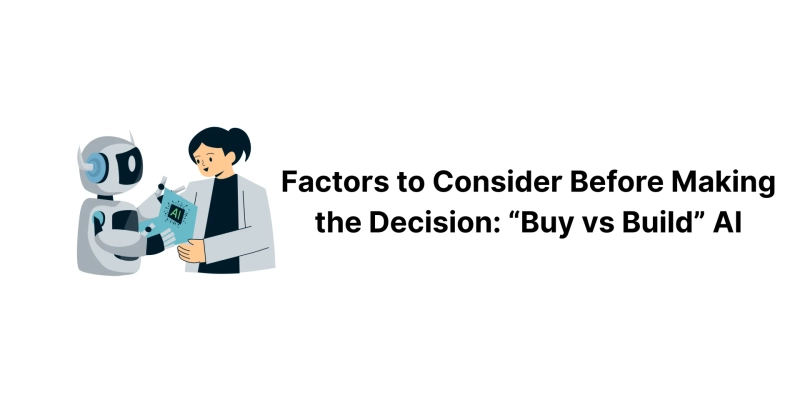
This “Buy vs. Build” AI conundrum is not just about cost — it’s about strategy, about its impact on scalability, and about long-term return on investment (ROI). Let’s take a look at some key elements businesses should consider before making this consequential decision.
1. Define Your Business Goals and AI Use Case
It is crucial to start with clarity in mind and understand what exactly you want AI to achieve for your business- is it automating customer support, forecasting demand, or tailored marketing?
If your goal is clearly defined and relatively standardized in terms of outputs (think chatbots or company analytics), purchasing an AI-based solution may be the quickest and cheapest way to deliver value.
If your goal is highly specialized and requires integration with a proprietary system or includes data unique to your domain, developing your own AI model may be a stronger strategic fit.
2. Examine Costs
Creating AI solutions sounds exciting, but it's rarely cheap. You will need to factor in:
- Infrastructure costs (servers, cloud, GPUs)
- Talent acquisition (data scientists, ML engineers)
- Maintenance and updates
On the flip side, buying AI solutions involves subscriptions or licensing fees. However, there are no setup and maintenance costs.
3. Control and Customization
Buying AI gives you quick deployment and performance, but with limited opportunity for customization. On the other hand, building AI gives full control over model design, data governance, and security. This is ideal for businesses seeking a competitive advantage through personalization.
4. Data Readiness and Integration
AI models work as good as the data that feeds them. Hence, it is vital to assess data maturity before making any choice:
- Do you have enough high-quality, labeled data?
- Is your data centralized, accessible, and compliant with privacy regulations (like GDPR)?
- Can your existing systems integrate easily with AI tools?
If your business does not have clean data or a strong data pipeline, an off-the-shelf AI tool, "out of the box", might perform better. However, if you have a mature data ecosystem, then building an in-house AI model allows you to leverage your data for higher-quality insights and more control.
In The End
When choosing to purchase or develop AI, it’s not just about being right or wrong, but rather what’s best for your business.
- It's better to buy AI if you need speed, lower costs, and ready-to-use features.
- Build AI if your business aims for innovation, differentiation, and long-term economic value.
Best advice to all CEOs and decision-makers: consider your desired business outcomes, data maturity, budget, and timeline—and proceed with the approach in alignment with your business vision.
Remember that AI is not only an investment in technology but also an investment in your growth strategy.